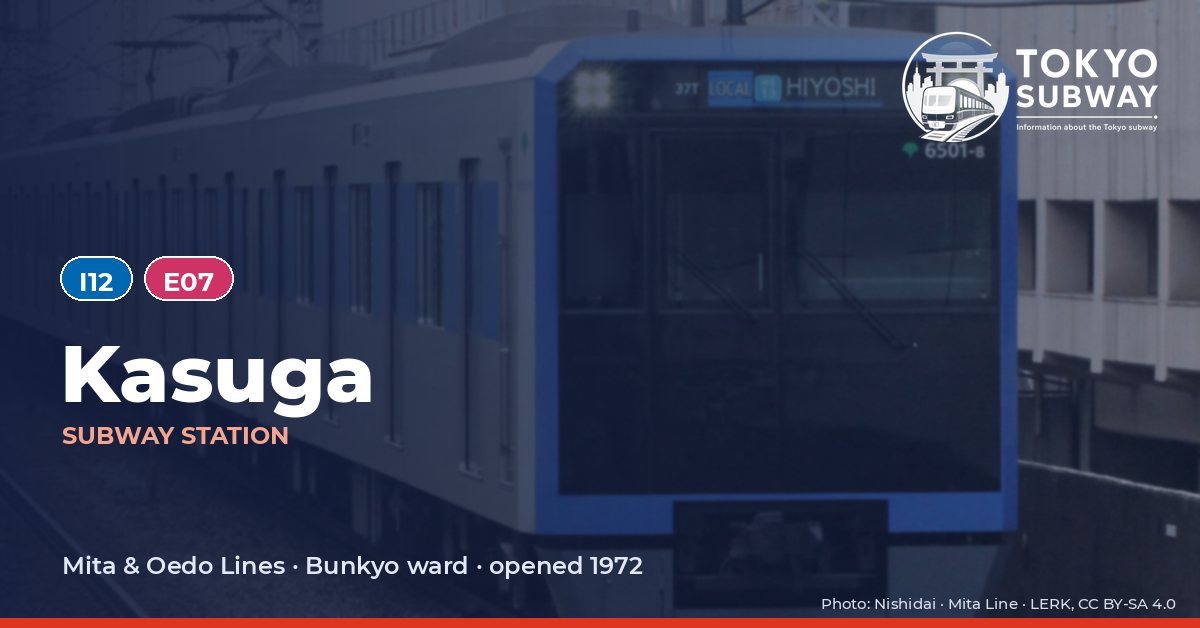
Kasuga Station
I12 E07 · Mita Line and Oedo Line · Bunkyo
Kasuga Station (春日)
Kasuga is built under the Bunkyo Civic Center, the ward’s own offices, and both of its lines carry that building’s name as a subtitle. The Mita Line platforms opened on 30 June 1972, when the line ran from Hibiya to Sugamo, and Toei’s Oedo Line platform followed on 12 December 2000. The name comes from the district, which in turn recalls the estate of Kasuga no Tsubone; the working name during planning was Kasugacho.
The two platforms are far apart vertically – the Mita Line on the second basement level, the Oedo Line on the fourth – and the Mita Line has nothing above it on the first basement because a sewer culvert occupies that space. A ticket gate at the foot of the stairs from the middle of the Oedo platform leads into Tokyo Metro’s Korakuen, which is how passengers reach the Marunouchi and Namboku Lines, and since 16 March 2013 you may also pass through Korakuen’s paid area without being charged for the walk. Toei counted 71,886 entries and exits a day on the Mita Line in 2024 and 60,957 on the Oedo Line.
Finding Kasuga on the signs
Every line gives the station its own letter-and-number code. You never have to read the Japanese name to find the right platform.
Station numbers at Kasuga
Tokyo signposts every platform, exit and train door with a letter and a two-digit number. Matching the number is faster than reading the name — and it is what you will see on the map, in announcements and on the platform edge.
First and last trains at Kasuga
| Line and direction | Weekdays first – last | Saturdays, Sundays & holidays first – last |
|---|---|---|
| IMitaI12 towards Nishi-takashimadaira | 05:18 – 00:18 to Takashimadaira | 05:18 – 00:18 to Takashimadaira |
| IMitaI12 towards Meguro | 05:10 to Shirokane-takanawa – 00:14 to Shirokane-takanawa | 05:10 to Shirokane-takanawa – 00:14 to Shirokane-takanawa |
| EOedoE07 towards Tochomae | 05:23 – 00:40 to Kiyosumi-shirakawa | 05:23 – 00:40 to Kiyosumi-shirakawa |
| EOedoE07 towards Tochomae | 05:05 – 00:10 | 05:05 – 00:09 |
Departure times come from the operators’ own GTFS timetables (ODPT GTFS Toei-Train-GTFS (version 20261009, valid 2026-03-14..2027-03-12) + TokyoMetro-Train-GTFS (version 20261008, valid 2026-09-19..2027-03-12)). Japan publishes two subway timetables: 平日 weekdays and 土休日 Saturdays, Sundays and national holidays. There is no separate Sunday timetable, and the December 30 – January 3 period runs the holiday timetable.
How often do trains run?
Departures in one direction during the hour with the most trains at this station, counted in the operators’ timetable.
Next stations from Kasuga
Scheduled running time between Kasuga and the stations either side of it.
| Line | Next station | Running time |
|---|---|---|
| IMita | I13Hakusan | 2 min |
| IMita | I11Suidobashi | 1 min |
| EOedo | E08Hongo-sanchome | 1 min |
| EOedo | E06Iidabashi | 2 min |
Transfers and connections
- Subway: transfer between Mita Line and Oedo Line.
- Walking transfer: Korakuen (Marunouchi Line and Namboku Line), an official transfer between two separately named stations, about 2 minutes on foot — our estimate from the distance, not an operator figure.
Accessibility
- Mita Line: Toei: step-free “1-route” secured; 3 elevator(s) on this line. Operator page (checked Oct 20, 2026).
- Oedo Line: Toei: step-free “1-route” secured; 2 elevator(s) on this line. Operator page (checked Oct 20, 2026).
Taken from the operators’ own accessibility pages and nothing else. Toei: every station has elevators and a street-gate-platform “1-route” is secured.
What is near Kasuga Station?
Bunkyo City Hall stands directly above, about 130 m from an exit, and its free observation deck is roughly 110 m from the gates. Tokyo Dome City is a few minutes away, with the LaQua complex around 250 m and the Baseball Hall of Fame and Museum about 380 m. Chuo University’s Korakuen campus is some 380 m off, Rekisen Park roughly 200 m and Genkakuji, the temple of the konnyaku Enma, around 260 m, with the Bunkyo Hometown History Museum about 350 m away.
| Place | Distance (straight line) | On foot, estimated |
|---|---|---|
| Rekisen Park 礫川公園 | 200 m | about 3 min |
| Genkakuji Temple 源覚寺 | 260 m | about 4 min |
| Bunkyo Hometown History Museum 文京ふるさと歴史館 | 350 m | about 6 min |
| The Baseball Hall of Fame and Museum 野球殿堂博物館 | 380 m | about 6 min |
| Chuo University 中央大学 | 380 m | about 6 min |
| 妙光山興善寺 | 290 m | about 5 min |
| 小石川大神宮 | 330 m | about 5 min |
| Seiwa Park 清和公園 | 180 m | about 3 min |
Places from OpenStreetMap within 400 m of the station. The walking time is an estimate (straight line plus 30 %, 80 m a minute), not a measured route. © OpenStreetMap contributors, ODbL.