
Suidobashi Station
I11 · Mita Line · Chiyoda
Suidobashi Station (水道橋)
The name records an aqueduct. The Kanda Josui crossed the Kanda River near here on an aqueduct bridge, and the station took its name from it when the railway above opened in 1906. Toei’s platforms came much later: the Mita Line, then Line 6, reached Suidobashi on 30 June 1972, and the line was renamed in 1978.
The two stations are not one building. JR East’s east entrance and the Mita Line’s A2 exit stand about 100 m apart, on opposite sides of the Kanda River and Sotobori-dori, and no passage joins the platforms. I11 straddles the Chiyoda–Bunkyo boundary and serves Tokyo Dome City, which is the other thing to know about it: on event days the crowds are heavy enough for entry to the station to be restricted. JR has used the Yomiuri Giants’ fight song as its departure melody since 2006. Toei counted 47,236 passengers a day in 2024.
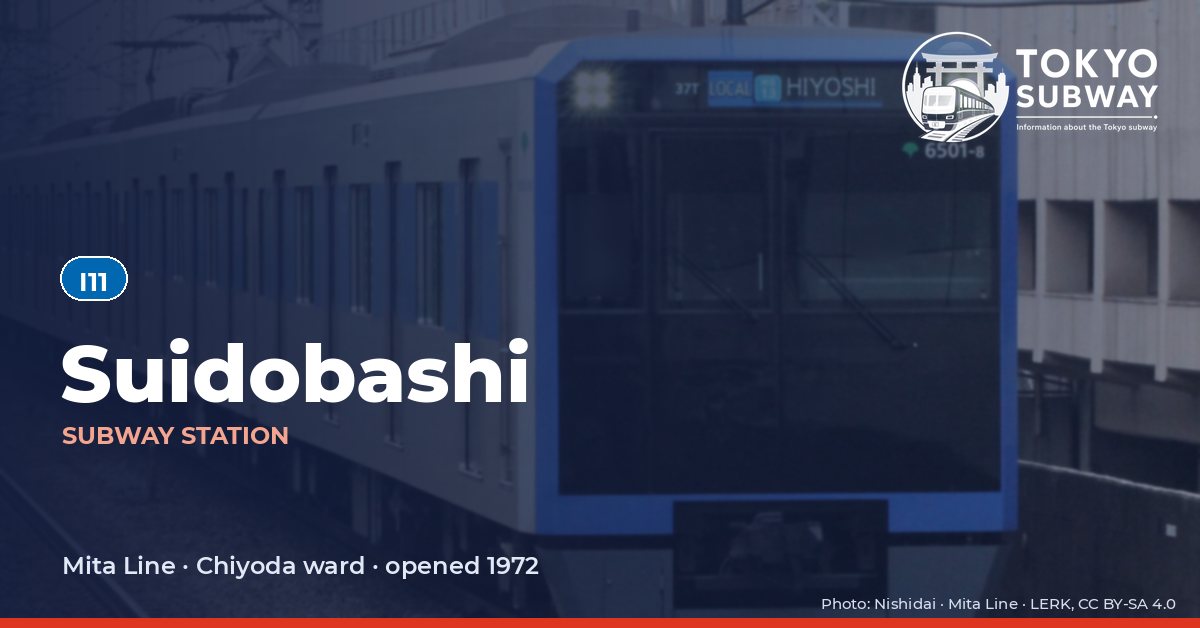
Finding Suidobashi on the signs
Every line gives the station its own letter-and-number code. You never have to read the Japanese name to find the right platform.
Station numbers at Suidobashi
Tokyo signposts every platform, exit and train door with a letter and a two-digit number. Matching the number is faster than reading the name — and it is what you will see on the map, in announcements and on the platform edge.
First and last trains at Suidobashi
| Line and direction | Weekdays first – last | Saturdays, Sundays & holidays first – last |
|---|---|---|
| IMitaI11 towards Nishi-takashimadaira | 05:16 – 00:17 to Takashimadaira | 05:16 – 00:17 to Takashimadaira |
| IMitaI11 towards Meguro | 05:12 to Shirokane-takanawa – 00:16 to Shirokane-takanawa | 05:12 to Shirokane-takanawa – 00:16 to Shirokane-takanawa |
Departure times come from the operators’ own GTFS timetables (ODPT GTFS Toei-Train-GTFS (version 20261009, valid 2026-03-14..2027-03-12) + TokyoMetro-Train-GTFS (version 20261008, valid 2026-09-19..2027-03-12)). Japan publishes two subway timetables: 平日 weekdays and 土休日 Saturdays, Sundays and national holidays. There is no separate Sunday timetable, and the December 30 – January 3 period runs the holiday timetable.
How often do trains run?
| Line | Weekdays, busiest hour | Sat / Sun / holidays, busiest hour |
|---|---|---|
| IMita | 19 trains/hour (about one every 3.2 min) | 11 trains/hour |
Departures in one direction during the hour with the most trains at this station, counted in the operators’ timetable.
Transfers and connections
- JR: Chuo-Sobu Local Line (JR East). These are separate railways with their own fares.
Accessibility
| Line | Step-free by elevator | Accessible toilet | Escalator | Exits |
|---|---|---|---|---|
| IMita | Yes | Yes | Yes | 6 |
- Mita Line: Toei: step-free “1-route” secured; 2 elevator(s) on this line. Elevator exit(s): A2. Operator page (checked Oct 20, 2026).
Taken from the operators’ own accessibility pages and nothing else. Toei: every station has elevators and a street-gate-platform “1-route” is secured.
What is near Suidobashi Station?
Tokyo Dome City is the neighbour that matters: the Tokyo Dome itself about 370 m from the exits, Tokyo Dome City Hall barely 50 m, the attractions park about 110 m, Korakuen Hall about 300 m and the Baseball Hall of Fame and Museum about 310 m. Universities fill the gaps — Tokyo Dental College at roughly 220 m and Toyo Gakuen at about 260 m, with Nihon, Senshu and Chuo campuses among the places the station serves. The Hosho noh theatre, about 90 m away, is the quiet counterweight.
| Place | Distance (straight line) | On foot, estimated |
|---|---|---|
| Tokyo Dome City Hall TOKYO DOME CITY HALL | 50 m | about 1 min |
| Hosho No Theatre 宝生能楽堂 | 90 m | about 2 min |
| Tokyo Dome City Attractions 東京ドームシティアトラクションズ | 110 m | about 2 min |
| Misaki Inari Shrine 三崎稲荷神社 | 210 m | about 3 min |
| Tokyo Dental College 東京歯科大学 | 220 m | about 3 min |
| Shōseiji Temple 昌清寺 | 230 m | about 4 min |
| Toyo Gakuen University 東洋学園大学 | 260 m | about 4 min |
| Korakuen Hall 後楽園ホール | 300 m | about 5 min |
Places from OpenStreetMap within 400 m of the station. The walking time is an estimate (straight line plus 30 %, 80 m a minute), not a measured route. © OpenStreetMap contributors, ODbL.
Frequently asked questions
From a bridge that carried water rather than people: the Kanda Josui aqueduct crossed the Kanda River near here, and the spot was known by that name long before any railway. The surface station took it in 1906, and the Mita Line platforms inherited it in 1972.
No. The JR east entrance and the Mita Line’s A2 exit are about 100 m apart, separated by the Kanda River and Sotobori-dori, and no passage connects the platforms. Either station will get you to Tokyo Dome, but the change between them is made at street level.