
Korakuen Station
M22 N11 · Marunouchi Line and Namboku Line · Bunkyo
Korakuen Station (後楽園)
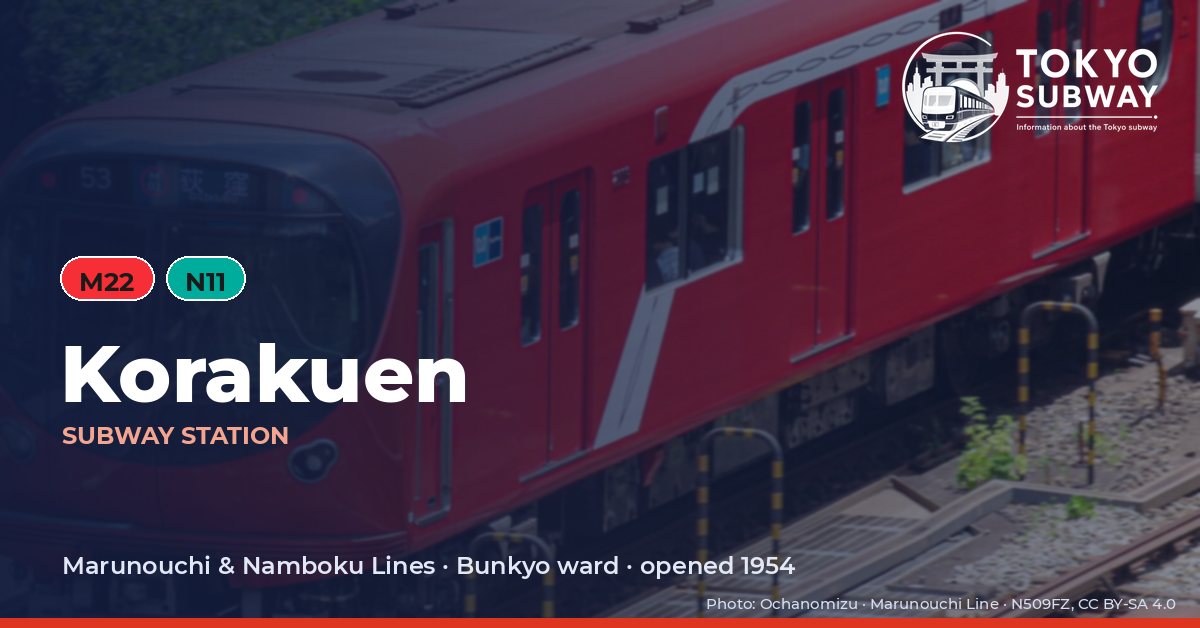
Korakuen keeps its two lines at opposite extremes. The Marunouchi Line, which opened here on 20 January 1954, runs above ground at this point, so M22 sits on the second floor as two side platforms; the Namboku Line arrived on 26 March 1996 and its island platform, N11, is six floors below street level. Moving between them is a long vertical journey inside one station.
Korakuen has grown into the Tokyo Dome City complex and the Bunkyo ward offices above it, and the baseball connection reaches the platform: since 13 March 2015 the Namboku Line departure melody has been “Take Me Out to the Ball Game”. The station is also half of a pair. An underground passage links it to Kasuga, run by Toei on the Mita and Oedo lines, and the two are treated as a single transfer even though the names and the operators differ.
Finding Korakuen on the signs
Every line gives the station its own letter-and-number code. You never have to read the Japanese name to find the right platform.
Station numbers at Korakuen
Tokyo signposts every platform, exit and train door with a letter and a two-digit number. Matching the number is faster than reading the name — and it is what you will see on the map, in announcements and on the platform edge.
First and last trains at Korakuen
| Line and direction | Weekdays first – last | Saturdays, Sundays & holidays first – last |
|---|---|---|
| MMarunouchiM22 towards Ikebukuro | 05:28 – 00:22 | 05:27 – 00:22 |
| MMarunouchiM22 towards Ogikubo | 05:08 – 00:02 to Shinjuku | 05:08 – 00:02 to Shinjuku |
| NNambokuN11 towards Akabane-iwabuchi | 05:08 – 00:21 | 05:08 – 00:21 to Komagome |
| NNambokuN11 towards Meguro | 05:07 to Shirokane-takanawa – 00:30 to Ichigaya | 05:07 to Shirokane-takanawa – 00:17 |
Departure times come from the operators’ own GTFS timetables (ODPT GTFS Toei-Train-GTFS (version 20261009, valid 2026-03-14..2027-03-12) + TokyoMetro-Train-GTFS (version 20261008, valid 2026-09-19..2027-03-12)). Japan publishes two subway timetables: 平日 weekdays and 土休日 Saturdays, Sundays and national holidays. There is no separate Sunday timetable, and the December 30 – January 3 period runs the holiday timetable.
How often do trains run?
| Line | Weekdays, busiest hour | Sat / Sun / holidays, busiest hour |
|---|---|---|
| MMarunouchi | 27 trains/hour (about one every 2.2 min) | 15 trains/hour |
| NNamboku | 17 trains/hour (about one every 3.5 min) | 12 trains/hour |
Departures in one direction during the hour with the most trains at this station, counted in the operators’ timetable.
Next stations from Korakuen
Scheduled running time between Korakuen and the stations either side of it.
| Line | Next station | Running time |
|---|---|---|
| MMarunouchi | M21Hongo-sanchome | 2 min |
| MMarunouchi | M23Myogadani | 3 min |
| NNamboku | N10Iidabashi | 2 min |
| NNamboku | N12Todaimae | 3 min |
Transfers and connections
- Subway: transfer between Marunouchi Line and Namboku Line.
- Walking transfer: Kasuga (Mita Line and Oedo Line), an official transfer between two separately named stations, about 2 minutes on foot — our estimate from the distance, not an operator figure.
Accessibility
| Line | Step-free by elevator | Accessible toilet | Escalator | Exits |
|---|---|---|---|---|
| MMarunouchi | Yes | Yes | Yes | 8 |
| NNamboku | Yes | Yes | Yes | 8 |
- Marunouchi Line: Step-free elevator route street-gate-platform (official “1-route by elevator”). Street elevator at exit(s): 1, 6. Operator page (checked Oct 20, 2026).
Taken from the operators’ own accessibility pages and nothing else. Tokyo Metro: the “1-route” (step-free street-gate-platform path by elevator, slope, stair lift or wheelchair escalator) is complete at all 180 stations; a separate list shows stations with an elevator-only 1-route.
What is near Korakuen Station?
Tokyo Dome is about 270 m from the exits, with the LaQua complex roughly 140–200 m away, the Baseball Hall of Fame and Museum around 290 m and Korakuen Hall, the boxing and wrestling venue, about 400 m. Koishikawa Korakuen Gardens, which gave the station its name, is some 300 m out, and Rekisen Park practically on top of the exits at 30 m. Chuo University’s campus lies about 220 m away, and the Bunkyo Civic Center is the tall building beside the station.
| Place | Distance (straight line) | On foot, estimated |
|---|---|---|
| Rekisen Park 礫川公園 | 30 m | about 1 min |
| Chuo University 中央大学 | 220 m | about 4 min |
| Tokyo Dome 東京ドーム | 270 m | about 4 min |
| The Baseball Hall of Fame and Museum 野球殿堂博物館 | 290 m | about 5 min |
| Koishikawa Kōrakuen Gardens 小石川後楽園 | 300 m | about 5 min |
| Genkakuji Temple 源覚寺 | 330 m | about 5 min |
| Korakuen Hall 後楽園ホール | 400 m | about 6 min |
| 小石川大神宮 | 260 m | about 4 min |
Places from OpenStreetMap within 400 m of the station. The walking time is an estimate (straight line plus 30 %, 80 m a minute), not a measured route. © OpenStreetMap contributors, ODbL.
Frequently asked questions
Because of the stadium next door. Tokyo Metro adopted the tune as the departure melody for the Namboku Line platforms on 13 March 2015, chosen because Tokyo Dome, about 270 m away, is the home of baseball in this part of the city.
Kasuga is a separate Toei station on the Mita and Oedo lines, joined to Korakuen by an underground passage; the operators count the two as one transfer point. They are about 60 m apart, and the walking time shown in the data above is our estimate rather than an official figure.