
Iidabashi Station
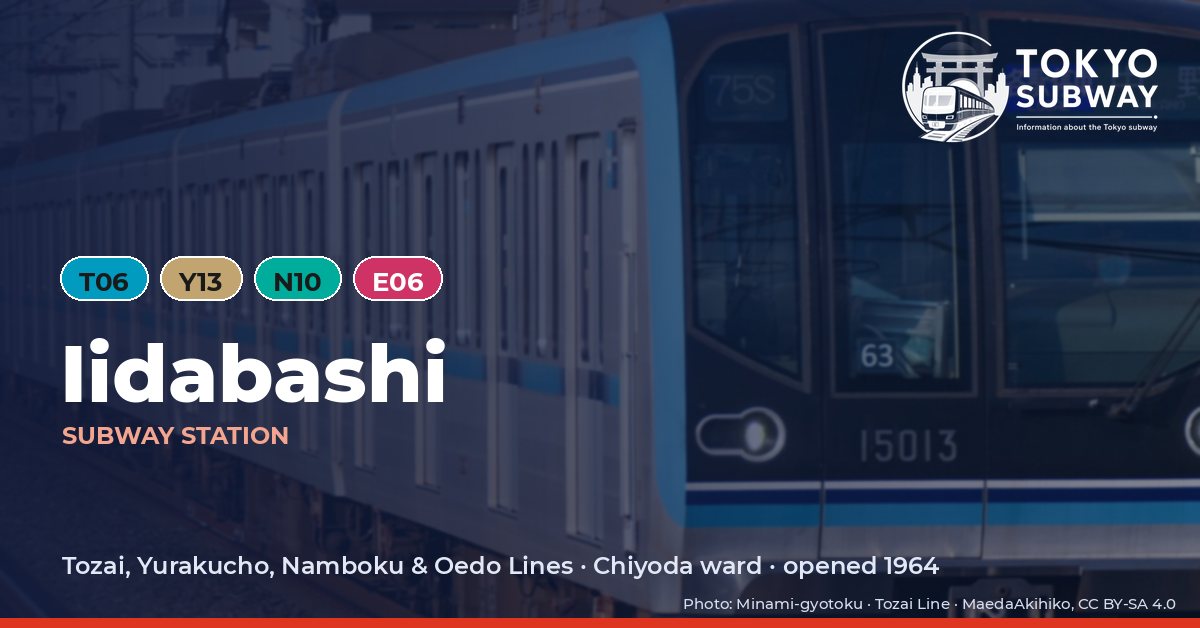
T06 Y13 N10 E06 · Tozai Line, Yurakucho Line, Namboku Line, and Oedo Line · Chiyoda
Iidabashi Station (飯田橋)
Four subway lines and a JR line meet across three wards here, and they arrived over thirty-six years: the Tozai Line on 23 December 1964, the Yurakucho Line on 30 October 1974, the Namboku Line on 26 March 1996 and Toei’s Oedo Line on 12 December 2000, the last of them designed by the architect Makoto Sei Watanabe. The railway above is older still: the present JR station dates from 15 November 1928, and its predecessor, Iidamachi, was the terminus of the Kobu Railway.
The JR platform was the station’s long-standing problem. It stood on a sharp curve with a wide gap between train and platform edge, and the solution was drastic – the platforms were rebuilt roughly 200 m along the line, opening with a new west station building on 12 July 2020. Tokyo Metro counted 164,232 entries and exits a day across its three lines in 2025, Toei 28,807 in 2024. A 24-floor mixed-use building is under construction on the east side as part of a redevelopment scheduled to finish in 2026.
Finding Iidabashi on the signs
Every line gives the station its own letter-and-number code. You never have to read the Japanese name to find the right platform.
Station numbers at Iidabashi
Tokyo signposts every platform, exit and train door with a letter and a two-digit number. Matching the number is faster than reading the name — and it is what you will see on the map, in announcements and on the platform edge.
First and last trains at Iidabashi
| Line and direction | Weekdays first – last | Saturdays, Sundays & holidays first – last |
|---|---|---|
| TTozaiT06 towards Nishi-funabashi | 05:14 – 00:07 to Myoden | 05:14 – 00:07 to Myoden |
| TTozaiT06 towards Nakano | 05:16 – 00:20 | 05:16 – 00:20 |
| YYurakuchoY13 towards Shin-kiba | 05:09 – 00:09 | 05:09 – 00:09 |
| YYurakuchoY13 towards Wakoshi | 05:02 – 00:23 to Ikebukuro | 05:02 – 00:23 to Ikebukuro |
| NNambokuN10 towards Akabane-iwabuchi | 05:05 – 00:18 | 05:05 – 00:18 to Komagome |
| NNambokuN10 towards Meguro | 05:09 to Shirokane-takanawa – 00:33 to Ichigaya | 05:09 to Shirokane-takanawa – 00:19 |
| EOedoE06 towards Tochomae | 05:21 – 00:38 to Kiyosumi-shirakawa | 05:21 – 00:38 to Kiyosumi-shirakawa |
| EOedoE06 towards Tochomae | 05:07 – 00:12 | 05:07 – 00:11 |
Departure times come from the operators’ own GTFS timetables (ODPT GTFS Toei-Train-GTFS (version 20261009, valid 2026-03-14..2027-03-12) + TokyoMetro-Train-GTFS (version 20261008, valid 2026-09-19..2027-03-12)). Japan publishes two subway timetables: 平日 weekdays and 土休日 Saturdays, Sundays and national holidays. There is no separate Sunday timetable, and the December 30 – January 3 period runs the holiday timetable.
How often do trains run?
| Line | Weekdays, busiest hour | Sat / Sun / holidays, busiest hour |
|---|---|---|
| TTozai | 24 trains/hour (about one every 2.5 min) | 15 trains/hour |
| YYurakucho | 21 trains/hour (about one every 2.9 min) | 12 trains/hour |
| NNamboku | 18 trains/hour (about one every 3.3 min) | 12 trains/hour |
| EOedo | 16 trains/hour (about one every 3.8 min) | 12 trains/hour |
Departures in one direction during the hour with the most trains at this station, counted in the operators’ timetable.
Next stations from Iidabashi
Scheduled running time between Iidabashi and the stations either side of it.
| Line | Next station | Running time |
|---|---|---|
| TTozai | T05Kagurazaka | 3 min |
| TTozai | T07Kudanshita | 2 min |
| YYurakucho | Y12Edogawabashi | 3 min |
| YYurakucho | Y14Ichigaya | 2 min |
| NNamboku | N09Ichigaya | 2 min |
| NNamboku | N11Korakuen | 2 min |
| EOedo | E07Kasuga | 2 min |
| EOedo | E05Ushigome-kagurazaka | 2 min |
Transfers and connections
- Subway: transfer between Tozai Line, Yurakucho Line, Namboku Line, and Oedo Line. The Tokyo Metro lines and the Toei Subway lines belong to different companies, so a trip that uses both costs more than one operator alone — see fares.
- JR: Chuo-Sobu Local Line (JR East). These are separate railways with their own fares.
Accessibility
| Line | Step-free by elevator | Accessible toilet | Escalator | Exits |
|---|---|---|---|---|
| TTozai | Yes | Yes | Yes | 13 |
| YYurakucho | Yes | Yes | Yes | 13 |
| NNamboku | Yes | Yes | Yes | 13 |
| EOedo | Yes | Yes | Yes | 14 |
- Tozai Line: Step-free elevator route street-gate-platform (official “1-route by elevator”). Street elevator at exit(s): A5, エレベーター出口. Operator page (checked Oct 20, 2026).
- Oedo Line: Toei: step-free “1-route” secured; 2 elevator(s) on this line. Elevator exit(s): C2, C3. Operator page (checked Oct 20, 2026).
Taken from the operators’ own accessibility pages and nothing else. Tokyo Metro: the “1-route” (step-free street-gate-platform path by elevator, slope, stair lift or wheelchair escalator) is complete at all 180 stations; a separate list shows stations with an elevator-only 1-route. Toei: every station has elevators and a street-gate-platform “1-route” is secured.
What is near Iidabashi Station?
The Kanda river runs through the middle of it all, with Iidabashi on one bank and the slopes of Kagurazaka on the other, and the moat and the remains of the Ushigome-mitsuke gate beside the JR tracks. Tokyo Daijingu is about 280 m from the exits, the Nippon Dental University Hospital roughly 190 m and the JCHO Tokyo Shinjuku Medical Center around 300 m. Koishikawa Korakuen Garden is a walk away, and smaller things cluster near the gates: a puppet museum about 150 m off, a long-running repertory cinema roughly 170 m, and a public bath near the 400 m mark.
| Place | Distance (straight line) | On foot, estimated |
|---|---|---|
| Tokyo Daijingu 東京大神宮 | 280 m | about 5 min |
| Gallery Zo 像造 | 130 m | about 2 min |
| Puppet House パペットハウス | 150 m | about 2 min |
| Japan-China Friendship Center Art Museum 日中友好会館美術館 | 370 m | about 6 min |
| 富士見二丁目広場 | 240 m | about 4 min |
| 伏見火防稲荷神社 | 380 m | about 6 min |
| Tully's Coffee タリーズコーヒー | 100 m | about 2 min |
| SoftBank Shop ソフトバンクショップ | 230 m | about 4 min |
Places from OpenStreetMap within 400 m of the station. The walking time is an estimate (straight line plus 30 %, 80 m a minute), not a measured route. © OpenStreetMap contributors, ODbL.