
Hakusan Station
I13 · Mita Line · Bunkyo
Hakusan Station (白山)
Toei opened Hakusan on 30 June 1972 as a station on Line 6, which became the Mita Line six years later; the working name during construction was Sashigaya-cho, after an older name for the district. Building it was awkward. The site sits under the Yakushi slope on the old Hakusan-dori, the platforms had to be laid on a curve of 500 m radius to fit the available land, and when the ground toward the north turned out to be waterlogged the contractors switched to a caisson sunk 21 m deep for part of the structure.
The slope also explains the station’s one practical quirk: its two ticket halls are at different heights and are not linked inside. Signs call them Hakusan-shita, the lower one at the A1 exit, and Hakusan-ue, the upper one serving A2 and A3, and to move from one to the other you leave the station and walk. The platform name boards carry the words Toyo University-mae underneath, which is not an official subtitle but reflects where most passengers are going; Toei counted 48,388 entries and exits a day in 2024, a figure that has been climbing as the university and new apartments have brought people back to the area.
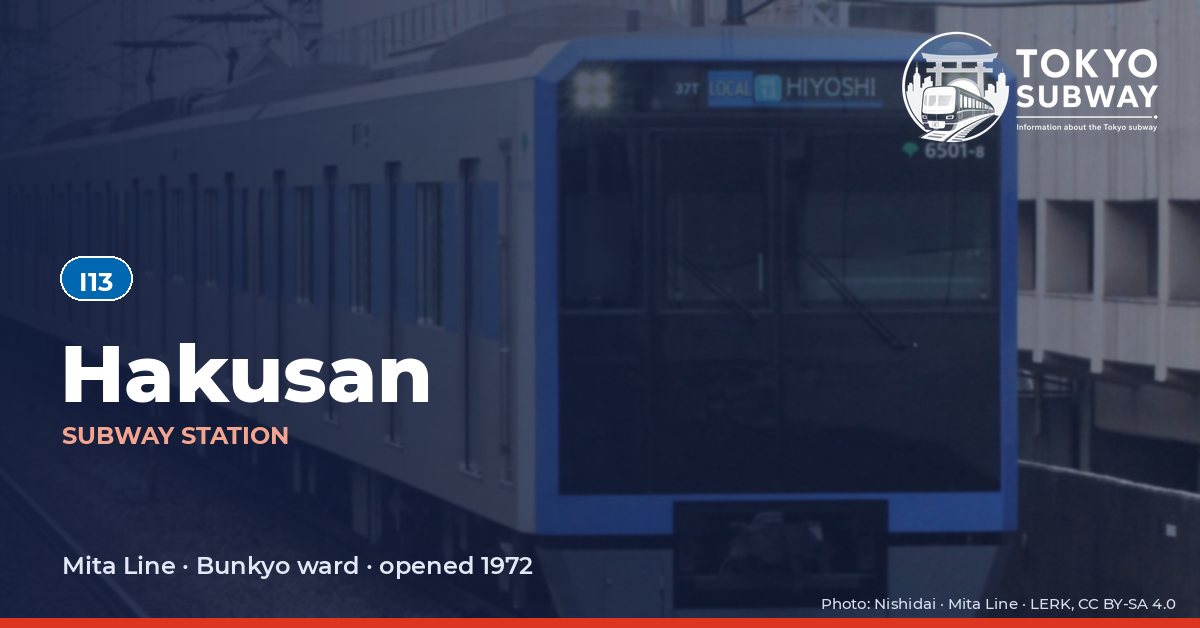
Finding Hakusan on the signs
Every line gives the station its own letter-and-number code. You never have to read the Japanese name to find the right platform.
Station numbers at Hakusan
Tokyo signposts every platform, exit and train door with a letter and a two-digit number. Matching the number is faster than reading the name — and it is what you will see on the map, in announcements and on the platform edge.
First and last trains at Hakusan
| Line and direction | Weekdays first – last | Saturdays, Sundays & holidays first – last |
|---|---|---|
| IMitaI13 towards Nishi-takashimadaira | 05:20 – 00:21 to Takashimadaira | 05:20 – 00:21 to Takashimadaira |
| IMitaI13 towards Meguro | 05:08 to Shirokane-takanawa – 00:12 to Shirokane-takanawa | 05:08 to Shirokane-takanawa – 00:12 to Shirokane-takanawa |
Departure times come from the operators’ own GTFS timetables (ODPT GTFS Toei-Train-GTFS (version 20261009, valid 2026-03-14..2027-03-12) + TokyoMetro-Train-GTFS (version 20261008, valid 2026-09-19..2027-03-12)). Japan publishes two subway timetables: 平日 weekdays and 土休日 Saturdays, Sundays and national holidays. There is no separate Sunday timetable, and the December 30 – January 3 period runs the holiday timetable.
How often do trains run?
| Line | Weekdays, busiest hour | Sat / Sun / holidays, busiest hour |
|---|---|---|
| IMita | 18 trains/hour (about one every 3.3 min) | 11 trains/hour |
Departures in one direction during the hour with the most trains at this station, counted in the operators’ timetable.
Transfers and connections
Only the Mita Line stops here, and no other railway serves this station, so there is nothing to transfer to inside the station.
Accessibility
| Line | Step-free by elevator | Accessible toilet | Escalator | Exits |
|---|---|---|---|---|
| IMita | Yes | Yes | Yes | 3 |
- Mita Line: Toei: step-free “1-route” secured; 3 elevator(s) on this line. Elevator exit(s): A3. Operator page (checked Oct 20, 2026).
Taken from the operators’ own accessibility pages and nothing else. Toei: every station has elevators and a street-gate-platform “1-route” is secured.
What is near Hakusan Station?
Toyo University’s Hakusan campus is about 240 m from the exits and sets the tone of the streets around, which fill with students at the start and end of the day. Hakusan Shrine, known for the Bunkyo hydrangea festival in June, is roughly 140 m away, and the surrounding blocks hold an unusual density of temples: Shinko-ji at about 80 m, Daienji around 150 m, Ryuun-in some 170 m and a dozen more within the same walk. The Inoue Enryo Memorial Museum stands about 300 m off, and Hon-komagome on the Namboku Line is roughly 250 m away in a straight line, with no transfer arrangement between them.
| Place | Distance (straight line) | On foot, estimated |
|---|---|---|
| Shinko-ji 心光寺 | 80 m | about 1 min |
| Hakusan Shrine 白山神社 | 140 m | about 2 min |
| Daienji Temple 大圓寺 | 150 m | about 2 min |
| Ryūun-in Temple 龍雲禅院 | 170 m | about 3 min |
| Chosen-ji Temple 潮泉寺 | 210 m | about 3 min |
| Tokushou-ji Temple 徳性寺 | 240 m | about 4 min |
| Toyo University 東洋大学 | 240 m | about 4 min |
| Jippoji Temple 十方寺 | 300 m | about 5 min |
Places from OpenStreetMap within 400 m of the station. The walking time is an estimate (straight line plus 30 %, 80 m a minute), not a measured route. © OpenStreetMap contributors, ODbL.