
Shinjuku Station
M08 S01 E27 · Marunouchi Line, Shinjuku Line, and Oedo Line · Shinjuku
Shinjuku Station (新宿)
Shinjuku is the busiest railway station in the world — an average of 3.59 million people a day in 2018, a figure recorded by Guinness — and the subway is only part of it. The Marunouchi Line came first, on 15 March 1959 as M08; the Toei Shinjuku Line opened on 16 March 1980 with S01, the first number on that line and its terminus; and the Oedo Line’s E27 followed on 19 December 1997.
Two companies, three lines, and a fourth subway platform a short walk away: Toei’s Shinjuku-nishiguchi, which is counted as a separate station on the same Oedo Line. Around them are JR East, Keio, Odakyu and, a little further off, Seibu. The name means new post station, after the Naito Shinjuku relay town that stood on the east side of the site. Toei counted 289,400 passengers a day on its Shinjuku Line platforms in 2024, and Tokyo Metro’s Marunouchi survey recorded 201,609 in 2025.
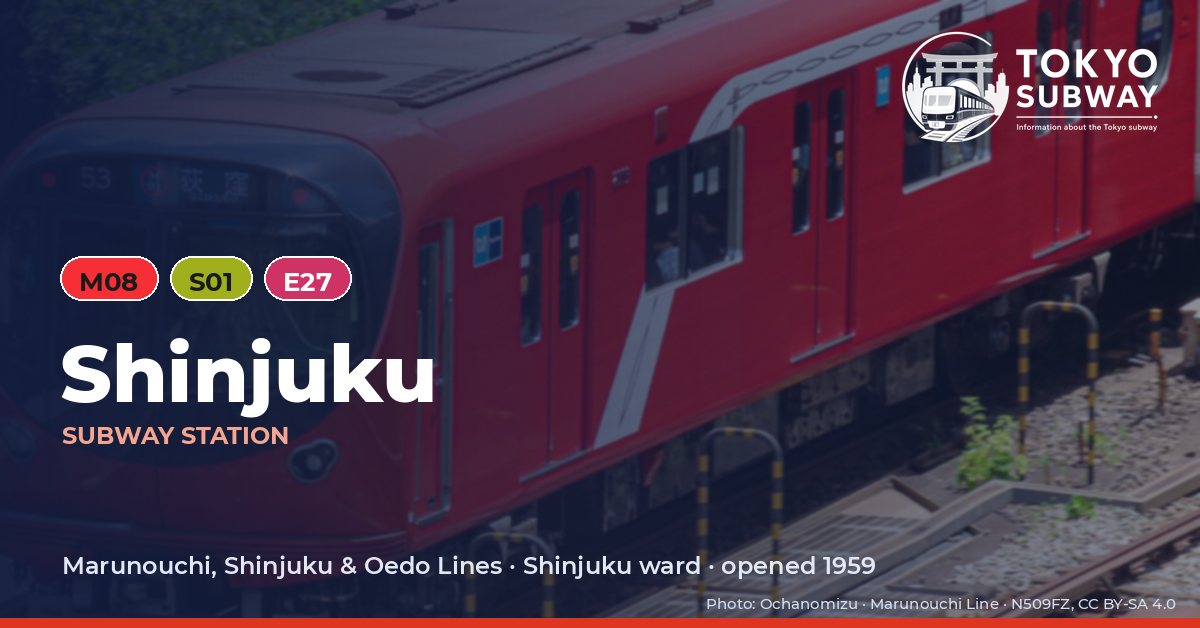
Finding Shinjuku on the signs
Every line gives the station its own letter-and-number code. You never have to read the Japanese name to find the right platform.
Station numbers at Shinjuku
Tokyo signposts every platform, exit and train door with a letter and a two-digit number. Matching the number is faster than reading the name — and it is what you will see on the map, in announcements and on the platform edge.
First and last trains at Shinjuku
| Line and direction | Weekdays first – last | Saturdays, Sundays & holidays first – last |
|---|---|---|
| MMarunouchiM08 towards Ikebukuro | 05:00 – 00:09 to Shinjuku-sanchome | 05:00 – 00:09 to Shinjuku-sanchome |
| MMarunouchiM08 towards Ogikubo | 05:16 – 00:22 to Nakano-sakaue | 05:16 – 00:22 to Nakano-sakaue |
| SShinjukuS01 towards Motoyawata | 05:00 – 00:10 to Iwamotocho | 05:00 – 00:10 to Iwamotocho |
| EOedoE27 towards Tochomae | 05:18 – 00:46 to Tochomae | 05:18 – 00:46 to Tochomae |
| EOedoE27 towards Tochomae | 05:02 – 00:30 to Shiodome | 05:02 – 00:30 to Shiodome |
Departure times come from the operators’ own GTFS timetables (ODPT GTFS Toei-Train-GTFS (version 20261009, valid 2026-03-14..2027-03-12) + TokyoMetro-Train-GTFS (version 20261008, valid 2026-09-19..2027-03-12)). Japan publishes two subway timetables: 平日 weekdays and 土休日 Saturdays, Sundays and national holidays. There is no separate Sunday timetable, and the December 30 – January 3 period runs the holiday timetable.
How often do trains run?
| Line | Weekdays, busiest hour | Sat / Sun / holidays, busiest hour |
|---|---|---|
| MMarunouchi | 27 trains/hour (about one every 2.2 min) | 15 trains/hour |
| SShinjuku | 16 trains/hour (about one every 3.8 min) | 12 trains/hour |
| EOedo | 20 trains/hour (about one every 3 min) | 12 trains/hour |
Departures in one direction during the hour with the most trains at this station, counted in the operators’ timetable.
Next stations from Shinjuku
Scheduled running time between Shinjuku and the stations either side of it.
| Line | Next station | Running time |
|---|---|---|
| MMarunouchi | M07Nishi-shinjuku | 2 min |
| MMarunouchi | M09Shinjuku-sanchome | 2 min |
| SShinjuku | S02Shinjuku-sanchome | 1 min |
| EOedo | E28Tochomae | 2 min |
| EOedo | E26Yoyogi | 1 min |
Transfers and connections
- Subway: transfer between Marunouchi Line, Shinjuku Line, and Oedo Line. The Tokyo Metro lines and the Toei Subway lines belong to different companies, so a trip that uses both costs more than one operator alone — see fares.
- Walking transfer: Shinjuku-nishiguchi (Oedo Line), an official transfer between two separately named stations, about 3 minutes on foot — our estimate from the distance, not an operator figure.
- JR: Chuo Rapid Line (JR East), Chuo-Sobu Local Line (JR East), Saikyo-Kawagoe Line (JR East), Shonan-Shinjuku Line (JR East), Yamanote Line (JR East). These are separate railways with their own fares.
- Private railways: Keio Line (Keio Corporation), Keio New Line (Keio Corporation), Odawara Line (Odakyu Electric Railway), Shinjuku Line (Seibu Railway). These are separate railways with their own fares.
Accessibility
| Line | Step-free by elevator | Accessible toilet | Escalator | Exits |
|---|---|---|---|---|
| MMarunouchi | Yes | Yes | Yes | 21 |
| SShinjuku | Yes | Yes | Yes | 7 |
| EOedo | Yes | Yes | Yes | 7 |
- Marunouchi Line: Step-free elevator route street-gate-platform (official “1-route by elevator”). Street elevator at exit(s): B12a. Operator page (checked Oct 20, 2026).
- Shinjuku Line: Toei: step-free “1-route” secured; 1 elevator(s) on this line. Elevator exit(s): A1. Operator page (checked Oct 20, 2026).
- Oedo Line: Toei: step-free “1-route” secured; 2 elevator(s) on this line. Elevator exit(s): A1. Operator page (checked Oct 20, 2026).
Taken from the operators’ own accessibility pages and nothing else. Tokyo Metro: the “1-route” (step-free street-gate-platform path by elevator, slope, stair lift or wheelchair escalator) is complete at all 180 stations; a separate list shows stations with an elevator-only 1-route. Toei: every station has elevators and a street-gate-platform “1-route” is secured.
What is near Shinjuku Station?
The subway exits open into department stores rather than onto streets: the Keio Department Store about 60 m away, LUMINE 1 about 70 m, the Keio Mall underground beside it, Odakyu Ace about 230 m and Lumine EST about 250 m. Flags and Bicqlo stand a little further, with the Odakyu Department Store about 300 m. Omoide-yokocho is roughly 370 m off, Kogakuin University about 340 m, and the 3D cat billboard on the Cross Shinjuku building about the same.
| Place | Distance (straight line) | On foot, estimated |
|---|---|---|
| Keio Department Store Shinjuku 京王百貨店新宿店 | 60 m | about 1 min |
| LUMINE1 ルミネ新宿 | 70 m | about 1 min |
| Flags 新宿フラッグス | 190 m | about 3 min |
| Odakyu Ace 小田急エース | 230 m | about 4 min |
| Lumine EST Shinjuku ルミネエスト新宿 | 250 m | about 4 min |
| Odakyu Department Store 小田急百貨店 | 300 m | about 5 min |
| 3D billboard (Shinjuku Cat) クロス新宿ビジョン | 340 m | about 6 min |
| Kogakuin University 工学院大学 | 340 m | about 5 min |
Places from OpenStreetMap within 400 m of the station. The walking time is an estimate (straight line plus 30 %, 80 m a minute), not a measured route. © OpenStreetMap contributors, ODbL.
Frequently asked questions
Because it does. E27 Shinjuku sits beside the Marunouchi and Toei Shinjuku Line platforms, while Shinjuku-nishiguchi is a separate Oedo Line station on the other side of the complex. The two are listed as a walking transfer rather than as one station, so check which one your route uses.
New post station. The characters stand for a new relay stop on the old highway, and the Naito Shinjuku post town lay on the east side of the present station. When the railway opened in 1885 the place was still quiet, and the station saw very little use in its first years.