Shinjuku-sanchome Station
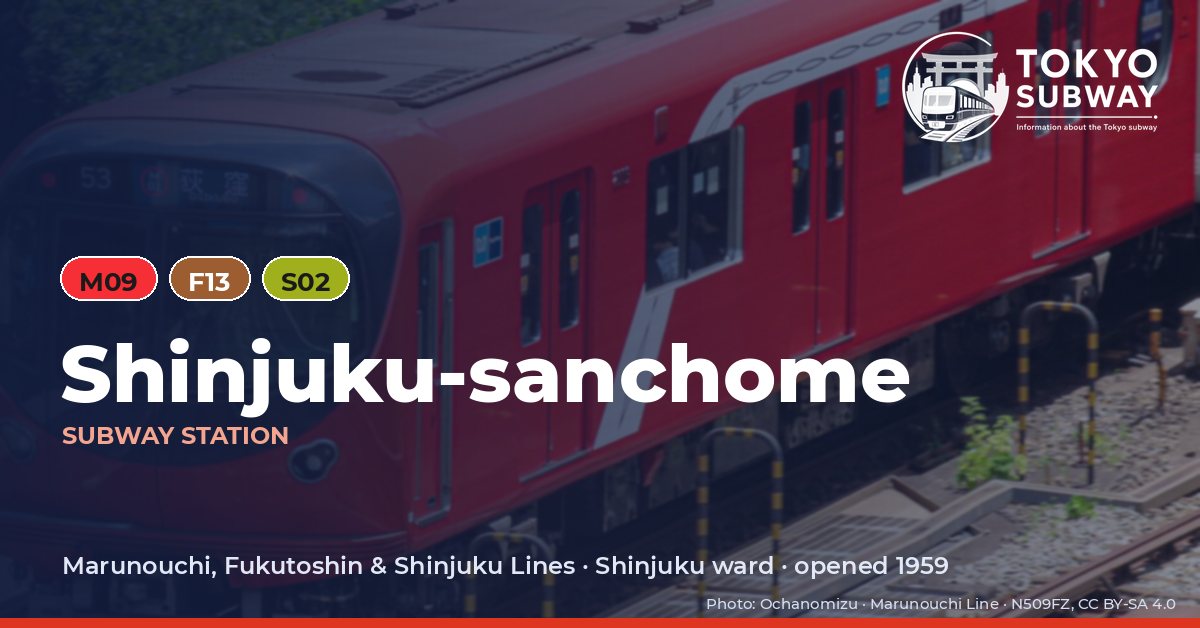
M09 F13 S02 · Marunouchi Line, Fukutoshin Line, and Shinjuku Line · Shinjuku
Shinjuku-sanchome Station (新宿三丁目)
Three island platforms on two levels, two operators, and a department store on top of nearly every exit. The Marunouchi Line came first, on 15 March 1959 as M09; the Toei Shinjuku Line opened on 16 March 1980 with S02, its platform on the same basement level but beyond the Marunouchi one; and the Fukutoshin Line arrived on 14 June 2008 as F13, a level lower and running at right angles to the others.
The two Tokyo Metro platforms are linked directly, by stairs and escalators between the north end of the Fukutoshin platform and the east end of the Marunouchi one. Reaching the Toei platform means passing both companies’ gates. The complex spreads far enough that the name only half fits: the Marunouchi and Toei platforms lie in Shinjuku 3-chome, which gave the station its name, while the Fukutoshin platforms are in Shinjuku 5-chome. Tokyo Metro counted 159,057 passengers a day in 2025, and Toei 72,667 in 2024.
Finding Shinjuku-sanchome on the signs
Every line gives the station its own letter-and-number code. You never have to read the Japanese name to find the right platform.
Station numbers at Shinjuku-sanchome
Tokyo signposts every platform, exit and train door with a letter and a two-digit number. Matching the number is faster than reading the name — and it is what you will see on the map, in announcements and on the platform edge.
First and last trains at Shinjuku-sanchome
| Line and direction | Weekdays first – last | Saturdays, Sundays & holidays first – last |
|---|---|---|
| MMarunouchiM09 towards Ikebukuro | 05:01 – 23:56 | 05:01 – 23:56 |
| MMarunouchiM09 towards Ogikubo | 05:14 – 00:28 to Shinjuku | 05:14 – 00:28 to Shinjuku |
| FFukutoshinF13 towards Shibuya | 05:07 – 00:24 | 05:07 – 00:24 |
| FFukutoshinF13 towards Wakoshi | 05:12 – 00:15 to Ikebukuro | 05:12 – 00:15 to Ikebukuro |
| SShinjukuS02 towards Motoyawata | 05:01 – 00:12 to Iwamotocho | 05:01 – 00:12 to Iwamotocho |
| SShinjukuS02 towards Shinjuku | 05:12 – 00:27 | 05:12 – 00:27 |
Departure times come from the operators’ own GTFS timetables (ODPT GTFS Toei-Train-GTFS (version 20261009, valid 2026-03-14..2027-03-12) + TokyoMetro-Train-GTFS (version 20261008, valid 2026-09-19..2027-03-12)). Japan publishes two subway timetables: 平日 weekdays and 土休日 Saturdays, Sundays and national holidays. There is no separate Sunday timetable, and the December 30 – January 3 period runs the holiday timetable.
How often do trains run?
| Line | Weekdays, busiest hour | Sat / Sun / holidays, busiest hour |
|---|---|---|
| MMarunouchi | 27 trains/hour (about one every 2.2 min) | 15 trains/hour |
| FFukutoshin | 20 trains/hour (about one every 3 min) | 16 trains/hour |
| SShinjuku | 17 trains/hour (about one every 3.5 min) | 12 trains/hour |
Departures in one direction during the hour with the most trains at this station, counted in the operators’ timetable.
Next stations from Shinjuku-sanchome
Scheduled running time between Shinjuku-sanchome and the stations either side of it.
| Line | Next station | Running time |
|---|---|---|
| MMarunouchi | M08Shinjuku | 2 min |
| MMarunouchi | M10Shinjuku-gyoemmae | 2 min |
| FFukutoshin | F12Higashi-shinjuku | 3 min |
| FFukutoshin | F14Kita-sando | 3 min |
| SShinjuku | S03Akebonobashi | 2 min |
| SShinjuku | S01Shinjuku | 1 min |
Transfers and connections
- Subway: transfer between Marunouchi Line, Fukutoshin Line, and Shinjuku Line. The Tokyo Metro lines and the Toei Subway lines belong to different companies, so a trip that uses both costs more than one operator alone — see fares.
Accessibility
| Line | Step-free by elevator | Accessible toilet | Escalator | Exits |
|---|---|---|---|---|
| MMarunouchi | Yes | Yes | Yes | 23 |
| FFukutoshin | Yes | Yes | Yes | 23 |
| SShinjuku | Yes | Yes | Yes | 28 |
- Marunouchi Line: Step-free elevator route street-gate-platform (official “1-route by elevator”). Street elevator at exit(s): B4, E1, E10, E5, E8, E9. Operator page (checked Oct 20, 2026).
- Shinjuku Line: Toei: step-free “1-route” secured; 2 elevator(s) on this line. Elevator exit(s): C6. Operator page (checked Oct 20, 2026).
Taken from the operators’ own accessibility pages and nothing else. Tokyo Metro: the “1-route” (step-free street-gate-platform path by elevator, slope, stair lift or wheelchair escalator) is complete at all 180 stations; a separate list shows stations with an elevator-only 1-route. Toei: every station has elevators and a street-gate-platform “1-route” is secured.
What is near Shinjuku-sanchome Station?
Department stores define the surface: Mitsukoshi about 50 m from an exit, Marui’s main building about 100 m, Isetan and its men’s store about 110 and 160 m away, Bicqlo about 210 m. The concourse is joined to Shinjuku station by an underground walkway called the Metro Promenade, and the south end of the Fukutoshin platform runs into Takashimaya Times Square. Older Shinjuku survives nearby — Hanazono Shrine about 270 m away, the Golden Gai lanes about 360 m and Tenryuji about 250 m.
| Place | Distance (straight line) | On foot, estimated |
|---|---|---|
| Shinjuku Marui Honkan 新宿マルイ本館 | 100 m | about 2 min |
| Bicqlo ビックロ | 210 m | about 3 min |
| Kinokuniya Hall 紀ノ国屋ホール | 250 m | about 4 min |
| Tenryuji Temple 天龍寺 | 250 m | about 4 min |
| Hanazono Jinja Shrine 花園神社 | 270 m | about 4 min |
| Flags 新宿フラッグス | 360 m | about 6 min |
| Shinjuku Golden Gai 新宿ゴールデン街 | 360 m | about 6 min |
| Jokakuji 成覚寺 | 370 m | about 6 min |
Places from OpenStreetMap within 400 m of the station. The walking time is an estimate (straight line plus 30 %, 80 m a minute), not a measured route. © OpenStreetMap contributors, ODbL.
Frequently asked questions
Yes. The Metro Promenade runs from the first basement concourse above the Marunouchi Line all the way to Shinjuku Station, and a second passage beneath the Koshu Kaido was completed in 2012. From the south end of the Fukutoshin platform another passage leads into Takashimaya Times Square.
Nearly all of them. Every service on the three lines calls here except express trains on the Toei Shinjuku Line, which run through. That includes Fukutoshin Line trains working onto the Tokyu Toyoko, Minatomirai, Seibu Ikebukuro and Tobu Tojo lines, so a single platform can offer a very wide choice of destinations.