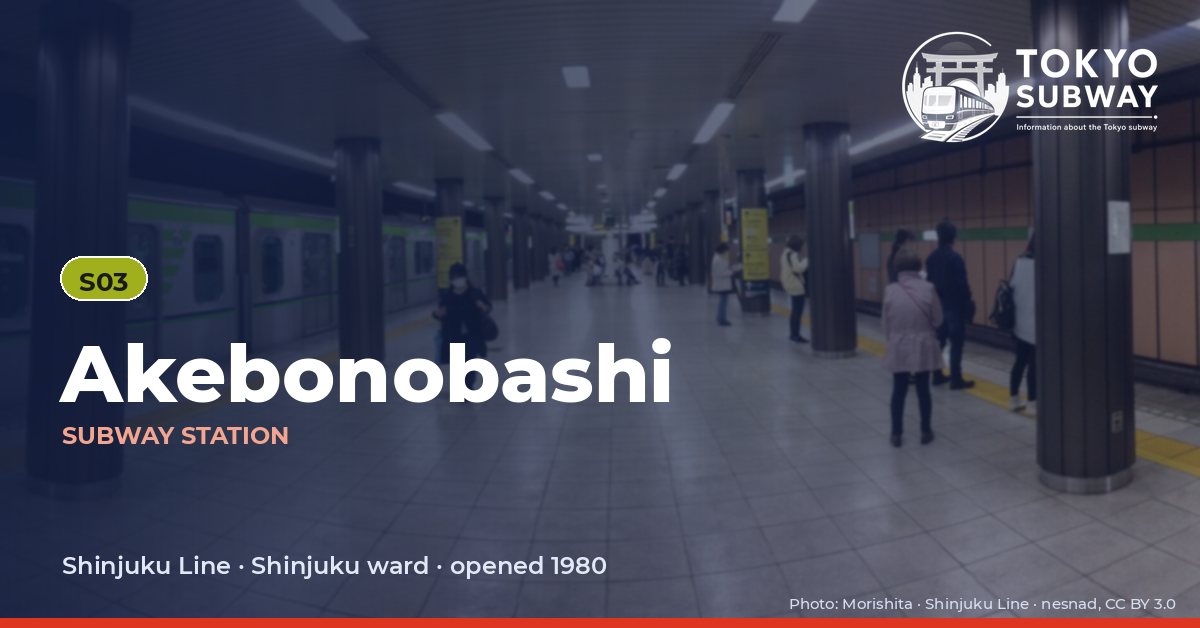
Akebonobashi Station
S03 · Shinjuku Line · Shinjuku
Akebonobashi Station (曙橋)
Until 1997 this was the station for Fuji Television’s Kawadacho headquarters, and the broadcaster left its mark everywhere: its logo marked the boarding positions on the platform, the advertising sold its programs, and station announcements called the stop Fuji TV-mae. The studios moved out, the site became the Kawadacho Confo Garden apartment complex, and the shopping street outside, once known as Fuji Television street, is now Akebonobashi-dori.
Toei opened the station on 16 March 1980 as S03, and its structure is less standard than most of the Shinjuku Line: two side platforms rather than an island, with exits A1 and A2 at the Shinjuku-sanchome end and A3 and A4 toward Ichigaya. The track curves as it runs through, which leaves a gap between train and platform wide enough that a spoken warning was added to the announcements once departure indicators were installed. The 2024 Toei survey counted 36,403 entries and exits on an average day.
Finding Akebonobashi on the signs
Every line gives the station its own letter-and-number code. You never have to read the Japanese name to find the right platform.
Station numbers at Akebonobashi
Tokyo signposts every platform, exit and train door with a letter and a two-digit number. Matching the number is faster than reading the name — and it is what you will see on the map, in announcements and on the platform edge.
First and last trains at Akebonobashi
| Line and direction | Weekdays first – last | Saturdays, Sundays & holidays first – last |
|---|---|---|
| SShinjukuS03 towards Motoyawata | 05:04 – 00:14 to Iwamotocho | 05:04 – 00:14 to Iwamotocho |
| SShinjukuS03 towards Shinjuku | 05:10 – 00:25 | 05:10 – 00:25 |
Departure times come from the operators’ own GTFS timetables (ODPT GTFS Toei-Train-GTFS (version 20261009, valid 2026-03-14..2027-03-12) + TokyoMetro-Train-GTFS (version 20261008, valid 2026-09-19..2027-03-12)). Japan publishes two subway timetables: 平日 weekdays and 土休日 Saturdays, Sundays and national holidays. There is no separate Sunday timetable, and the December 30 – January 3 period runs the holiday timetable.
How often do trains run?
| Line | Weekdays, busiest hour | Sat / Sun / holidays, busiest hour |
|---|---|---|
| SShinjuku | 16 trains/hour (about one every 3.8 min) | 11 trains/hour |
Departures in one direction during the hour with the most trains at this station, counted in the operators’ timetable.
Next stations from Akebonobashi
Scheduled running time between Akebonobashi and the stations either side of it.
| Line | Next station | Running time |
|---|---|---|
| SShinjuku | S04Ichigaya | 2 min |
| SShinjuku | S02Shinjuku-sanchome | 2 min |
Transfers and connections
Only the Shinjuku Line stops here, and no other railway serves this station, so there is nothing to transfer to inside the station.
Accessibility
| Line | Step-free by elevator | Accessible toilet | Escalator | Exits |
|---|---|---|---|---|
| SShinjuku | Yes | Yes | Yes | 4 |
- Shinjuku Line: Toei: step-free “1-route” secured; 3 elevator(s) on this line. Elevator exit(s): A3. Operator page (checked Oct 20, 2026).
Taken from the operators’ own accessibility pages and nothing else. Toei: every station has elevators and a street-gate-platform “1-route” is secured.
What is near Akebonobashi Station?
The Akebonobashi-dori shopping street begins at the exits, and the station serves Tokyo Women’s Medical University and its hospital, Chuo University’s Ichigaya campus and the Ministry of Defense site. Nakano Park and Saigeiji Temple are both about 180 m away, Yokokuji Temple around 220 m, and the Fishing Culture Museum roughly 300 m out; Jounji Temple sits near the edge of the same walk. Two other subway stations are close enough to walk to, Yotsuya-sanchome and Ushigome-yanagicho.
| Place | Distance (straight line) | On foot, estimated |
|---|---|---|
| Saigeiji Temple 西迎寺 | 180 m | about 3 min |
| Yokokuji Temple 養國寺 | 220 m | about 4 min |
| Jounji Temple 増光山 浄運寺 | 370 m | about 6 min |
| 全勝寺 | 220 m | about 4 min |
| Nakano Park 仲之公園 | 180 m | about 3 min |
| Fishing Culture Museum 釣り文化資料館 | 300 m | about 5 min |
| みずも児童遊園 | 60 m | about 1 min |
| 全長寺 | 280 m | about 5 min |
Places from OpenStreetMap within 400 m of the station. The walking time is an estimate (straight line plus 30 %, 80 m a minute), not a measured route. © OpenStreetMap contributors, ODbL.