Kita-sando Station
F14 · Fukutoshin Line · Shibuya
Kita-sando Station (北参道)
Kita-sando was not in the plan for Line 13 at all. The route through Sendagaya was to pass under this part of Meiji-dori without stopping; Shibuya ward and others pushed for a station, permission came in May 1999, and the project carried the working name Shin-Sendagaya until the Kita-sando crossing and Meiji Jingu’s northern approach gave it the name it opened with on 14 June 2008.
The station is shallow by the standards of the Fukutoshin Line, whose newer tunnels run deep under central Tokyo: the island platform at F14 lies about 16 m below the street, with platform edge doors and movable steps. One quirk is invisible from inside. The Oedo Line, open since 2000, passes directly beneath the same Kita-sando intersection, but no interchange was built, because Yoyogi is close enough to serve the purpose. What F14 does have is reach: Fukutoshin Line trains run through onto Tobu, Seibu, Tokyu, Minatomirai and Sotetsu tracks, so a platform in a side street of Sendagaya is a direct ride to five other companies’ networks.
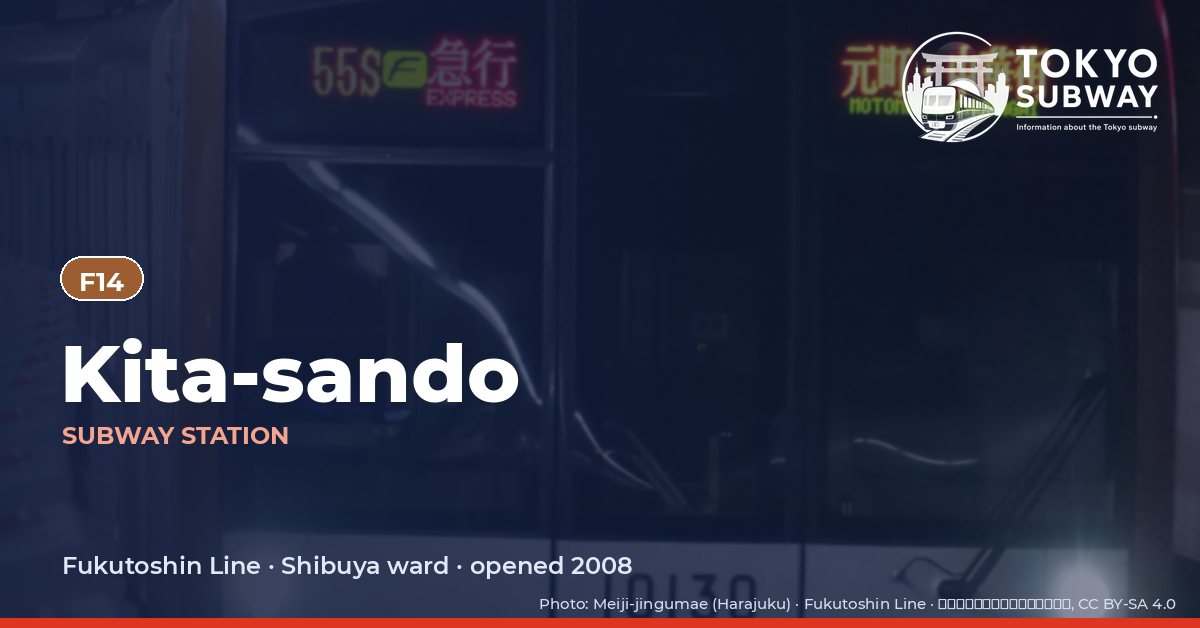
Finding Kita-sando on the signs
Every line gives the station its own letter-and-number code. You never have to read the Japanese name to find the right platform.
Station numbers at Kita-sando
Tokyo signposts every platform, exit and train door with a letter and a two-digit number. Matching the number is faster than reading the name — and it is what you will see on the map, in announcements and on the platform edge.
First and last trains at Kita-sando
| Line and direction | Weekdays first – last | Saturdays, Sundays & holidays first – last |
|---|---|---|
| FFukutoshinF14 towards Shibuya | 05:10 – 00:27 | 05:10 – 00:27 |
| FFukutoshinF14 towards Wakoshi | 05:09 – 00:24 to Shinjuku-sanchome | 05:09 – 00:24 to Shinjuku-sanchome |
Departure times come from the operators’ own GTFS timetables (ODPT GTFS Toei-Train-GTFS (version 20261009, valid 2026-03-14..2027-03-12) + TokyoMetro-Train-GTFS (version 20261008, valid 2026-09-19..2027-03-12)). Japan publishes two subway timetables: 平日 weekdays and 土休日 Saturdays, Sundays and national holidays. There is no separate Sunday timetable, and the December 30 – January 3 period runs the holiday timetable.
How often do trains run?
| Line | Weekdays, busiest hour | Sat / Sun / holidays, busiest hour |
|---|---|---|
| FFukutoshin | 16 trains/hour (about one every 3.8 min) | 11 trains/hour |
Departures in one direction during the hour with the most trains at this station, counted in the operators’ timetable.
Next stations from Kita-sando
Scheduled running time between Kita-sando and the stations either side of it.
| Line | Next station | Running time |
|---|---|---|
| FFukutoshin | F15Meiji-jingumae (Harajuku) | 2 min |
| FFukutoshin | F13Shinjuku-sanchome | 3 min |
Transfers and connections
Only the Fukutoshin Line stops here, and no other railway serves this station, so there is nothing to transfer to inside the station.
Accessibility
| Line | Step-free by elevator | Accessible toilet | Escalator | Exits |
|---|---|---|---|---|
| FFukutoshin | Yes | Yes | Yes | 3 |
- Fukutoshin Line: Step-free elevator route street-gate-platform (official “1-route by elevator”). Street elevator at exit(s): 1. Operator page (checked Oct 20, 2026).
Taken from the operators’ own accessibility pages and nothing else. Tokyo Metro: the “1-route” (step-free street-gate-platform path by elevator, slope, stair lift or wheelchair escalator) is complete at all 180 stations; a separate list shows stations with an elevator-only 1-route.
What is near Kita-sando Station?
The name points at what the station is for: the northern approach to Meiji Jingu, and the Sendagaya side of Shibuya ward rather than the crowds at Meiji-jingumae (Harajuku), one stop away. The National Noh Theatre is about 310 m from the exits and Hatonomori Hachiman shrine roughly 370 m; a children’s playground sits 80 m away, and the Yoyogi Animation Gakuin campus about 360 m, which explains part of the daytime traffic.
| Place | Distance (straight line) | On foot, estimated |
|---|---|---|
| National Noh Theatre 国立能楽堂 | 310 m | about 5 min |
| Hatonomori Hachiman Jinja 鳩森八幡神社 | 370 m | about 6 min |
| Sendagaya Children's Playground | 80 m | about 1 min |
| 北参道ふれあい公園 | 130 m | about 2 min |
| studio VIVID | 400 m | about 6 min |
| Yoyogi Animation Gakuin 代々木アニメーション学院 | 360 m | about 6 min |
| 裏参道公衆便所 | 260 m | about 4 min |
Places from OpenStreetMap within 400 m of the station. The walking time is an estimate (straight line plus 30 %, 80 m a minute), not a measured route. © OpenStreetMap contributors, ODbL.
Frequently asked questions
From the kita-sando, the northern approach to Meiji Jingu, and from the Kita-sando intersection on Meiji-dori above the station. During construction the project used the provisional name Shin-Sendagaya; the present name was chosen before the station opened in 2008.
The Oedo Line does run directly under the Kita-sando intersection, and has since 2000, but it was never planned to stop here and no interchange was added when the Fukutoshin Line station was built in 2008 — Yoyogi was judged close enough to do the job.