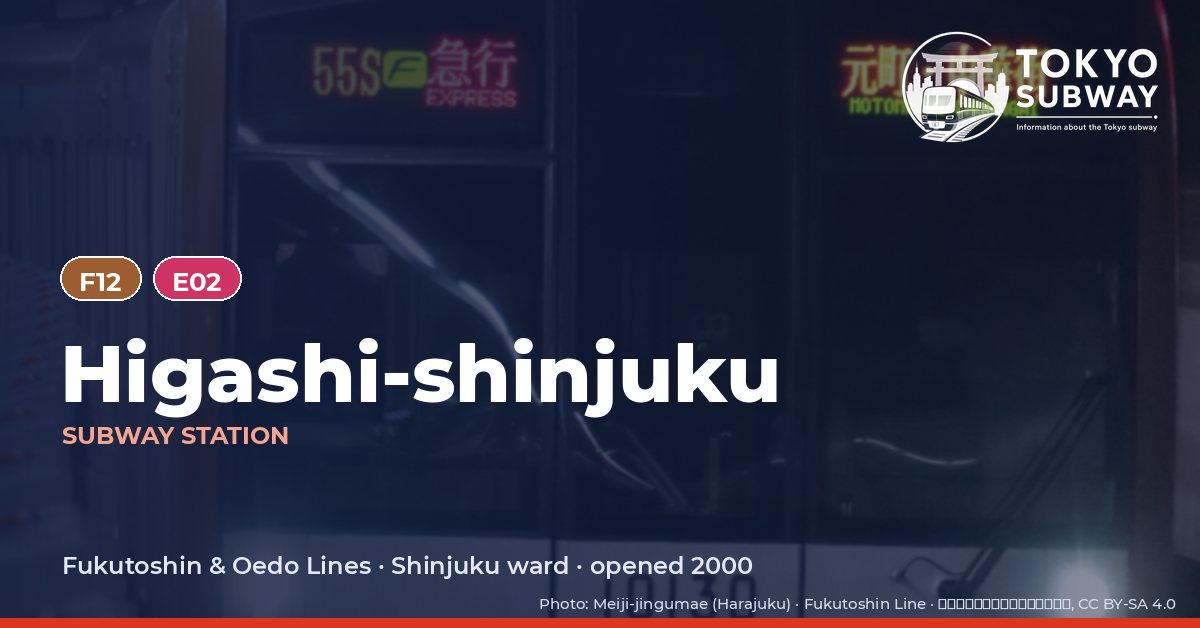
Higashi-shinjuku Station
F12 E02 · Fukutoshin Line and Oedo Line · Shinjuku
Higashi-shinjuku Station (東新宿)
Two companies, two stations, and a difference of eight years: Toei’s Oedo Line island platform opened on 12 December 2000 on the third basement level, and Tokyo Metro’s Fukutoshin Line platforms on 14 June 2008, far below it. The Metro part was built with four tracks on two levels, southbound on the fifth basement and northbound on the sixth, so that express and commuter express trains can overtake the locals that stop here – one of the few places on the network where that happens underground.
For the first years the extra tracks were not used. Each island platform worked with a single track while the other side stayed hidden behind screens, which were taken down in 2015. The two operators count separately: 41,170 entries and exits a day for Tokyo Metro in 2025 and 37,339 for Toei in 2024. Fukutoshin Line trains here run well beyond the subway, onto Tobu, Seibu, Tokyu, Sotetsu and Minatomirai tracks, so F12 sees services bound for Yokohama and beyond.
Finding Higashi-shinjuku on the signs
Every line gives the station its own letter-and-number code. You never have to read the Japanese name to find the right platform.
Station numbers at Higashi-shinjuku
Tokyo signposts every platform, exit and train door with a letter and a two-digit number. Matching the number is faster than reading the name — and it is what you will see on the map, in announcements and on the platform edge.
First and last trains at Higashi-shinjuku
| Line and direction | Weekdays first – last | Saturdays, Sundays & holidays first – last |
|---|---|---|
| FFukutoshinF12 towards Shibuya | 05:13 – 00:22 | 05:13 – 00:22 |
| FFukutoshinF12 towards Wakoshi | 05:15 – 00:17 to Ikebukuro | 05:15 – 00:17 to Ikebukuro |
| EOedoE02 towards Tochomae | 05:12 – 00:30 to Kiyosumi-shirakawa | 05:12 – 00:30 to Kiyosumi-shirakawa |
| EOedoE02 towards Tochomae | 05:15 – 00:20 | 05:15 – 00:20 |
Departure times come from the operators’ own GTFS timetables (ODPT GTFS Toei-Train-GTFS (version 20261009, valid 2026-03-14..2027-03-12) + TokyoMetro-Train-GTFS (version 20261008, valid 2026-09-19..2027-03-12)). Japan publishes two subway timetables: 平日 weekdays and 土休日 Saturdays, Sundays and national holidays. There is no separate Sunday timetable, and the December 30 – January 3 period runs the holiday timetable.
How often do trains run?
| Line | Weekdays, busiest hour | Sat / Sun / holidays, busiest hour |
|---|---|---|
| FFukutoshin | 13 trains/hour (about one every 4.6 min) | 11 trains/hour |
| EOedo | 15 trains/hour (about one every 4 min) | 12 trains/hour |
Departures in one direction during the hour with the most trains at this station, counted in the operators’ timetable.
Next stations from Higashi-shinjuku
Scheduled running time between Higashi-shinjuku and the stations either side of it.
| Line | Next station | Running time |
|---|---|---|
| FFukutoshin | F11Nishi-waseda | 3 min |
| FFukutoshin | F13Shinjuku-sanchome | 3 min |
| EOedo | E01Shinjuku-nishiguchi | 2 min |
| EOedo | E03Wakamatsu-kawada | 2 min |
Transfers and connections
- Subway: transfer between Fukutoshin Line and Oedo Line. The Tokyo Metro lines and the Toei Subway lines belong to different companies, so a trip that uses both costs more than one operator alone — see fares.
Accessibility
| Line | Step-free by elevator | Accessible toilet | Escalator | Exits |
|---|---|---|---|---|
| FFukutoshin | Yes | Yes | Yes | 14 |
| EOedo | Yes | Yes | Yes | 6 |
- Fukutoshin Line: Step-free elevator route street-gate-platform (official “1-route by elevator”). Street elevator at exit(s): B2. Operator page (checked Oct 20, 2026).
- Oedo Line: Toei: step-free “1-route” secured; 2 elevator(s) on this line. Elevator exit(s): A2, A3, EV. Operator page (checked Oct 20, 2026).
Taken from the operators’ own accessibility pages and nothing else. Tokyo Metro: the “1-route” (step-free street-gate-platform path by elevator, slope, stair lift or wheelchair escalator) is complete at all 180 stations; a separate list shows stations with an elevator-only 1-route. Toei: every station has elevators and a street-gate-platform “1-route” is secured.
What is near Higashi-shinjuku Station?
Shinjuku Eastside Square, about 260 m from exit A3, is the biggest thing nearby, holding the headquarters of Citigroup and Square Enix, with the Nissin Foods head office close by. Inari Kio Shrine stands roughly 250 m from the gates and the Korea Museum around 360 m, while Okubo Library is about 310 m away and the Red Cloth music venue a similar distance. Kabukicho begins a few minutes from the exits, which is why the station keeps working long after the offices empty.
| Place | Distance (straight line) | On foot, estimated |
|---|---|---|
| Inari Kio Shrine 稲荷鬼王神社 | 250 m | about 4 min |
| Nakano-Sakaue Eki Stamp 中野坂上駅 駅スタンプ | 110 m | about 2 min |
| Korea Museum 高麗博物館 | 360 m | about 6 min |
| ATELIER Fanfare アトリエファンファーレ | 210 m | about 3 min |
| 小泉八雲記念公園 | 250 m | about 4 min |
| Tully's Coffee タリーズコーヒー イーホテル東新宿店 | 130 m | about 2 min |
| Tully's Coffee タリーズコーヒー 新宿イーストサイドスクエアアトリウム店 | 240 m | about 4 min |
| Shinjuku Eastside Square 新宿イーストサイドスクエア | 260 m | about 4 min |
Places from OpenStreetMap within 400 m of the station. The walking time is an estimate (straight line plus 30 %, 80 m a minute), not a measured route. © OpenStreetMap contributors, ODbL.