
Hibiya Station
H08 C09 I08 · Hibiya Line, Chiyoda Line, and Mita Line · Chiyoda
Hibiya Station (日比谷)
The Hibiya Line platforms were built against the clock: the ground here is soft, so contractors sank eight pneumatic caissons along 279 m beneath the Hibiya crossing and dug between them, under orders to be finished in time for the 1964 Olympics. They opened on 29 August 1964. The Chiyoda Line island platform followed on 20 March 1971 and Toei’s Mita Line platform on 30 June 1972. A name connected to the Imperial Palace was considered for the station and refused by the government and the Imperial Household Agency, so it took the name of Hibiya Park instead.
The Chiyoda and Mita Lines run side by side under Hibiya-dori for about 2 km, and because the street is too narrow for two stations abreast their stops alternate along it roughly every 500 m. Near the Chiyoda Line gates is a mosaic relief of Hibiya Park in four panels, made by Rokuro Yabashi with students from the Tokyo University of the Arts. From 3 November 2026 the departure melodies on all platforms are due to change to the Godzilla theme, a nod to Toho and the Godzilla statue outside.
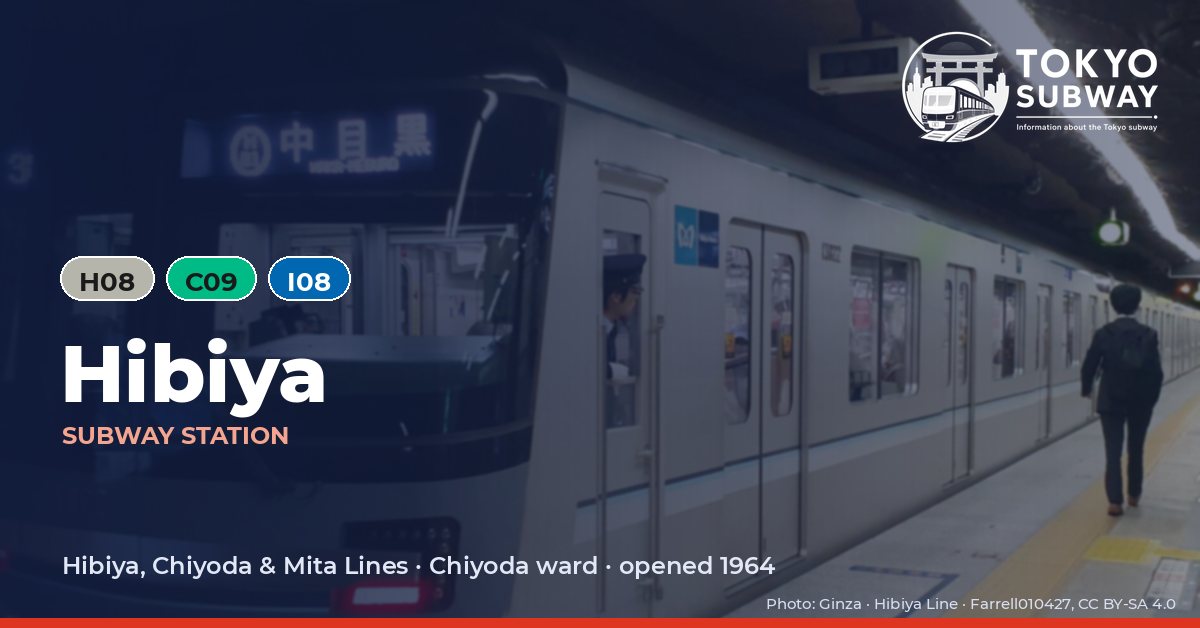
Finding Hibiya on the signs
Every line gives the station its own letter-and-number code. You never have to read the Japanese name to find the right platform.
Station numbers at Hibiya
Tokyo signposts every platform, exit and train door with a letter and a two-digit number. Matching the number is faster than reading the name — and it is what you will see on the map, in announcements and on the platform edge.
First and last trains at Hibiya
| Line and direction | Weekdays first – last | Saturdays, Sundays & holidays first – last |
|---|---|---|
| HHibiyaH08 towards Kita-senju | 05:02 – 00:04 | 05:03 – 00:04 |
| HHibiyaH08 towards Naka-meguro | 05:07 – 00:19 | 05:07 – 00:19 |
| CChiyodaC09 towards Ayase | 05:16 – 00:16 | 05:16 – 00:12 |
| CChiyodaC09 towards Yoyogi-uehara | 05:23 – 00:31 | 05:23 – 00:28 to Kasumigaseki |
| IMitaI08 towards Nishi-takashimadaira | 05:10 – 00:10 to Takashimadaira | 05:10 – 00:10 to Takashimadaira |
| IMitaI08 towards Meguro | 05:20 to Shirokane-takanawa – 00:23 to Shirokane-takanawa | 05:20 to Shirokane-takanawa – 00:23 to Shirokane-takanawa |
Departure times come from the operators’ own GTFS timetables (ODPT GTFS Toei-Train-GTFS (version 20261009, valid 2026-03-14..2027-03-12) + TokyoMetro-Train-GTFS (version 20261008, valid 2026-09-19..2027-03-12)). Japan publishes two subway timetables: 平日 weekdays and 土休日 Saturdays, Sundays and national holidays. There is no separate Sunday timetable, and the December 30 – January 3 period runs the holiday timetable.
How often do trains run?
Departures in one direction during the hour with the most trains at this station, counted in the operators’ timetable.
Next stations from Hibiya
Scheduled running time between Hibiya and the stations either side of it.
| Line | Next station | Running time |
|---|---|---|
| HHibiya | H09Ginza | 1 min |
| HHibiya | H07Kasumigaseki | 3 min |
| CChiyoda | C08Kasumigaseki | 2 min |
| CChiyoda | C10Nijubashimae | 2 min |
| IMita | I09Otemachi | 1 min |
| IMita | I07Uchisaiwaicho | 1 min |
Transfers and connections
- Subway: transfer between Hibiya Line, Chiyoda Line, and Mita Line. The Tokyo Metro lines and the Toei Subway lines belong to different companies, so a trip that uses both costs more than one operator alone — see fares.
- Walking transfer: Yurakucho (Yurakucho Line), an official transfer between two separately named stations, about 3 minutes on foot — our estimate from the distance, not an operator figure.
- JR: Keihin-Tohoku-Negishi Line (JR East), Yamanote Line (JR East). These are separate railways with their own fares.
Accessibility
- Hibiya Line: Step-free elevator route street-gate-platform (official “1-route by elevator”). Operator page (checked Oct 20, 2026).
- Mita Line: Toei: step-free “1-route” secured; 1 elevator(s) on this line. Elevator exit(s): A6, B5. Operator page (checked Oct 20, 2026).
Taken from the operators’ own accessibility pages and nothing else. Tokyo Metro: the “1-route” (step-free street-gate-platform path by elevator, slope, stair lift or wheelchair escalator) is complete at all 180 stations; a separate list shows stations with an elevator-only 1-route. Toei: every station has elevators and a street-gate-platform “1-route” is secured.
What is near Hibiya Station?
Theatres and hotels surround the exits: Tokyo Midtown Hibiya about 170 m away, the Nissay Theatre roughly 220 m, the Tokyo Takarazuka Theater around 240 m and Theatre Creation a little beyond, with Konica Minolta Planetaria Tokyo some 280 m and the Imperial Hotel Plaza about 310 m. Hibiya Park, which gave the station its name, begins around 380 m from the gates, and the Imperial Palace lies on the other side of the avenue. Yurakucho is the official walking transfer from here, reached without leaving the paid area.
| Place | Distance (straight line) | On foot, estimated |
|---|---|---|
| TOKYO Midtown HIBIYA 東京ミッドタウン日比谷 | 170 m | about 3 min |
| Nissay Theatre 日生劇場 | 220 m | about 4 min |
| Tokyo Takarazuka Theater 東京宝塚劇場 | 240 m | about 4 min |
| Theatre Creation シアタークリエ | 270 m | about 4 min |
| Hankyu Men's Tokyo 阪急メンズ東京 | 270 m | about 4 min |
| Yomiuri Otemachi Hall よみうりホール | 310 m | about 5 min |
| Lumine Yurakucho ルミネ有楽町 | 320 m | about 5 min |
| Hibiya Park 日比谷公園 | 380 m | about 6 min |
Places from OpenStreetMap within 400 m of the station. The walking time is an estimate (straight line plus 30 %, 80 m a minute), not a measured route. © OpenStreetMap contributors, ODbL.