
Ginza Station
G09 M16 H09 · Ginza Line, Marunouchi Line, and Hibiya Line · Chuo
Ginza Station (銀座)
For its first twenty-three years this was a one-line stop. The Tokyo Underground Railway opened it on 3 March 1934 and nothing else called here until the postwar building programme reached the district. The Marunouchi Line began serving it on 15 December 1957 and the Teito Rapid Transit Authority opened the Hibiya Line platforms on 29 August 1964. Each line has an island platform with two tracks; the Ginza Line and Marunouchi Line platforms sit apart from each other on the second basement level and the Hibiya Line runs a level below.
Departure melodies here are chosen with the district in mind – Ginza Kankan Musume on the Ginza Line platforms since 2012, The Love Story of Ginza on the Hibiya Line since 2016. With 233,901 entries and exits on an average day in the 2025 survey, this is the fourth-busiest station Tokyo Metro operates, behind only Ikebukuro, Otemachi and Kita-senju, and the single survey covers all three lines rather than counting them separately.
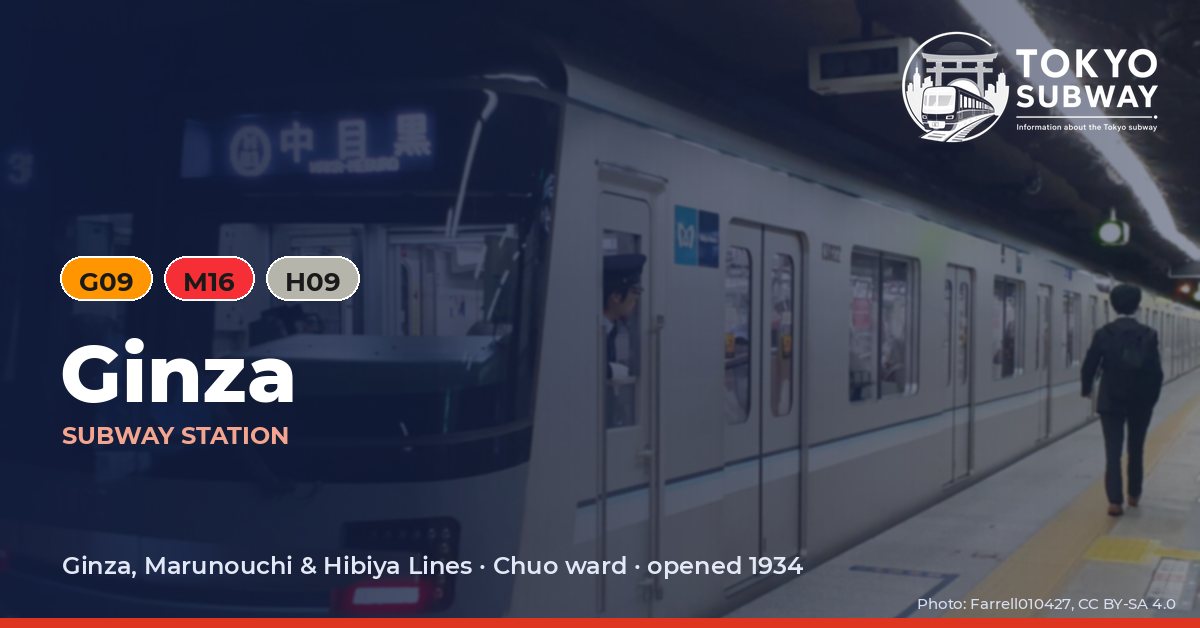
Finding Ginza on the signs
Every line gives the station its own letter-and-number code. You never have to read the Japanese name to find the right platform.
Station numbers at Ginza
Tokyo signposts every platform, exit and train door with a letter and a two-digit number. Matching the number is faster than reading the name — and it is what you will see on the map, in announcements and on the platform edge.
First and last trains at Ginza
| Line and direction | Weekdays first – last | Saturdays, Sundays & holidays first – last |
|---|---|---|
| GGinzaG09 towards Asakusa | 05:17 – 00:18 to Ueno | 05:17 – 00:18 to Ueno |
| GGinzaG09 towards Shibuya | 05:19 – 00:13 | 05:19 – 00:13 |
| MMarunouchiM16 towards Ikebukuro | 05:16 – 00:10 | 05:16 – 00:10 |
| MMarunouchiM16 towards Ogikubo | 05:19 – 00:13 to Shinjuku | 05:19 – 00:13 to Shinjuku |
| HHibiyaH09 towards Kita-senju | 05:04 – 00:06 | 05:04 – 00:06 |
| HHibiyaH09 towards Naka-meguro | 05:06 – 00:18 | 05:06 – 00:18 |
Departure times come from the operators’ own GTFS timetables (ODPT GTFS Toei-Train-GTFS (version 20261009, valid 2026-03-14..2027-03-12) + TokyoMetro-Train-GTFS (version 20261008, valid 2026-09-19..2027-03-12)). Japan publishes two subway timetables: 平日 weekdays and 土休日 Saturdays, Sundays and national holidays. There is no separate Sunday timetable, and the December 30 – January 3 period runs the holiday timetable.
How often do trains run?
| Line | Weekdays, busiest hour | Sat / Sun / holidays, busiest hour |
|---|---|---|
| GGinza | 27 trains/hour (about one every 2.2 min) | 20 trains/hour |
| MMarunouchi | 26 trains/hour (about one every 2.3 min) | 15 trains/hour |
| HHibiya | 27 trains/hour (about one every 2.2 min) | 14 trains/hour |
Departures in one direction during the hour with the most trains at this station, counted in the operators’ timetable.
Next stations from Ginza
Scheduled running time between Ginza and the stations either side of it.
| Line | Next station | Running time |
|---|---|---|
| GGinza | G10Kyobashi | 2 min |
| GGinza | G08Shimbashi | 2 min |
| MMarunouchi | M15Kasumigaseki | 2 min |
| MMarunouchi | M17Tokyo | 3 min |
| HHibiya | H08Hibiya | 1 min |
| HHibiya | H10Higashi-ginza | 2 min |
Transfers and connections
- Subway: transfer between Ginza Line, Marunouchi Line, and Hibiya Line.
- Walking transfer: Ginza-itchome (Yurakucho Line), an official transfer between two separately named stations, about 5 minutes on foot — our estimate from the distance, not an operator figure.
Accessibility
| Line | Step-free by elevator | Accessible toilet | Escalator | Exits |
|---|---|---|---|---|
| GGinza | Yes | Not listed | Yes | 31 |
| MMarunouchi | Yes | Yes | Yes | 31 |
| HHibiya | Yes | Yes | Yes | 31 |
- Ginza Line: Step-free elevator route street-gate-platform (official “1-route by elevator”). Street elevator at exit(s): A8, B2, B7, B8. Operator page (checked Oct 20, 2026).
Taken from the operators’ own accessibility pages and nothing else. Tokyo Metro: the “1-route” (step-free street-gate-platform path by elevator, slope, stair lift or wheelchair escalator) is complete at all 180 stations; a separate list shows stations with an elevator-only 1-route.
What is near Ginza Station?
The exits open directly into the department stores: Wako and the Seiko Museum within about 100 m, Matsuya Ginza roughly 210 m, Hankyu Men’s Tokyo around 240 m and Ginza Six about 290 m, with Tokyu Plaza Ginza, Nishi Ginza and Marronnier Gate Ginza 2 in between. Ginza Crossing itself is some 120 m from a gate. The Art Aquarium Museum, the Nichido Art Gallery and the Kanze Noh Theater are all within a few minutes, and Ginza-itchome on the Yurakucho Line is the official walking transfer from here.
| Place | Distance (straight line) | On foot, estimated |
|---|---|---|
| Ginza Church 銀座教会 | 90 m | about 1 min |
| WAKO 和光 | 90 m | about 2 min |
| Nishi Ginza 西銀座 | 140 m | about 2 min |
| Art Aquarium Museum GINZA アートアクアリウム美術館 GINZA | 150 m | about 2 min |
| Marronnier Gate Ginza 2 マロニエゲート銀座2 | 170 m | about 3 min |
| TOKYU PLAZA GINZA 東急プラザ銀座 | 180 m | about 3 min |
| Lumine Yurakucho ルミネ有楽町 | 190 m | about 3 min |
| Matsuya Ginza 松屋銀座 | 210 m | about 3 min |
Places from OpenStreetMap within 400 m of the station. The walking time is an estimate (straight line plus 30 %, 80 m a minute), not a measured route. © OpenStreetMap contributors, ODbL.