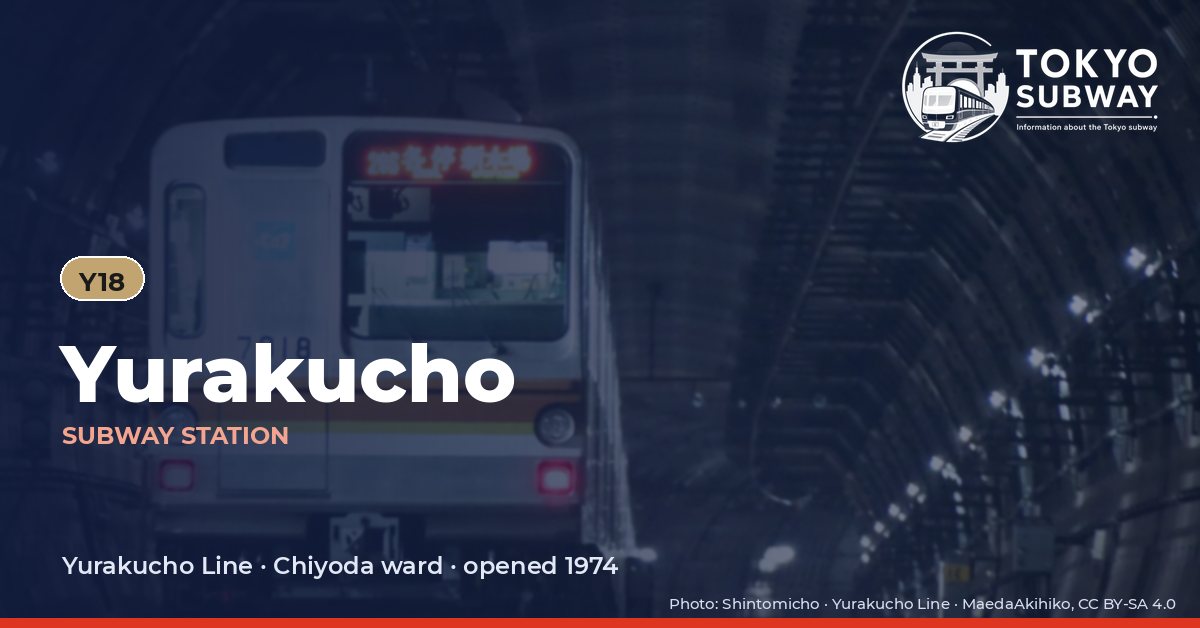
Yurakucho Station
Y18 · Yurakucho Line · Chiyoda
Yurakucho Station (有楽町)
Y18 opened on 30 October 1974, and from the first day it was handled as a transfer with Hibiya, about 190 m away, which is why subway maps mark the two as one interchange although they have different names, different gates and three extra lines between them. Platform doors came into use on 10 March 2012.
The railway above is much older and has had a harder history. The elevated JR station opened on 25 June 1910 as the end of a Tokaido Main Line branch and became a through station that September, when the line was pushed on to Gofukubashi. On 27 January 1945 an air raid destroyed the central ticket gate and killed ninety-six people, nine of them staff and eighty-seven passengers. Today the Yamanote Line calls at all hours and the Keihin-Tohoku Line runs past without stopping in the middle of the day. Yurakucho means something like pleasure quarter, which suits the use the district is put to now. In 2025 the Tokyo Metro station was used by 141,461 people on an average day.
Finding Yurakucho on the signs
Every line gives the station its own letter-and-number code. You never have to read the Japanese name to find the right platform.
Station numbers at Yurakucho
Tokyo signposts every platform, exit and train door with a letter and a two-digit number. Matching the number is faster than reading the name — and it is what you will see on the map, in announcements and on the platform edge.
First and last trains at Yurakucho
| Line and direction | Weekdays first – last | Saturdays, Sundays & holidays first – last |
|---|---|---|
| YYurakuchoY18 towards Shin-kiba | 05:01 – 00:18 | 05:01 – 00:18 |
| YYurakuchoY18 towards Wakoshi | 05:13 – 00:14 to Ikebukuro | 05:13 – 00:14 to Ikebukuro |
Departure times come from the operators’ own GTFS timetables (ODPT GTFS Toei-Train-GTFS (version 20261009, valid 2026-03-14..2027-03-12) + TokyoMetro-Train-GTFS (version 20261008, valid 2026-09-19..2027-03-12)). Japan publishes two subway timetables: 平日 weekdays and 土休日 Saturdays, Sundays and national holidays. There is no separate Sunday timetable, and the December 30 – January 3 period runs the holiday timetable.
How often do trains run?
| Line | Weekdays, busiest hour | Sat / Sun / holidays, busiest hour |
|---|---|---|
| YYurakucho | 22 trains/hour (about one every 2.7 min) | 12 trains/hour |
Departures in one direction during the hour with the most trains at this station, counted in the operators’ timetable.
Next stations from Yurakucho
Scheduled running time between Yurakucho and the stations either side of it.
| Line | Next station | Running time |
|---|---|---|
| YYurakucho | Y19Ginza-itchome | 2 min |
| YYurakucho | Y17Sakuradamon | 2 min |
Transfers and connections
- Walking transfer: Hibiya (Hibiya Line, Chiyoda Line, and Mita Line), an official transfer between two separately named stations, about 3 minutes on foot — our estimate from the distance, not an operator figure.
- JR: Keihin-Tohoku-Negishi Line (JR East), Yamanote Line (JR East). These are separate railways with their own fares.
Accessibility
| Line | Step-free by elevator | Accessible toilet | Escalator | Exits |
|---|---|---|---|---|
| YYurakucho | Yes | Yes | Yes | 8 |
- Yurakucho Line: Step-free elevator route street-gate-platform (official “1-route by elevator”). Street elevator at exit(s): D7. Operator page (checked Oct 20, 2026).
Taken from the operators’ own accessibility pages and nothing else. Tokyo Metro: the “1-route” (step-free street-gate-platform path by elevator, slope, stair lift or wheelchair escalator) is complete at all 180 stations; a separate list shows stations with an elevator-only 1-route.
What is near Yurakucho Station?
Yurakucho comes up between Marunouchi and Ginza and is surrounded by places to spend money and places to look at pictures. Tokyo Kotsu Kaikan is about 210 m from the exits, Hankyu Men’s Tokyo about 250 m, Lumine Yurakucho about 280 m and Nishi Ginza about 320 m, with Tokyo Midtown Hibiya about 390 m. The Mitsuo Aida Museum is about 260 m away, the Mitsubishi Ichigokan Museum about 280 m and the Seikado Bunko Art Museum about 320 m. Yomiuri Otemachi Hall is about 100 m off and Konica Minolta Planetaria Tokyo about 270 m.
| Place | Distance (straight line) | On foot, estimated |
|---|---|---|
| Yomiuri Otemachi Hall よみうりホール | 100 m | about 2 min |
| Tokyo Kotsu Kaikan 東京交通会館 | 210 m | about 3 min |
| Hankyu Men's Tokyo 阪急メンズ東京 | 250 m | about 4 min |
| Mitsuo Aida Museum 相田みつを美術館 | 260 m | about 4 min |
| Lumine Yurakucho ルミネ有楽町 | 280 m | about 5 min |
| Mitsubishi Ichigokan Museum 三菱一号館 | 280 m | about 5 min |
| Nishi Ginza 西銀座 | 320 m | about 5 min |
| Marronnier Gate Ginza 2 マロニエゲート銀座2 | 360 m | about 6 min |
Places from OpenStreetMap within 400 m of the station. The walking time is an estimate (straight line plus 30 %, 80 m a minute), not a measured route. © OpenStreetMap contributors, ODbL.
Frequently asked questions
Not quite, but the subway map treats them as one. The two are about 190 m apart and linked by underground passages, and a change between them has counted as a single transfer since this station opened in 1974. Hibiya has its own name and its own gates, and brings the Hibiya, Chiyoda and Mita lines within reach of Yurakucho.
It opened on 25 June 1910, sixty-four years before the subway, as the terminus of a branch of the Tokaido Main Line; it became a through station on 15 September the same year. The station was badly hit in the air raid of 27 January 1945, when the central ticket gate was destroyed and ninety-six people were killed.