
Takaracho Station
A12 · Asakusa Line · Chuo
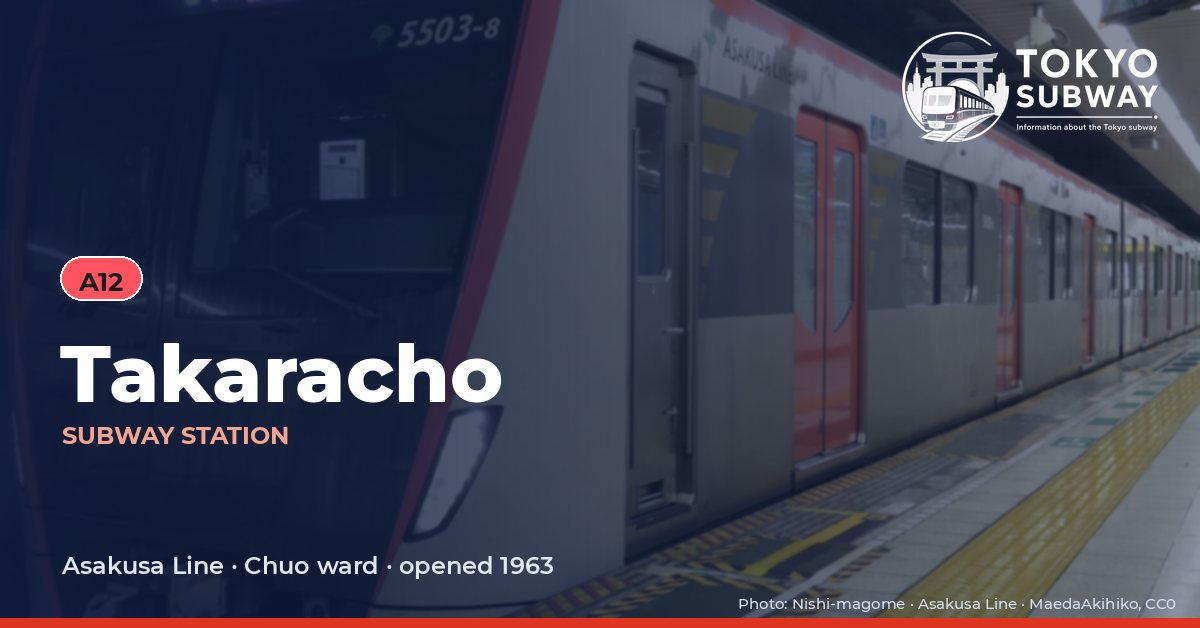
Takaracho Station (宝町)
A12 opened on 28 February 1963 beneath the Showa-dori underpass in Kyobashi, on the line then known by its number alone; the Asakusa Line name followed in 1978. The station is called after Takaracho, a neighborhood created in 1931 when older street names were tidied up and dissolved in 1978, when it was folded back into Kyobashi. The place has gone, the word has not.
Two side platforms sit directly under the road, with a ticket hall of its own for each. For years that left them linked only outside the barrier; rebuilding work later cut a passage between the two inside the gates. Two unusual entrances were added afterwards. A7, opened on 11 December 2010, is an elevator shaft with its own gate serving platform 2 and no ticket or fare-adjustment machines at all, so anyone whose ticket the reader will not take has to call staff on the intercom; A8, opened on 23 December 2011, does the same job for platform 1. In 2024 Takaracho was used by 31,022 people on an average day.
Finding Takaracho on the signs
Every line gives the station its own letter-and-number code. You never have to read the Japanese name to find the right platform.
Station numbers at Takaracho
Tokyo signposts every platform, exit and train door with a letter and a two-digit number. Matching the number is faster than reading the name — and it is what you will see on the map, in announcements and on the platform edge.
First and last trains at Takaracho
| Line and direction | Weekdays first – last | Saturdays, Sundays & holidays first – last |
|---|---|---|
| AAsakusaA12 towards Oshiage (Skytree) | 05:10 – 00:13 | 05:10 – 00:13 |
| AAsakusaA12 towards Nishi-magome | 05:14 – 00:19 | 05:14 – 00:19 |
Departure times come from the operators’ own GTFS timetables (ODPT GTFS Toei-Train-GTFS (version 20261009, valid 2026-03-14..2027-03-12) + TokyoMetro-Train-GTFS (version 20261008, valid 2026-09-19..2027-03-12)). Japan publishes two subway timetables: 平日 weekdays and 土休日 Saturdays, Sundays and national holidays. There is no separate Sunday timetable, and the December 30 – January 3 period runs the holiday timetable.
How often do trains run?
| Line | Weekdays, busiest hour | Sat / Sun / holidays, busiest hour |
|---|---|---|
| AAsakusa | 22 trains/hour (about one every 2.7 min) | 14 trains/hour |
Departures in one direction during the hour with the most trains at this station, counted in the operators’ timetable.
Next stations from Takaracho
Scheduled running time between Takaracho and the stations either side of it.
| Line | Next station | Running time |
|---|---|---|
| AAsakusa | A11Higashi-ginza | 1 min |
| AAsakusa | A13Nihombashi | 1 min |
Transfers and connections
Only the Asakusa Line stops here, and no other railway serves this station, so there is nothing to transfer to inside the station.
Accessibility
| Line | Step-free by elevator | Accessible toilet | Escalator | Exits |
|---|---|---|---|---|
| AAsakusa | Yes | Yes | Yes | 8 |
- Asakusa Line: Toei: step-free “1-route” secured; 2 elevator(s) on this line. Elevator exit(s): A7, A8. Operator page (checked Oct 20, 2026).
Taken from the operators’ own accessibility pages and nothing else. Toei: every station has elevators and a street-gate-platform “1-route” is secured.
What is near Takaracho Station?
The blocks above Takaracho are thick with small galleries and museums. The National Film Archive of Japan is about 120 m from the exits, the Police Museum about 220 m and the Artizon Museum about 350 m, with Nantenshi Gallery, Gallery Tsubaki, White Gallery Tokyo and the LIXIL Gallery all within a few minutes. The Chuo Ward Local History Museum is about 370 m away and Horikawa Danjobashi Park about 110 m. Kyobashi and Hatchobori are both a short walk, although neither is a recognized transfer.
| Place | Distance (straight line) | On foot, estimated |
|---|---|---|
| National Film Archive of Japan 国立映画アーカイブ | 120 m | about 2 min |
| Police Museum 警察博物館 | 220 m | about 4 min |
| Artizon Museum アーティゾン美術館 | 350 m | about 6 min |
| Horikawa Danjobashi Park 堀川弾正橋公園 | 110 m | about 2 min |
| Nantenshi Gallery 南天子画廊 | 160 m | about 3 min |
| LIXIL Gallery LIXILギャラリー | 220 m | about 4 min |
| Kyobashi Park 京橋公園 | 290 m | about 5 min |
| Gallery Tsubaki ギャラリー椿 | 310 m | about 5 min |
Places from OpenStreetMap within 400 m of the station. The walking time is an estimate (straight line plus 30 %, 80 m a minute), not a measured route. © OpenStreetMap contributors, ODbL.
Frequently asked questions
Takaracho was laid out as a place name in 1931 and vanished in 1978, when the address reform merged it into neighboring Kyobashi. The station had carried the name for fifteen years by then and kept it. One detail often repeated is wrong: Takaracho was never part of Nihonbashi, as it belonged to the old Kyobashi ward.
Two late additions, each built around a single lift. A7 opened on 11 December 2010 with its own gate onto platform 2 and A8 on 23 December 2011 onto platform 1. Neither has ticket machines, so passengers with a ticket the gate will not read use the intercom to call staff.