
Kyobashi Station
G10 · Ginza Line · Chuo
Kyobashi Station (京橋)
When Kyobashi opened on 24 December 1932 it was the end of the Tokyo Underground Railway’s line from Mitsukoshimae, and it stayed the terminus until the extension to Ginza opened on 3 March 1934. Part of the building cost was met by the Meidi-Ya store above, which is why the station still carries the secondary name Meidi-Ya-mae. Its early decades were eventful: a fire around the ticket office in March 1935, the first at a Japanese subway station; air-raid damage on 27 January 1945; and a bomb planted on a train in September 1963 that injured ten people.
Today G10 is a single island platform on the second basement level of the Ginza Line, with stairs at both ends and an elevator serving its own gate in the middle. Near exit 3 stands a public artwork installed on 1 April 2020, Nakanishi Nobuhiro’s “Stripe Drawing – Flow of time”, built from about 600 dichroic mirrors donated by the glassmaker AGC.
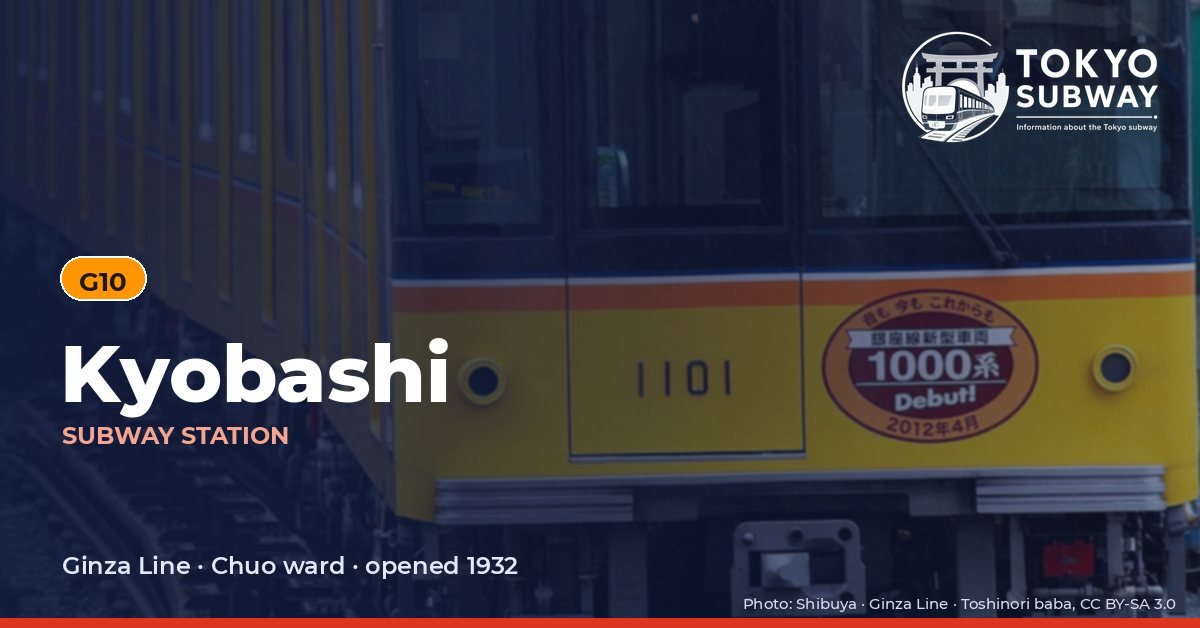
Finding Kyobashi on the signs
Every line gives the station its own letter-and-number code. You never have to read the Japanese name to find the right platform.
Station numbers at Kyobashi
Tokyo signposts every platform, exit and train door with a letter and a two-digit number. Matching the number is faster than reading the name — and it is what you will see on the map, in announcements and on the platform edge.
First and last trains at Kyobashi
Departure times come from the operators’ own GTFS timetables (ODPT GTFS Toei-Train-GTFS (version 20261009, valid 2026-03-14..2027-03-12) + TokyoMetro-Train-GTFS (version 20261008, valid 2026-09-19..2027-03-12)). Japan publishes two subway timetables: 平日 weekdays and 土休日 Saturdays, Sundays and national holidays. There is no separate Sunday timetable, and the December 30 – January 3 period runs the holiday timetable.
How often do trains run?
| Line | Weekdays, busiest hour | Sat / Sun / holidays, busiest hour |
|---|---|---|
| GGinza | 28 trains/hour (about one every 2.1 min) | 20 trains/hour |
Departures in one direction during the hour with the most trains at this station, counted in the operators’ timetable.
Next stations from Kyobashi
Scheduled running time between Kyobashi and the stations either side of it.
| Line | Next station | Running time |
|---|---|---|
| GGinza | G09Ginza | 2 min |
| GGinza | G11Nihombashi | 2 min |
Transfers and connections
Only the Ginza Line stops here, and no other railway serves this station, so there is nothing to transfer to inside the station.
Accessibility
| Line | Step-free by elevator | Accessible toilet | Escalator | Exits |
|---|---|---|---|---|
| GGinza | Yes | Yes | Not listed | 8 |
- Ginza Line: Step-free elevator route street-gate-platform (official “1-route by elevator”). Street elevator at exit(s): 2, 3, 8. Operator page (checked Oct 20, 2026).
Taken from the operators’ own accessibility pages and nothing else. Tokyo Metro: the “1-route” (step-free street-gate-platform path by elevator, slope, stair lift or wheelchair escalator) is complete at all 180 stations; a separate list shows stations with an elevator-only 1-route.
What is near Kyobashi Station?
Kyobashi sits between Ginza and Nihombashi in Chuo ward, and what distinguishes it is art. The National Film Archive of Japan is roughly 140 m from the exits, the Police Museum about 180 m and the Artizon Museum around 290 m, with the Pola Museum Annex some 330 m away and a cluster of commercial galleries — Nantenshi, Tsubaki, LIXIL and others — between 30 m and 350 m. The Meidi-Ya main store is at the station itself, and Horikawa Danjobashi Park about 320 m away.
| Place | Distance (straight line) | On foot, estimated |
|---|---|---|
| National Film Archive of Japan 国立映画アーカイブ | 140 m | about 2 min |
| Police Museum 警察博物館 | 180 m | about 3 min |
| Artizon Museum アーティゾン美術館 | 290 m | about 5 min |
| Nantenshi Gallery 南天子画廊 | 150 m | about 2 min |
| LIXIL Gallery LIXILギャラリー | 160 m | about 3 min |
| Gallery Tsubaki ギャラリー椿 | 190 m | about 3 min |
| Chibata Etsuko Gallery 柴田悦子画廊 | 300 m | about 5 min |
| Horikawa Danjobashi Park 堀川弾正橋公園 | 320 m | about 5 min |
Places from OpenStreetMap within 400 m of the station. The walking time is an estimate (straight line plus 30 %, 80 m a minute), not a measured route. © OpenStreetMap contributors, ODbL.
Frequently asked questions
Meidi-Ya, the grocery store above the station, paid part of the construction cost when the Tokyo Underground Railway built here in 1932, and the station has carried “Meidi-Ya-mae” as an official secondary name ever since.
“Stripe Drawing – Flow of time” by Nakanishi Nobuhiro, made from roughly 600 dichroic mirrors given to the station by AGC and installed on 1 April 2020. The colors it throws change as you move past it.