
Nihombashi Station
G11 T10 A13 · Ginza Line, Tozai Line, and Asakusa Line · Chuo
Nihombashi Station (日本橋)
The oldest part of this complex dates from 24 December 1932, when the Tokyo Underground Railway extended its line to Kyobashi and opened what is now G11. Toei’s platforms came on 28 February 1963 under a different name: they were Edobashi Station until 19 March 1989, when they were renamed Nihombashi to stop travelers confusing them with Edogawabashi on the Yurakucho Line. The Tozai Line opened T10 on 14 September 1967, and that is when the place became a genuine interchange rather than two stations in contact.
Each line has its own awkwardness. The Ginza Line opened with an island platform, but crowding forced a side platform for Shibuya-bound trains in 1984, so the island now takes only Asakusa-bound trains and its other face is fenced off. On the Asakusa Line, A13, the two side platforms are not linked inside the gates, so you must pick your direction before you touch in. Both Tokyo Metro platforms play the folk song “Oedo Nihonbashi” as their departure melody.
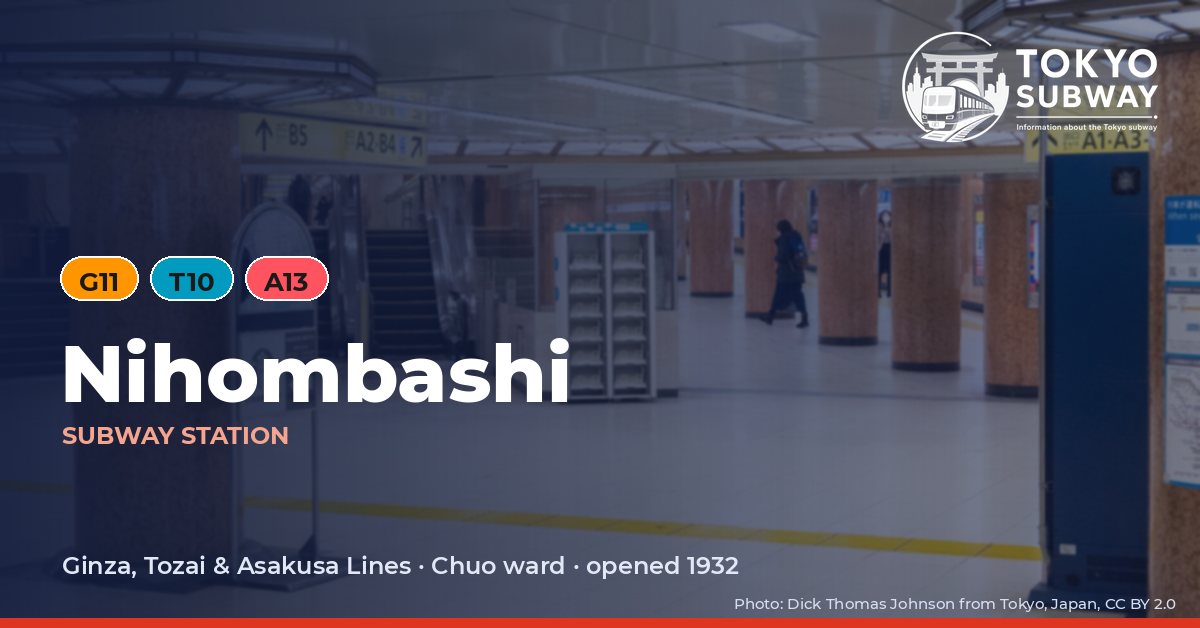
Finding Nihombashi on the signs
Every line gives the station its own letter-and-number code. You never have to read the Japanese name to find the right platform.
Station numbers at Nihombashi
Tokyo signposts every platform, exit and train door with a letter and a two-digit number. Matching the number is faster than reading the name — and it is what you will see on the map, in announcements and on the platform edge.
First and last trains at Nihombashi
| Line and direction | Weekdays first – last | Saturdays, Sundays & holidays first – last |
|---|---|---|
| GGinzaG11 towards Asakusa | 05:20 – 00:21 to Ueno | 05:20 – 00:21 to Ueno |
| GGinzaG11 towards Shibuya | 05:15 – 00:09 | 05:15 – 00:09 |
| TTozaiT10 towards Nishi-funabashi | 05:22 – 00:15 to Myoden | 05:22 – 00:15 to Myoden |
| TTozaiT10 towards Nakano | 05:08 – 00:12 | 05:08 – 00:12 |
| AAsakusaA13 towards Oshiage (Skytree) | 05:11 – 00:14 | 05:11 – 00:14 |
| AAsakusaA13 towards Nishi-magome | 05:12 – 00:18 | 05:12 – 00:18 |
Departure times come from the operators’ own GTFS timetables (ODPT GTFS Toei-Train-GTFS (version 20261009, valid 2026-03-14..2027-03-12) + TokyoMetro-Train-GTFS (version 20261008, valid 2026-09-19..2027-03-12)). Japan publishes two subway timetables: 平日 weekdays and 土休日 Saturdays, Sundays and national holidays. There is no separate Sunday timetable, and the December 30 – January 3 period runs the holiday timetable.
How often do trains run?
Departures in one direction during the hour with the most trains at this station, counted in the operators’ timetable.
Transfers and connections
- Subway: transfer between Ginza Line, Tozai Line, and Asakusa Line. The Tokyo Metro lines and the Toei Subway lines belong to different companies, so a trip that uses both costs more than one operator alone — see fares.
Accessibility
- Ginza Line: Step-free elevator route street-gate-platform (official “1-route by elevator”). Street elevator at exit(s): A4, A7, B0, B9, C5. Operator page (checked Oct 20, 2026).
- Asakusa Line: Toei: step-free “1-route” secured; 3 elevator(s) on this line. Elevator exit(s): A4, D3. Operator page (checked Oct 20, 2026).
Taken from the operators’ own accessibility pages and nothing else. Tokyo Metro: the “1-route” (step-free street-gate-platform path by elevator, slope, stair lift or wheelchair escalator) is complete at all 180 stations; a separate list shows stations with an elevator-only 1-route. Toei: every station has elevators and a street-gate-platform “1-route” is secured.
What is near Nihombashi Station?
Nihombashi is a department-store district above a bank district. Coredo Nihombashi stands about 60 m from the exits, Takashimaya roughly 160 m and the Nihonbashi Mitsukoshi main store around 360 m, with Tokyo Nihonbashi Tower practically overhead at 30 m. The Kite Museum is about 280 m away, the Kabutocho Kayabacho Machikado Museum roughly 370 m, and Nihonbashi Sakura-dori around 220 m. Asakusa Line trains from here run onto Keikyu and Keisei tracks, which is what makes the station useful for airport access.
| Place | Distance (straight line) | On foot, estimated |
|---|---|---|
| Coredo Nihombashi コレド日本橋 | 60 m | about 1 min |
| Nihonbashi Mitsukoshi Main Store 日本橋三越本店 | 360 m | about 6 min |
| Takashimaya 高島屋 | 160 m | about 3 min |
| Nihonbashi Sakura-dori 日本橋さくら通り | 220 m | about 4 min |
| Kite Museum 凧の博物館 | 280 m | about 4 min |
| Sakamotocho Park 坂本町公園 | 350 m | about 6 min |
| Kabutocho Kayabacho Machikado Museum 兜町・茅場町まちかど展示館 | 370 m | about 6 min |
| 花の広場 | 200 m | about 3 min |
Places from OpenStreetMap within 400 m of the station. The walking time is an estimate (straight line plus 30 %, 80 m a minute), not a measured route. © OpenStreetMap contributors, ODbL.
Frequently asked questions
It was replaced. The Ginza Line station opened with a single island platform, and overcrowding led to a separate side platform for Shibuya-bound trains being built in 1984. Since then the island has served Asakusa-bound trains only, and the unused edge is closed off.
Not all of it. The Toei platforms opened on 28 February 1963 as Edobashi Station and kept that name for twenty-six years; they were renamed Nihombashi on 19 March 1989 because passengers were confusing Edobashi with Edogawabashi, which had opened on the Yurakucho Line in 1974.