
Higashi-ginza Station
H10 A11 · Hibiya Line and Asakusa Line · Chuo
Higashi-ginza Station (東銀座)
Both halves of this station opened on the same day, 28 February 1963 – the Toei line then known as Line 1, renamed the Asakusa Line in 1978, and Tokyo Metro’s Hibiya Line. They cross at right angles: the Toei platforms run under Showa-dori, the Hibiya Line island platform under Harumi-dori, with A11 and H10 as their numbers. The Hibiya Line station carries the subtitle Kabukiza-mae, and the theatre is the reason – its entrance is barely 40 m from an exit.
The two operators count their passengers separately and the numbers come out remarkably close: 85,379 entries and exits a day for Tokyo Metro in 2025 and 85,509 for Toei in 2024. Asakusa Line trains run through onto Keisei, Keikyu, Hokuso and Shibayama tracks, which is what makes this a usable starting point for airport access, while Hibiya Line trains continue onto the Tobu network toward Minami-kurihashi. Higashi-ginza is also linked to Ginza, one stop away, by the passages under the street.
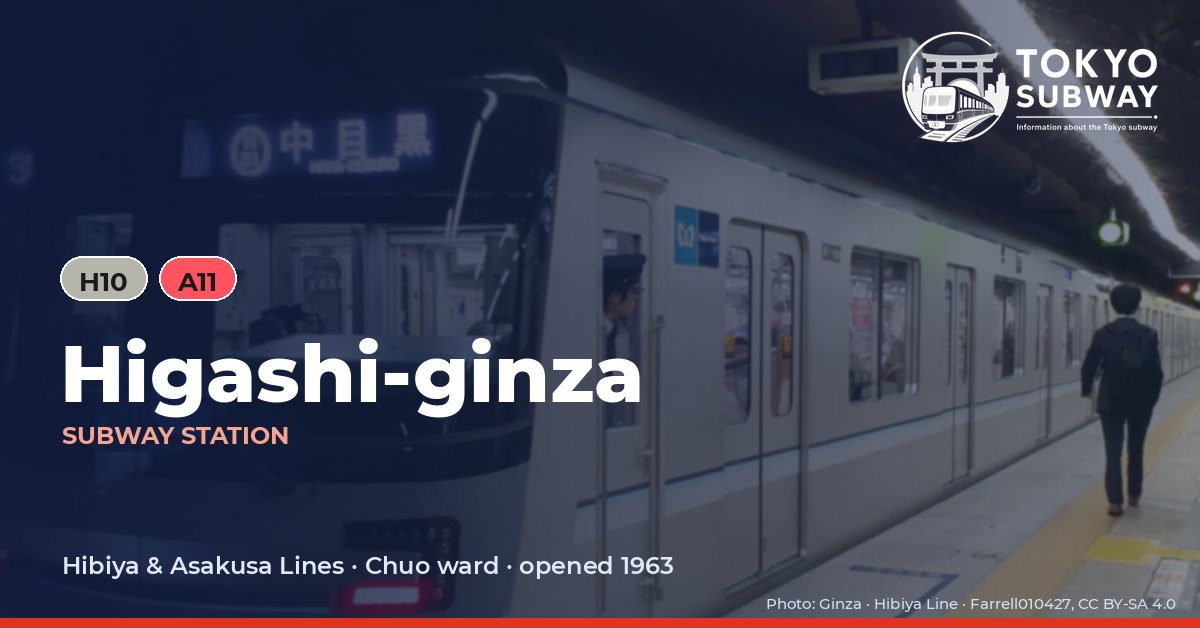
Finding Higashi-ginza on the signs
Every line gives the station its own letter-and-number code. You never have to read the Japanese name to find the right platform.
Station numbers at Higashi-ginza
Tokyo signposts every platform, exit and train door with a letter and a two-digit number. Matching the number is faster than reading the name — and it is what you will see on the map, in announcements and on the platform edge.
First and last trains at Higashi-ginza
| Line and direction | Weekdays first – last | Saturdays, Sundays & holidays first – last |
|---|---|---|
| HHibiyaH10 towards Kita-senju | 05:06 – 00:07 | 05:06 – 00:07 |
| HHibiyaH10 towards Naka-meguro | 05:04 – 00:16 | 05:04 – 00:16 |
| AAsakusaA11 towards Oshiage (Skytree) | 05:08 – 00:11 | 05:08 – 00:11 |
| AAsakusaA11 towards Nishi-magome | 05:16 – 00:21 | 05:16 – 00:21 |
Departure times come from the operators’ own GTFS timetables (ODPT GTFS Toei-Train-GTFS (version 20261009, valid 2026-03-14..2027-03-12) + TokyoMetro-Train-GTFS (version 20261008, valid 2026-09-19..2027-03-12)). Japan publishes two subway timetables: 平日 weekdays and 土休日 Saturdays, Sundays and national holidays. There is no separate Sunday timetable, and the December 30 – January 3 period runs the holiday timetable.
How often do trains run?
Departures in one direction during the hour with the most trains at this station, counted in the operators’ timetable.
Transfers and connections
- Subway: transfer between Hibiya Line and Asakusa Line. The Tokyo Metro lines and the Toei Subway lines belong to different companies, so a trip that uses both costs more than one operator alone — see fares.
Accessibility
- Hibiya Line: Step-free elevator route street-gate-platform (official “1-route by elevator”). Street elevator at exit(s): 3, A1. Operator page (checked Oct 20, 2026).
- Asakusa Line: Toei: step-free “1-route” secured; 2 elevator(s) on this line. Elevator exit(s): A1, 3. Operator page (checked Oct 20, 2026).
Taken from the operators’ own accessibility pages and nothing else. Tokyo Metro: the “1-route” (step-free street-gate-platform path by elevator, slope, stair lift or wheelchair escalator) is complete at all 180 stations; a separate list shows stations with an elevator-only 1-route. Toei: every station has elevators and a street-gate-platform “1-route” is secured.
What is near Higashi-ginza Station?
The Kabukiza Theatre, with the Kabukiza Gallery and the Kobikicho Square shops beneath it, stands immediately above the station. The Shimbashi Embujo Theatre is about 300 m from the exits and Oji Hall roughly 200 m, so a large share of the traffic here is theatre audiences. Hoju Inari Jinja is around 180 m away and Asahi Inari Shrine about 200 m, with the small riverside parks along the former Tsukiji river between them. Ginza Six, Matsuya Ginza and Wako are all a few minutes along the street.
| Place | Distance (straight line) | On foot, estimated |
|---|---|---|
| Hoju Inari Jinja 宝珠 稲荷神社 | 180 m | about 3 min |
| Art Aquarium Museum GINZA アートアクアリウム美術館 GINZA | 260 m | about 4 min |
| Kanze Noh Theater 観世能楽堂 | 290 m | about 5 min |
| Shimbashi Embujo Theatre 新橋演舞場 | 300 m | about 5 min |
| Ginza Six GINZA SIX | 310 m | about 5 min |
| WAKO 和光 | 320 m | about 5 min |
| Matsuya Ginza 松屋銀座 | 320 m | about 5 min |
| Kabukiza Gallery 歌舞伎座ギャラリー | 40 m | about 1 min |
Places from OpenStreetMap within 400 m of the station. The walking time is an estimate (straight line plus 30 %, 80 m a minute), not a measured route. © OpenStreetMap contributors, ODbL.