
Azabu-juban Station
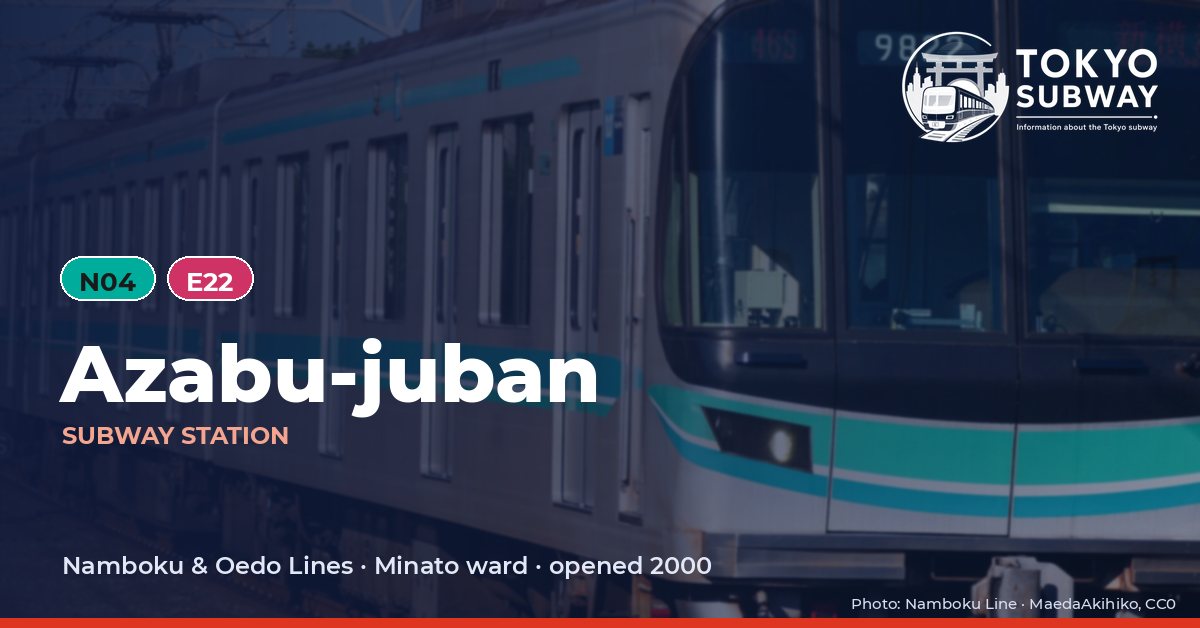
N04 E22 · Namboku Line and Oedo Line · Minato
Azabu-juban Station (麻布十番)
Both halves of Azabu-juban arrived in 2000: the Namboku Line platforms, N04, on 26 September with the completion of the line, and Toei’s Oedo Line platforms, E22, on 12 December. The Tokyo Metro side was to have been called simply Azabu while it was being built. The two stations are joined by an underground passage but keep separate ticket gates, so changing between them means passing out through one set of gates and in through another – worth knowing before you plan a tight connection.
Depth is the other thing to allow for. Namboku Line gates are on the first basement level with the platform on the third; the Oedo Line’s gates are on the fourth basement level and its platform on the sixth. The Namboku concourse was given an architectural treatment rare on the network: a vaulted ceiling eight metres high, meant to suggest an arched bridge, with murals of hemp cloth and a weaving loom that play on the origin of the name Azabu, and a relief donated by the Australian Embassy along the passage toward exits 1 and 2. In October 2004 a typhoon drove enough water underground to flood the Namboku Line track here.
Finding Azabu-juban on the signs
Every line gives the station its own letter-and-number code. You never have to read the Japanese name to find the right platform.
Station numbers at Azabu-juban
Tokyo signposts every platform, exit and train door with a letter and a two-digit number. Matching the number is faster than reading the name — and it is what you will see on the map, in announcements and on the platform edge.
First and last trains at Azabu-juban
| Line and direction | Weekdays first – last | Saturdays, Sundays & holidays first – last |
|---|---|---|
| NNambokuN04 towards Akabane-iwabuchi | 05:09 – 00:06 | 05:09 – 00:06 to Komagome |
| NNambokuN04 towards Meguro | 05:07 – 00:32 | 05:07 – 00:32 |
| EOedoE22 towards Tochomae | 05:06 – 00:34 to Tochomae | 05:06 – 00:34 to Tochomae |
| EOedoE22 towards Tochomae | 05:13 – 00:42 to Shiodome | 05:13 – 00:42 to Shiodome |
Departure times come from the operators’ own GTFS timetables (ODPT GTFS Toei-Train-GTFS (version 20261009, valid 2026-03-14..2027-03-12) + TokyoMetro-Train-GTFS (version 20261008, valid 2026-09-19..2027-03-12)). Japan publishes two subway timetables: 平日 weekdays and 土休日 Saturdays, Sundays and national holidays. There is no separate Sunday timetable, and the December 30 – January 3 period runs the holiday timetable.
How often do trains run?
Departures in one direction during the hour with the most trains at this station, counted in the operators’ timetable.
Next stations from Azabu-juban
Scheduled running time between Azabu-juban and the stations either side of it.
| Line | Next station | Running time |
|---|---|---|
| NNamboku | N05Roppongi-itchome | 2 min |
| NNamboku | N03Shirokane-takanawa | 2 min |
| EOedo | E21Akabanebashi | 1 min |
| EOedo | E23Roppongi | 2 min |
Transfers and connections
- Subway: transfer between Namboku Line and Oedo Line. The Tokyo Metro lines and the Toei Subway lines belong to different companies, so a trip that uses both costs more than one operator alone — see fares.
Accessibility
- Namboku Line: Step-free elevator route street-gate-platform (official “1-route by elevator”). Street elevator at exit(s): 1. Operator page (checked Oct 20, 2026).
- Oedo Line: Toei: step-free “1-route” secured; 3 elevator(s) on this line. Elevator exit(s): 1. Operator page (checked Oct 20, 2026).
Taken from the operators’ own accessibility pages and nothing else. Tokyo Metro: the “1-route” (step-free street-gate-platform path by elevator, slope, stair lift or wheelchair escalator) is complete at all 180 stations; a separate list shows stations with an elevator-only 1-route. Toei: every station has elevators and a street-gate-platform “1-route” is secured.
What is near Azabu-juban Station?
The Azabu-juban shopping streets sit directly above, and Zenpuku-ji, Roppongi Hills, TV Asahi and Temple University Japan are among the places the station serves. Juban Inari Shrine is about 210 m from the exits and the Kimichan statue roughly 170 m; Entokuji Temple is around 310 m, Daiho-ji Temple about 340 m, and Tokoji Temple near the 400 m edge. Ichinohashi Park lies a couple of minutes away and Mamiana Park a little further, with the Liszt Hungarian Cultural Institute about 300 m out.
| Place | Distance (straight line) | On foot, estimated |
|---|---|---|
| Juban Inari Shrine 十番稲荷神社 | 210 m | about 3 min |
| Liszt Hungarian Cultural Institute Tokyo リスト・ハンガリー文化センター東京 | 300 m | about 5 min |
| Tokoji Temple 綱生山 当光寺 | 400 m | about 6 min |
| 一の橋公園 | 120 m | about 2 min |
| 金蔵寺 | 330 m | about 5 min |
| 賢崇寺 | 330 m | about 5 min |
| 光善寺 | 390 m | about 6 min |
| Kimichan きみちゃん | 170 m | about 3 min |
Places from OpenStreetMap within 400 m of the station. The walking time is an estimate (straight line plus 30 %, 80 m a minute), not a measured route. © OpenStreetMap contributors, ODbL.