
Roppongi-itchome Station
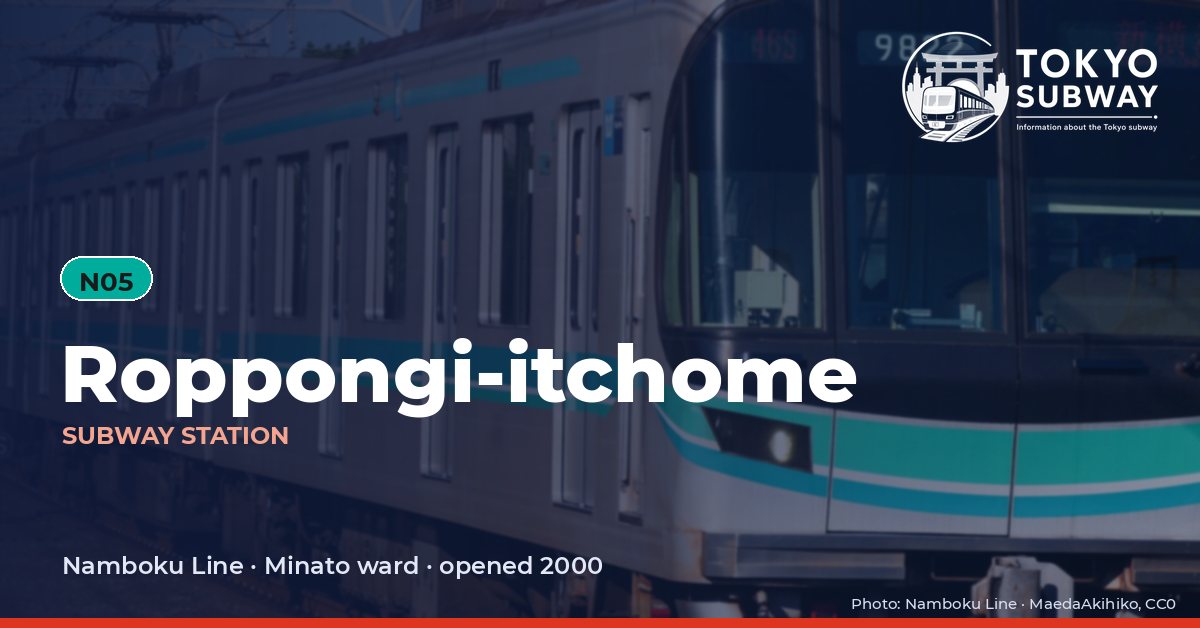
N05 · Namboku Line · Minato
Roppongi-itchome Station (六本木一丁目)
Before it opened, this station was going to be called Higashi-Roppongi — East Roppongi. The name was dropped, but the geography behind it was not: N05 stands about 800 m from Roppongi itself, close enough to be confusing on a map and far enough that no transfer corridor was ever built between the two.
The station opened on 26 September 2000, 4.8 km from the Namboku Line’s southern end at Meguro. Its ticket hall is on the second basement level and the island platform two floors below that, and the main exit leads straight into the basement of the Izumi Garden Tower rather than onto a street, which tells you what the station was built for. Trains run well past the subway in both directions, to Urawa-Misono on the Saitama Rapid Railway and to Hiyoshi on the Meguro Line. Tokyo Metro’s 2025 count was 79,259 passengers a day.
Finding Roppongi-itchome on the signs
Every line gives the station its own letter-and-number code. You never have to read the Japanese name to find the right platform.
Station numbers at Roppongi-itchome
Tokyo signposts every platform, exit and train door with a letter and a two-digit number. Matching the number is faster than reading the name — and it is what you will see on the map, in announcements and on the platform edge.
First and last trains at Roppongi-itchome
| Line and direction | Weekdays first – last | Saturdays, Sundays & holidays first – last |
|---|---|---|
| NNambokuN05 towards Akabane-iwabuchi | 05:11 – 00:08 | 05:11 – 00:08 to Komagome |
| NNambokuN05 towards Meguro | 05:05 – 00:29 | 05:05 – 00:29 |
Departure times come from the operators’ own GTFS timetables (ODPT GTFS Toei-Train-GTFS (version 20261009, valid 2026-03-14..2027-03-12) + TokyoMetro-Train-GTFS (version 20261008, valid 2026-09-19..2027-03-12)). Japan publishes two subway timetables: 平日 weekdays and 土休日 Saturdays, Sundays and national holidays. There is no separate Sunday timetable, and the December 30 – January 3 period runs the holiday timetable.
How often do trains run?
| Line | Weekdays, busiest hour | Sat / Sun / holidays, busiest hour |
|---|---|---|
| NNamboku | 17 trains/hour (about one every 3.5 min) | 12 trains/hour |
Departures in one direction during the hour with the most trains at this station, counted in the operators’ timetable.
Next stations from Roppongi-itchome
Scheduled running time between Roppongi-itchome and the stations either side of it.
| Line | Next station | Running time |
|---|---|---|
| NNamboku | N04Azabu-juban | 2 min |
| NNamboku | N06Tameike-sanno | 3 min |
Transfers and connections
Only the Namboku Line stops here, and no other railway serves this station, so there is nothing to transfer to inside the station.
Accessibility
| Line | Step-free by elevator | Accessible toilet | Escalator | Exits |
|---|---|---|---|---|
| NNamboku | Yes | Yes | Yes | 4 |
- Namboku Line: Step-free elevator route street-gate-platform (official “1-route by elevator”). Street elevator at exit(s): 1. Operator page (checked Oct 20, 2026).
Taken from the operators’ own accessibility pages and nothing else. Tokyo Metro: the “1-route” (step-free street-gate-platform path by elevator, slope, stair lift or wheelchair escalator) is complete at all 180 stations; a separate list shows stations with an elevator-only 1-route.
What is near Roppongi-itchome Station?
Offices and concert-going wrap around the exits: Izumi Garden Tower stands directly above one of them, Roppongi Grand Tower is about 110 m away, and ARK Hills with Suntory Hall lies roughly 290 to 350 m off. TV Tokyo and BS TV Tokyo have studios about 120 m from the station. For something quieter there is the Sen-Oku Hakukokan Museum at about 200 m, the Ark Garden, and a monument about 190 m away marking where the draft of the constitution was deliberated.
| Place | Distance (straight line) | On foot, estimated |
|---|---|---|
| Suntory Hall サントリーホール | 290 m | about 5 min |
| Myozoji Temple 妙像寺 | 320 m | about 5 min |
| Sen-Oku Hakukokan Museum Tokyo 泉屋博古館東京 | 200 m | about 3 min |
| Yoshida Hochiku Memorial Hall 吉田苞竹記念会館 | 300 m | about 5 min |
| Gazenbo Yokogawa Shozo Memorial Park 我善坊横川省三記念公園 | 320 m | about 5 min |
| 日本国憲法草案審議の地 | 190 m | about 3 min |
| アークガーデン | 200 m | about 3 min |
| Community Garden | 290 m | about 5 min |
Places from OpenStreetMap within 400 m of the station. The walking time is an estimate (straight line plus 30 %, 80 m a minute), not a measured route. © OpenStreetMap contributors, ODbL.
Frequently asked questions
No. Roppongi, on the Hibiya and Oedo lines, is about 800 m away, and the two are separate stations with no connecting passage between them. If you are heading for Roppongi Hills or Tokyo Midtown, Roppongi itself is the stop to use.
Higashi-Roppongi, meaning East Roppongi, served as the provisional name while the Namboku Line was under construction. Roppongi-itchome was chosen instead, after the address the platforms lie under, which also helps keep it distinct from the larger station nearby.