
Roppongi Station
H04 E23 · Hibiya Line and Oedo Line · Minato
Roppongi Station (六本木)
The deepest platform in the Tokyo subway is here: Oedo Line platform 1, on the seventh basement level, 42 m below the street. Platform 2 is two levels higher at 32 m, so the two are stacked rather than paired, and the long haul between them and daylight is what first-time users remember.
The Hibiya Line came first, opening H04 on 25 March 1964 with the stretch from Kasumigaseki to Ebisu. Its concourse and platforms were widened in work that began in 1994 and finished in 2001, in anticipation of the crowds the Oedo Line would bring when E23 opened on 12 December 2000. Since 2013 Oedo Line passengers have been allowed to cut through the Hibiya Line’s paid area rather than going round. Tokyo Metro counted 111,150 passengers a day in 2025; Toei’s 2024 figure for its own platforms was 83,043.
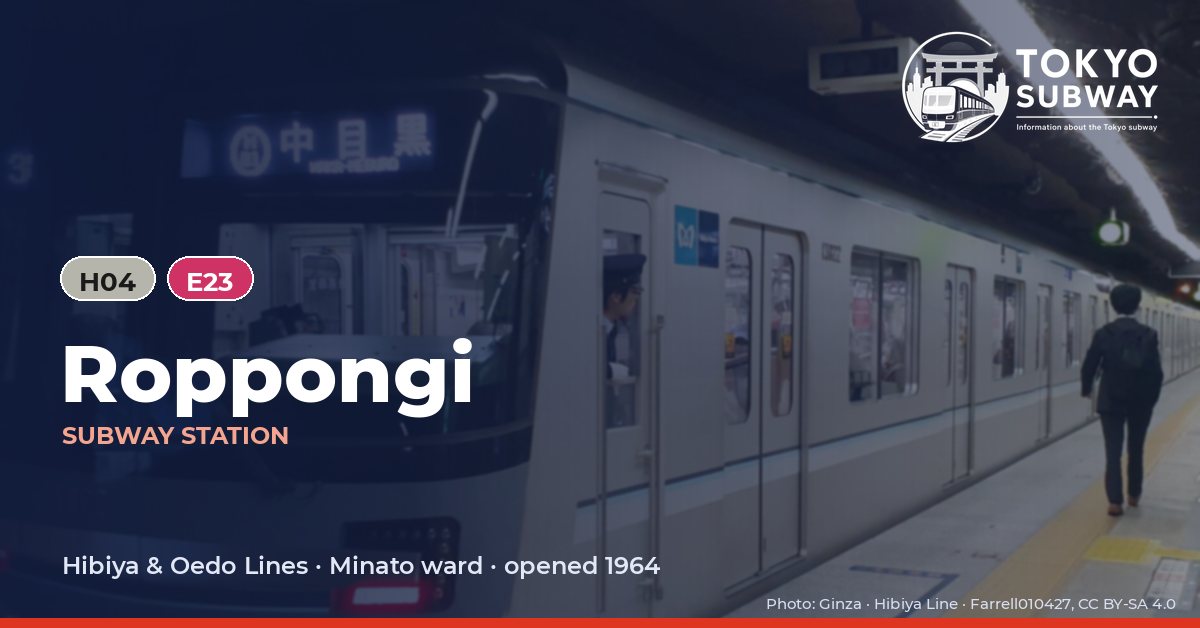
Finding Roppongi on the signs
Every line gives the station its own letter-and-number code. You never have to read the Japanese name to find the right platform.
Station numbers at Roppongi
Tokyo signposts every platform, exit and train door with a letter and a two-digit number. Matching the number is faster than reading the name — and it is what you will see on the map, in announcements and on the platform edge.
First and last trains at Roppongi
| Line and direction | Weekdays first – last | Saturdays, Sundays & holidays first – last |
|---|---|---|
| HHibiyaH04 towards Kita-senju | 05:08 – 23:55 | 05:08 – 23:55 |
| HHibiyaH04 towards Naka-meguro | 05:16 – 00:28 | 05:16 – 00:28 |
| EOedoE23 towards Tochomae | 05:08 – 00:37 to Tochomae | 05:08 – 00:37 to Tochomae |
| EOedoE23 towards Tochomae | 05:11 – 00:39 to Shiodome | 05:11 – 00:39 to Shiodome |
Departure times come from the operators’ own GTFS timetables (ODPT GTFS Toei-Train-GTFS (version 20261009, valid 2026-03-14..2027-03-12) + TokyoMetro-Train-GTFS (version 20261008, valid 2026-09-19..2027-03-12)). Japan publishes two subway timetables: 平日 weekdays and 土休日 Saturdays, Sundays and national holidays. There is no separate Sunday timetable, and the December 30 – January 3 period runs the holiday timetable.
How often do trains run?
Departures in one direction during the hour with the most trains at this station, counted in the operators’ timetable.
Next stations from Roppongi
Scheduled running time between Roppongi and the stations either side of it.
| Line | Next station | Running time |
|---|---|---|
| HHibiya | H03Hiro-o | 3 min |
| HHibiya | H05Kamiyacho | 3 min |
| EOedo | E24Aoyama-itchome | 2 min |
| EOedo | E22Azabu-juban | 2 min |
Transfers and connections
- Subway: transfer between Hibiya Line and Oedo Line. The Tokyo Metro lines and the Toei Subway lines belong to different companies, so a trip that uses both costs more than one operator alone — see fares.
Accessibility
- Hibiya Line: Step-free elevator route street-gate-platform (official “1-route by elevator”). Street elevator at exit(s): 1c, 4a. Operator page (checked Oct 20, 2026).
- Oedo Line: Toei: step-free “1-route” secured; 3 elevator(s) on this line. Elevator exit(s): 7. Operator page (checked Oct 20, 2026).
Taken from the operators’ own accessibility pages and nothing else. Tokyo Metro: the “1-route” (step-free street-gate-platform path by elevator, slope, stair lift or wheelchair escalator) is complete at all 180 stations; a separate list shows stations with an elevator-only 1-route. Toei: every station has elevators and a street-gate-platform “1-route” is secured.
What is near Roppongi Station?
Roppongi Hills begins about 400 m from the station, with the Mori Art Museum and the Tokyo City View observation floor inside it. Tokyo Midtown is a similar distance, its Suntory Museum of Art about 340 m off and the Midtown Garden about 370 m. Mohri Garden, the Fujifilm Photo History Museum and the Haiyuza theater are all closer, and the Izumo Taisha Tokyo branch shrine, roughly 250 m away, is a reminder that the district had a life before the towers.
| Place | Distance (straight line) | On foot, estimated |
|---|---|---|
| Haiyuzagekijou 俳優座劇場 | 140 m | about 2 min |
| Izumo Taisha Shrine Tokyo Branch 出雲大社 東京分祠 | 250 m | about 4 min |
| Suntory Museum of Art サントリー美術館 | 340 m | about 6 min |
| Mohri Garden 毛利庭園 | 360 m | about 6 min |
| National Graduate Institute for Policy Studies 政策研究大学院大学 | 370 m | about 6 min |
| Mori Art Museum 森美術館 | 380 m | about 6 min |
| Roppongi Hills 六本木ヒルズ | 400 m | about 6 min |
| 長耀寺 | 200 m | about 3 min |
Places from OpenStreetMap within 400 m of the station. The walking time is an estimate (straight line plus 30 %, 80 m a minute), not a measured route. © OpenStreetMap contributors, ODbL.
Frequently asked questions
By platform, yes. Oedo Line platform 1 lies 42 m below ground on the seventh basement level, the deepest platform on the network, and platform 2 is 32 m down. The Hibiya Line platforms are shallow by comparison, one level below their concourse.
No. Roppongi-itchome on the Namboku Line is about 800 m away, there is no transfer corridor, and the two are not recognized as one station. Anyone wanting the Namboku Line should plan the change at a proper interchange rather than walking between the two.