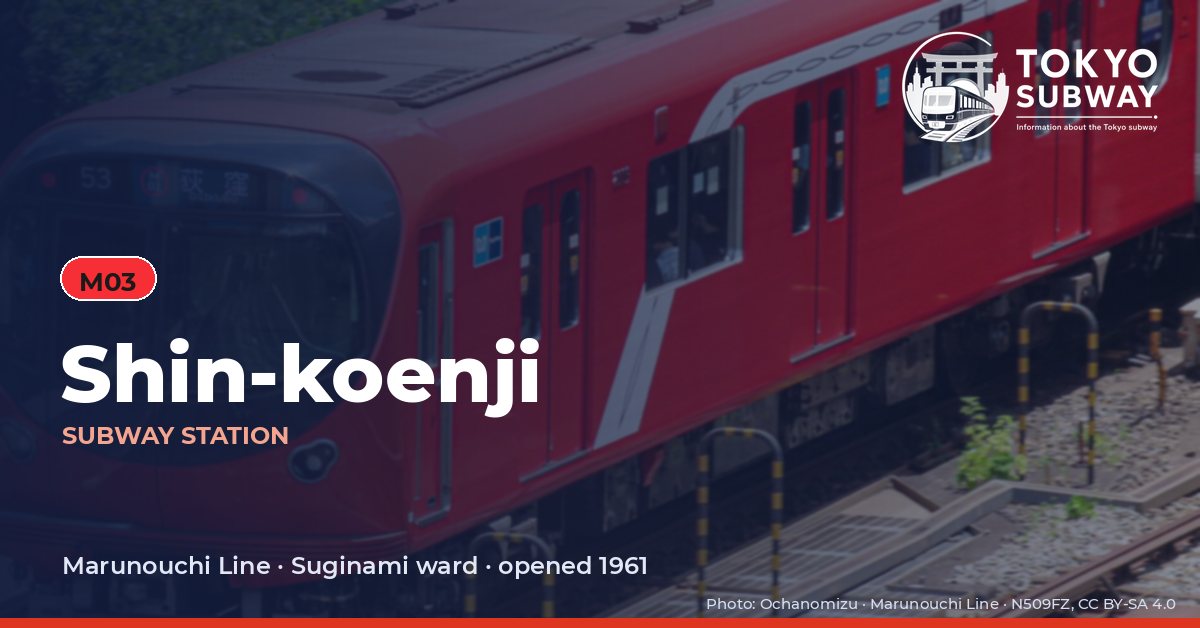
Shin-koenji Station
M03 · Marunouchi Line · Suginami
Shin-koenji Station (新高円寺)
When this station opened on 1 November 1961, the Marunouchi Line did not yet reach it under that name. The branch out to Ogikubo was then the Ogikubo Line, and only in April 1972 was it folded into the Marunouchi Line. M03 has kept the shape it was given at the start: two side platforms on the first basement level beneath Ome-kaido, each with its own ticket barriers and its own street exit, joined by a passage behind the gates.
The station lies 21.5 km from the other end of the line at Ikebukuro. A third ticket gate was added on the Ikebukuro-bound side in December 2012. Tokyo Metro’s 2025 count was 36,351 passengers a day — a modest total for a station whose exits open onto a shopping street that runs most of the way to the next railway station.
Finding Shin-koenji on the signs
Every line gives the station its own letter-and-number code. You never have to read the Japanese name to find the right platform.
Station numbers at Shin-koenji
Tokyo signposts every platform, exit and train door with a letter and a two-digit number. Matching the number is faster than reading the name — and it is what you will see on the map, in announcements and on the platform edge.
First and last trains at Shin-koenji
| Line and direction | Weekdays first – last | Saturdays, Sundays & holidays first – last |
|---|---|---|
| MMarunouchiM03 towards Ikebukuro | 05:05 – 00:16 to Nakano-sakaue | 05:05 – 00:16 to Nakano-sakaue |
| MMarunouchiM03 towards Ogikubo | 05:05 – 00:24 | 05:05 – 00:24 |
Departure times come from the operators’ own GTFS timetables (ODPT GTFS Toei-Train-GTFS (version 20261009, valid 2026-03-14..2027-03-12) + TokyoMetro-Train-GTFS (version 20261008, valid 2026-09-19..2027-03-12)). Japan publishes two subway timetables: 平日 weekdays and 土休日 Saturdays, Sundays and national holidays. There is no separate Sunday timetable, and the December 30 – January 3 period runs the holiday timetable.
How often do trains run?
| Line | Weekdays, busiest hour | Sat / Sun / holidays, busiest hour |
|---|---|---|
| MMarunouchi | 18 trains/hour (about one every 3.3 min) | 12 trains/hour |
Departures in one direction during the hour with the most trains at this station, counted in the operators’ timetable.
Next stations from Shin-koenji
Scheduled running time between Shin-koenji and the stations either side of it.
| Line | Next station | Running time |
|---|---|---|
| MMarunouchi | M04Higashi-koenji | 2 min |
| MMarunouchi | M02Minami-asagaya | 2 min |
Transfers and connections
Only the Marunouchi Line stops here, and no other railway serves this station, so there is nothing to transfer to inside the station.
Accessibility
| Line | Step-free by elevator | Accessible toilet | Escalator | Exits |
|---|---|---|---|---|
| MMarunouchi | Yes | Yes | Not listed | 2 |
- Marunouchi Line: Step-free elevator route street-gate-platform (official “1-route by elevator”). Operator page (checked Oct 20, 2026).
Taken from the operators’ own accessibility pages and nothing else. Tokyo Metro: the “1-route” (step-free street-gate-platform path by elevator, slope, stair lift or wheelchair escalator) is complete at all 180 stations; a separate list shows stations with an elevator-only 1-route.
What is near Shin-koenji Station?
The two exits stand on either side of Ome-kaido, the road that runs from Shinjuku out to the western suburbs. Beside one of them the Look shopping street begins, a pedestrian strip known for second-hand clothing and record shops that carries on most of the way to Koenji Station. Temples are scattered through the blocks on the north side, among them Koenji itself, which gave the district its name, and Daihoji about 150 m from the exits. An art college and a crematorium are also close.
| Place | Distance (straight line) | On foot, estimated |
|---|---|---|
| 大法寺 | 150 m | about 2 min |
| 心月院 | 230 m | about 4 min |
| 華徳院 | 260 m | about 4 min |
| 片岡山 智光院 | 270 m | about 4 min |
| 清徳寺 | 290 m | about 5 min |
| 西照寺 | 310 m | about 5 min |
| 清見寺 | 330 m | about 5 min |
| 松應寺 | 330 m | about 5 min |
Places from OpenStreetMap within 400 m of the station. The walking time is an estimate (straight line plus 30 %, 80 m a minute), not a measured route. © OpenStreetMap contributors, ODbL.
Frequently asked questions
Because that is what it was. The stretch from Nakano-sakaue out to Ogikubo opened as the Ogikubo Line, and Shin-koenji was one of its stations from 1 November 1961. The Marunouchi Line name was applied to the whole route on 1 April 1972.
They are different stations on different railways: Koenji is on the JR Chuo-Sobu Line and has no subway platforms. The Look and Pal shopping streets run between the two, so the walk is a continuous arcade rather than a detour, and the temple that gave both places their name stands on the north side of Shin-koenji.