Ogikubo Station
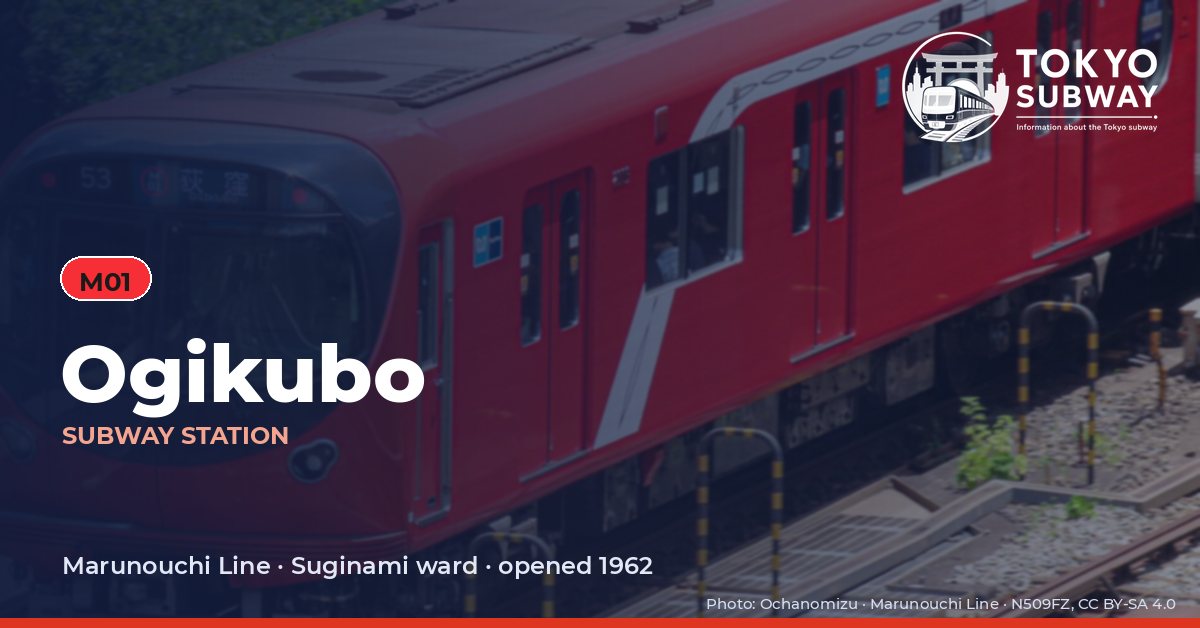
M01 · Marunouchi Line · Suginami
Ogikubo Station (荻窪)
The Marunouchi Line stops dead at Ogikubo: M01 is the first number on the line and the end of the 24.2 km run from Ikebukuro. Subway trains arrived on 23 January 1962, seventy years after the railway itself — JR East’s predecessor opened the surface station on 21 December 1891 — and the Metro platforms were tucked in below ground, parallel to the JR tracks and slightly to their south.
Above them, JR East runs Chuo Line rapid services and Chuo-Sobu locals from two island platforms and four tracks, 18.7 km out from Tokyo Station. Entrances are grouped as North and South at one end of the complex and West at the other, which is worth knowing, because the two ends are a long way apart. Tokyo Metro counted 88,136 entries and exits a day in 2025, a respectable figure for a suburban terminus that many visitors see only as the point where the red line runs out.
Finding Ogikubo on the signs
Every line gives the station its own letter-and-number code. You never have to read the Japanese name to find the right platform.
Station numbers at Ogikubo
Tokyo signposts every platform, exit and train door with a letter and a two-digit number. Matching the number is faster than reading the name — and it is what you will see on the map, in announcements and on the platform edge.
First and last trains at Ogikubo
| Line and direction | Weekdays first – last | Saturdays, Sundays & holidays first – last |
|---|---|---|
| MMarunouchiM01 towards Ikebukuro | 05:01 – 00:11 to Nakano-sakaue | 05:01 – 00:11 to Nakano-sakaue |
Departure times come from the operators’ own GTFS timetables (ODPT GTFS Toei-Train-GTFS (version 20261009, valid 2026-03-14..2027-03-12) + TokyoMetro-Train-GTFS (version 20261008, valid 2026-09-19..2027-03-12)). Japan publishes two subway timetables: 平日 weekdays and 土休日 Saturdays, Sundays and national holidays. There is no separate Sunday timetable, and the December 30 – January 3 period runs the holiday timetable.
How often do trains run?
| Line | Weekdays, busiest hour | Sat / Sun / holidays, busiest hour |
|---|---|---|
| MMarunouchi | 18 trains/hour (about one every 3.3 min) | 11 trains/hour |
Departures in one direction during the hour with the most trains at this station, counted in the operators’ timetable.
Next stations from Ogikubo
Scheduled running time between Ogikubo and the stations either side of it.
| Line | Next station | Running time |
|---|---|---|
| MMarunouchi | M02Minami-asagaya | 2 min |
Transfers and connections
- JR: Chuo Rapid Line (JR East), Chuo-Sobu Local Line (JR East). These are separate railways with their own fares.
Accessibility
| Line | Step-free by elevator | Accessible toilet | Escalator | Exits |
|---|---|---|---|---|
| MMarunouchi | Yes | Yes | Yes | 4 |
- Marunouchi Line: Step-free elevator route street-gate-platform (official “1-route by elevator”). Street elevator at exit(s): 南口b, 西口. Operator page (checked Oct 20, 2026).
Taken from the operators’ own accessibility pages and nothing else. Tokyo Metro: the “1-route” (step-free street-gate-platform path by elevator, slope, stair lift or wheelchair escalator) is complete at all 180 stations; a separate list shows stations with an elevator-only 1-route.
What is near Ogikubo Station?
Both halves of the station feed straight into shopping: LUMINE Ogikubo is barely 60 m from the exits and Ogikubo Town Seven about 100 m, with an Aoyama Flower Market, bank branches and fast-food counters filling the ground floors in between. The Suginami Ward Office and the Ogikubo tax office are among the civic buildings the station serves, along with Otaguro Park. Ogikubo High School is about 240 m off, and the streets beyond turn quickly to housing.
| Place | Distance (straight line) | On foot, estimated |
|---|---|---|
| Ogikubo Town Seven 荻窪タウンセブン | 100 m | about 2 min |
| 荻窪白山神社 | 360 m | about 6 min |
| LUMINE Ogikubo ルミネ荻窪店 | 60 m | about 1 min |
| KARAS APPARATUS カラス アパラタス | 290 m | about 5 min |
| たもん | 180 m | about 3 min |
| gallery 遊美 | 320 m | about 5 min |
| だるま座 | 320 m | about 5 min |
| Mitsui Fudosan Really 三井のリハウス | 20 m | about 1 min |
Places from OpenStreetMap within 400 m of the station. The walking time is an estimate (straight line plus 30 %, 80 m a minute), not a measured route. © OpenStreetMap contributors, ODbL.
Frequently asked questions
Marunouchi Line station numbers begin at this end of the line and climb towards Ikebukuro, 24.2 km away. Ogikubo is the western terminus, so it takes the first number. Nothing continues beyond it: trains reverse here, and the Chuo Line is the way onward for anyone travelling further out.
They share a name and a site but not a company. JR East runs the surface platforms, Tokyo Metro the subway platforms beneath them. The railway came first, in 1891; the Marunouchi Line followed in 1962 and its tunnel was built parallel to the JR tracks, slightly to the south of them.