
Todaimae Station
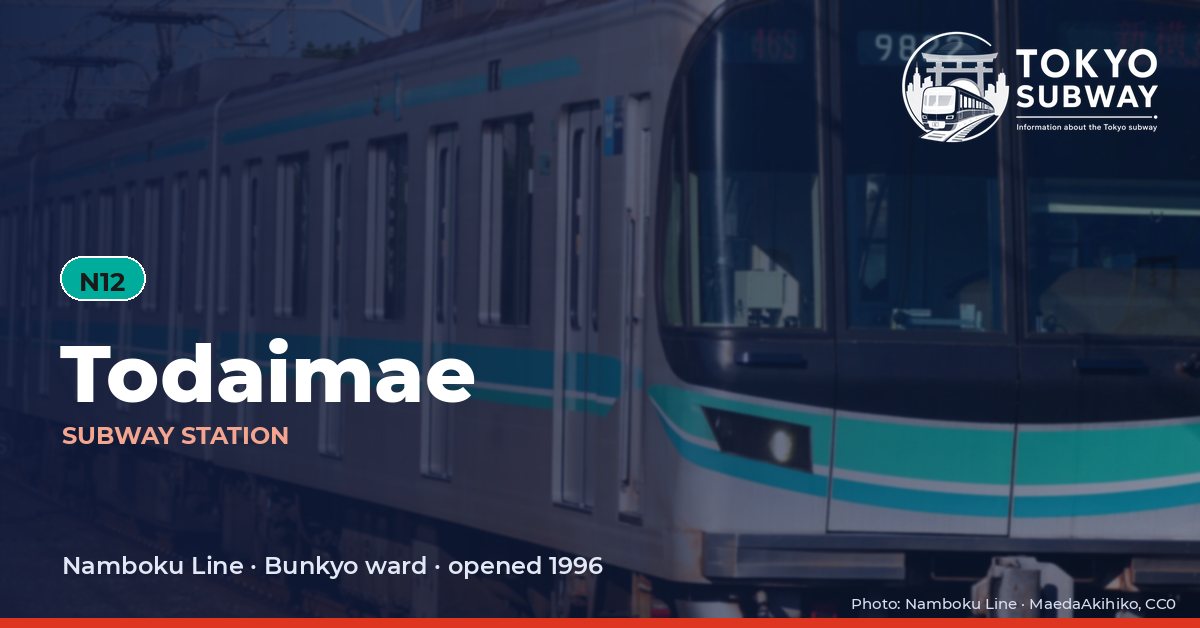
N12 · Namboku Line · Bunkyo
Todaimae Station (東大前)
A station on this spot was on paper long before anyone dug for it: it appears in a 1946 reconstruction notice for what was then Line 1. N12 finally opened on 26 March 1996 with the first section of the Namboku Line through Bunkyo. For a two-track station the box was a substantial piece of cut-and-cover, 274 m long, up to 17 m wide and up to 29 m deep, with the ticket hall at B1 and the island platform at B3 behind full-height screen doors.
The entrances say most about the place. Exit 1 opens inside the University of Tokyo’s Yayoi campus, on land belonging to the agriculture faculty; exit 2 stands beside the main gate of Bunkyo Gakuin University; and the elevator entrance in the middle of the station uses a plot handed over free of charge by Bunkyo City, the site of its sixth junior high school. The station had the standard Namboku Line departure tune until 13 March 2015, when it was given two of its own. In 2025 Todaimae was used by 28,284 people on an average day.
Finding Todaimae on the signs
Every line gives the station its own letter-and-number code. You never have to read the Japanese name to find the right platform.
Station numbers at Todaimae
Tokyo signposts every platform, exit and train door with a letter and a two-digit number. Matching the number is faster than reading the name — and it is what you will see on the map, in announcements and on the platform edge.
First and last trains at Todaimae
| Line and direction | Weekdays first – last | Saturdays, Sundays & holidays first – last |
|---|---|---|
| NNambokuN12 towards Akabane-iwabuchi | 05:10 – 00:23 | 05:10 – 00:23 to Komagome |
| NNambokuN12 towards Meguro | 05:04 to Shirokane-takanawa – 00:28 to Ichigaya | 05:04 to Shirokane-takanawa – 00:14 |
Departure times come from the operators’ own GTFS timetables (ODPT GTFS Toei-Train-GTFS (version 20261009, valid 2026-03-14..2027-03-12) + TokyoMetro-Train-GTFS (version 20261008, valid 2026-09-19..2027-03-12)). Japan publishes two subway timetables: 平日 weekdays and 土休日 Saturdays, Sundays and national holidays. There is no separate Sunday timetable, and the December 30 – January 3 period runs the holiday timetable.
How often do trains run?
| Line | Weekdays, busiest hour | Sat / Sun / holidays, busiest hour |
|---|---|---|
| NNamboku | 17 trains/hour (about one every 3.5 min) | 12 trains/hour |
Departures in one direction during the hour with the most trains at this station, counted in the operators’ timetable.
Next stations from Todaimae
Scheduled running time between Todaimae and the stations either side of it.
| Line | Next station | Running time |
|---|---|---|
| NNamboku | N13Hon-komagome | 2 min |
| NNamboku | N11Korakuen | 3 min |
Transfers and connections
Only the Namboku Line stops here, and no other railway serves this station, so there is nothing to transfer to inside the station.
Accessibility
| Line | Step-free by elevator | Accessible toilet | Escalator | Exits |
|---|---|---|---|---|
| NNamboku | Yes | Yes | Yes | 2 |
- Namboku Line: Step-free elevator route street-gate-platform (official “1-route by elevator”). Operator page (checked Oct 20, 2026).
Taken from the operators’ own accessibility pages and nothing else. Tokyo Metro: the “1-route” (step-free street-gate-platform path by elevator, slope, stair lift or wheelchair escalator) is complete at all 180 stations; a separate list shows stations with an elevator-only 1-route.
What is near Todaimae Station?
Todaimae is the station for the Yayoi side of the University of Tokyo: the campus gate is at exit 1, the Faculty of Agriculture about 300 m away and the University of Tokyo Agricultural Science Museum about 230 m. Bunkyo Gakuin University is about 60 m from the exits and the Nippon Medical School’s Sendagi campus a little further. Nezu Shrine and its azalea garden are about 340 m off, and temples line the streets between: Gangyo-ji about 90 m, Saikyo-ji about 140 m, Saizenji and Shogyoji within a few minutes.
| Place | Distance (straight line) | On foot, estimated |
|---|---|---|
| Gangyo-ji 願行寺 | 90 m | about 1 min |
| Saikyo-ji 西教寺 | 140 m | about 2 min |
| Saizenji Temple 西善寺 | 210 m | about 3 min |
| Shogyoji Temple 正行寺 | 260 m | about 4 min |
| Nezu Shrine 根津神社 | 340 m | about 5 min |
| Joshinji Temple 浄心寺 | 380 m | about 6 min |
| Faculty of Business Administration (Bunkyo Gakuin University) 文京学院大学(経営学部) | 60 m | about 1 min |
| Komyoji Temple 浩妙寺 | 220 m | about 4 min |
Places from OpenStreetMap within 400 m of the station. The walking time is an estimate (straight line plus 30 %, 80 m a minute), not a measured route. © OpenStreetMap contributors, ODbL.
Frequently asked questions
No. The Akamon stands on the Hongo campus to the south, and Hongo-sanchome is the station for it. Todaimae serves the Yayoi campus, where the agriculture faculty is, and exit 1 opens inside the campus grounds.
Half a century. A station called Todaimae was listed in a government reconstruction notice of 7 December 1946 for the line that was then numbered 1. The Namboku Line that eventually served the site did not reach it until 26 March 1996.