
Myogadani Station
M23 · Marunouchi Line · Bunkyo
Myogadani Station (茗荷谷)
Myogadani opened with the Marunouchi Line itself, on 20 January 1954, when the first section ran from Ikebukuro to Ochanomizu, which puts M23 in the postwar subway’s first generation. It is also barely underground: the line runs through a cutting in the Koishikawa valley, so the two side platforms on the first basement level are open to the sky and the station entrance stands at street level.
What fills those platforms is not the neighborhood. Koishikawa is mainly residential and the station is seldom busy outside the rush, yet Tokyo Metro counted 79,948 entries and exits a day in its 2025 survey — the result of sitting two stops from Ikebukuro with several universities within walking distance. The streets off Kasuga-dori, the avenue the station stands on, hold an unusual number of parks and green belts for so central a district, and the small printing workshops south of the botanical garden are the other local trade. Korakuen and Shin-otsuka are the neighboring stations.
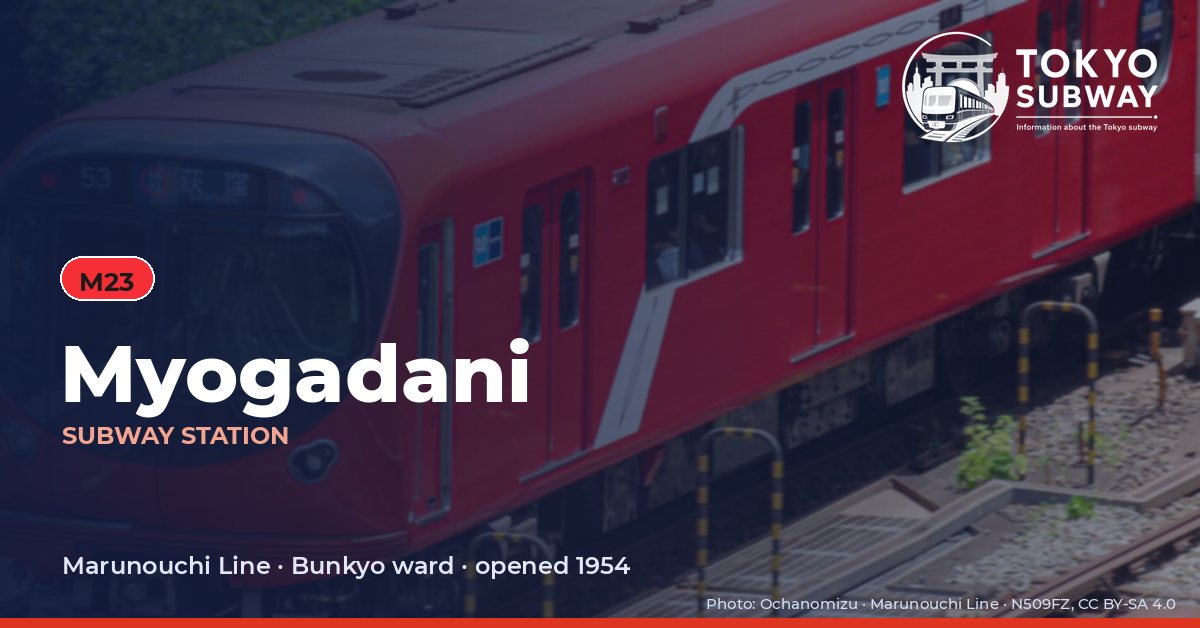
Finding Myogadani on the signs
Every line gives the station its own letter-and-number code. You never have to read the Japanese name to find the right platform.
Station numbers at Myogadani
Tokyo signposts every platform, exit and train door with a letter and a two-digit number. Matching the number is faster than reading the name — and it is what you will see on the map, in announcements and on the platform edge.
First and last trains at Myogadani
| Line and direction | Weekdays first – last | Saturdays, Sundays & holidays first – last |
|---|---|---|
| MMarunouchiM23 towards Ikebukuro | 05:00 – 00:25 | 05:00 – 00:25 |
| MMarunouchiM23 towards Ogikubo | 05:05 – 23:59 to Shinjuku | 05:05 – 23:59 to Shinjuku |
Departure times come from the operators’ own GTFS timetables (ODPT GTFS Toei-Train-GTFS (version 20261009, valid 2026-03-14..2027-03-12) + TokyoMetro-Train-GTFS (version 20261008, valid 2026-09-19..2027-03-12)). Japan publishes two subway timetables: 平日 weekdays and 土休日 Saturdays, Sundays and national holidays. There is no separate Sunday timetable, and the December 30 – January 3 period runs the holiday timetable.
How often do trains run?
| Line | Weekdays, busiest hour | Sat / Sun / holidays, busiest hour |
|---|---|---|
| MMarunouchi | 27 trains/hour (about one every 2.2 min) | 15 trains/hour |
Departures in one direction during the hour with the most trains at this station, counted in the operators’ timetable.
Next stations from Myogadani
Scheduled running time between Myogadani and the stations either side of it.
| Line | Next station | Running time |
|---|---|---|
| MMarunouchi | M22Korakuen | 3 min |
| MMarunouchi | M24Shin-otsuka | 2 min |
Transfers and connections
Only the Marunouchi Line stops here, and no other railway serves this station, so there is nothing to transfer to inside the station.
Accessibility
| Line | Step-free by elevator | Accessible toilet | Escalator | Exits |
|---|---|---|---|---|
| MMarunouchi | Yes | Yes | Yes | 3 |
- Marunouchi Line: Step-free elevator route street-gate-platform (official “1-route by elevator”). Operator page (checked Oct 20, 2026).
Taken from the operators’ own accessibility pages and nothing else. Tokyo Metro: the “1-route” (step-free street-gate-platform path by elevator, slope, stair lift or wheelchair escalator) is complete at all 180 stations; a separate list shows stations with an elevator-only 1-route.
What is near Myogadani Station?
This is a campus station. Chuo University’s Myogadani campus is about 140 m from the exits, Takushoku University’s Bunkyo campus roughly 210 m and the University of Tsukuba’s Tokyo campus some 300 m, with Ochanomizu University and Atomi University’s Bunkyo campus also served from here. Rinsenji stands about 110 m away and Shinkoji around 160 m; Kyouiku no Mori Park is roughly 300 m out and Senshuen Garden about 370 m, and the Koishikawa Botanical Garden is the other green space people walk to.
| Place | Distance (straight line) | On foot, estimated |
|---|---|---|
| Rinsenji 林泉寺 | 110 m | about 2 min |
| Chuo University Myogadani Campus 中央大学 茗荷谷キャンパス | 140 m | about 2 min |
| Shinkoji Temple 深光寺 | 160 m | about 3 min |
| Takushoku University Bunkyo Campus 拓殖大学 文京キャンパス | 210 m | about 3 min |
| Toku-unji Temple 徳雲寺 | 230 m | about 4 min |
| University of Tsukuba Tokyo Campus 筑波大学 東京キャンパス | 300 m | about 5 min |
| Senshuen Garden 占春園 | 370 m | about 6 min |
| 正信寺 | 280 m | about 5 min |
Places from OpenStreetMap within 400 m of the station. The walking time is an estimate (straight line plus 30 %, 80 m a minute), not a measured route. © OpenStreetMap contributors, ODbL.
Frequently asked questions
The Marunouchi Line surfaces into a cutting here. The two side platforms are a level below the street but not enclosed, so trains arrive in daylight; the station building itself stands at ground level above them.
Several: the Chuo University Myogadani campus about 140 m away, Takushoku University’s Bunkyo campus some 210 m, the University of Tsukuba’s Tokyo campus around 300 m, and Ochanomizu University and Atomi University’s Bunkyo campus close by. The student traffic is why the gates are busy at the start and end of the teaching day.