
Tsukiji Station
H11 · Hibiya Line · Chuo
Tsukiji Station (築地)
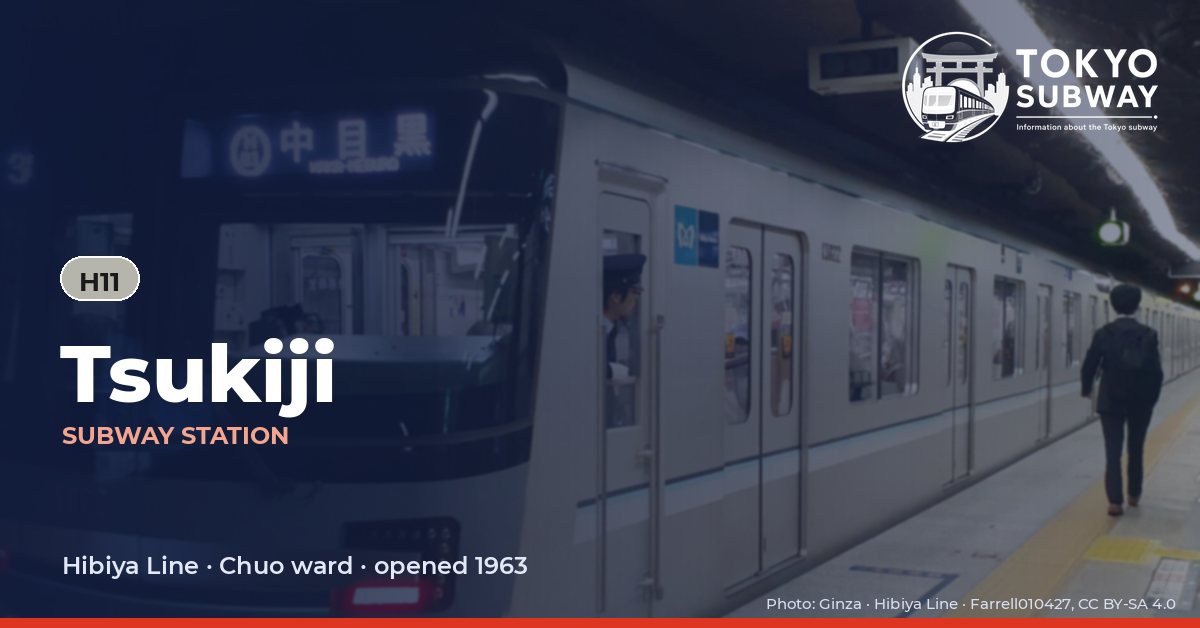
H11 opened on 28 February 1963, 10.7 km out from the Hibiya Line’s northern end at Kita-senju, and it has one of the plainest layouts on this part of the line: two side platforms, one track each, platform 1 for trains towards Ginza and platform 2 for trains towards Ueno. The entrances come in two pairs, 1 and 2 at one end of the station and 3 and 4 at the other, each pair facing the other across the road above.
Two neighbours complicate the picture. Shintomicho on the Yurakucho Line is about 310 m away and the operators count a change there as a single transfer with Tsukiji, although the two keep their own names and their own gates. Tsukijishijo, on the Oedo Line, carries the other half of the district’s name and is a different station again. Hibiya Line trains run off the subway onto Tobu tracks beyond Kita-senju, so destinations well outside Tokyo appear on the boards here. In 2025 Tsukiji was used by 59,809 people on an average day.
Finding Tsukiji on the signs
Every line gives the station its own letter-and-number code. You never have to read the Japanese name to find the right platform.
Station numbers at Tsukiji
Tokyo signposts every platform, exit and train door with a letter and a two-digit number. Matching the number is faster than reading the name — and it is what you will see on the map, in announcements and on the platform edge.
First and last trains at Tsukiji
| Line and direction | Weekdays first – last | Saturdays, Sundays & holidays first – last |
|---|---|---|
| HHibiyaH11 towards Kita-senju | 05:07 – 00:09 | 05:08 – 00:09 |
| HHibiyaH11 towards Naka-meguro | 05:02 – 00:14 | 05:02 – 00:14 |
Departure times come from the operators’ own GTFS timetables (ODPT GTFS Toei-Train-GTFS (version 20261009, valid 2026-03-14..2027-03-12) + TokyoMetro-Train-GTFS (version 20261008, valid 2026-09-19..2027-03-12)). Japan publishes two subway timetables: 平日 weekdays and 土休日 Saturdays, Sundays and national holidays. There is no separate Sunday timetable, and the December 30 – January 3 period runs the holiday timetable.
How often do trains run?
| Line | Weekdays, busiest hour | Sat / Sun / holidays, busiest hour |
|---|---|---|
| HHibiya | 26 trains/hour (about one every 2.3 min) | 13 trains/hour |
Departures in one direction during the hour with the most trains at this station, counted in the operators’ timetable.
Next stations from Tsukiji
Scheduled running time between Tsukiji and the stations either side of it.
| Line | Next station | Running time |
|---|---|---|
| HHibiya | H12Hatchobori | 2 min |
| HHibiya | H10Higashi-ginza | 2 min |
Transfers and connections
- Walking transfer: Shintomicho (Yurakucho Line), an official transfer between two separately named stations, about 5 minutes on foot — our estimate from the distance, not an operator figure.
Accessibility
| Line | Step-free by elevator | Accessible toilet | Escalator | Exits |
|---|---|---|---|---|
| HHibiya | Yes | Yes | Not listed | 5 |
- Hibiya Line: Step-free elevator route street-gate-platform (official “1-route by elevator”). Street elevator at exit(s): 1, 2, 3b. Operator page (checked Oct 20, 2026).
Taken from the operators’ own accessibility pages and nothing else. Tokyo Metro: the “1-route” (step-free street-gate-platform path by elevator, slope, stair lift or wheelchair escalator) is complete at all 180 stations; a separate list shows stations with an elevator-only 1-route.
What is near Tsukiji Station?
Tsukiji is the station people use for the market streets and the temple. Tsukiji Hongan-ji stands about 140 m from the exits and draws Buddhist visitors from far beyond Japan; the Tsukiji Outer Market is about 320 m away and the Tsukiji Nippon Fish Port Market about 400 m. Chuo City Hall is about 300 m off, Tsukiji Police Station about 270 m, and a line of small parks — Tsukijigawa park, Tsukijigawa Iwaibashi Park, Akatsuki Park — runs through the blocks between.
| Place | Distance (straight line) | On foot, estimated |
|---|---|---|
| Tsukiji Honganji Temple 築地本願寺 | 140 m | about 2 min |
| Hoju Inari Jinja 宝珠 稲荷神社 | 370 m | about 6 min |
| 聖路加国際大学 | 270 m | about 4 min |
| Tsukijigawa park 築地川公園 | 180 m | about 3 min |
| Tsukijigawa Iwaibashi Park Meta | 290 m | about 5 min |
| Tsukijigawa Kameibashi Park 築地川亀井橋公園 | 310 m | about 5 min |
| Tsukiji River Ginza Park 築地川銀座公園 | 340 m | about 5 min |
| Akatsuki Park あかつき公園 | 350 m | about 6 min |
Places from OpenStreetMap within 400 m of the station. The walking time is an estimate (straight line plus 30 %, 80 m a minute), not a measured route. © OpenStreetMap contributors, ODbL.
Frequently asked questions
Yes, in the way the operators record it: the two are about 310 m apart and a change between them counts as a single transfer to the Yurakucho Line. They are separate stations with separate names and separate ticket halls, so you make the change at street level and the signs, not the map, are what to follow.
They serve two parts of the same district on two different lines. Tsukiji, on the Hibiya Line, opened in 1963 and sits by the temple; Tsukijishijo, on the Toei Oedo Line, took the name of the market instead. They are run by different companies and are not treated as a transfer.