Shintomicho Station
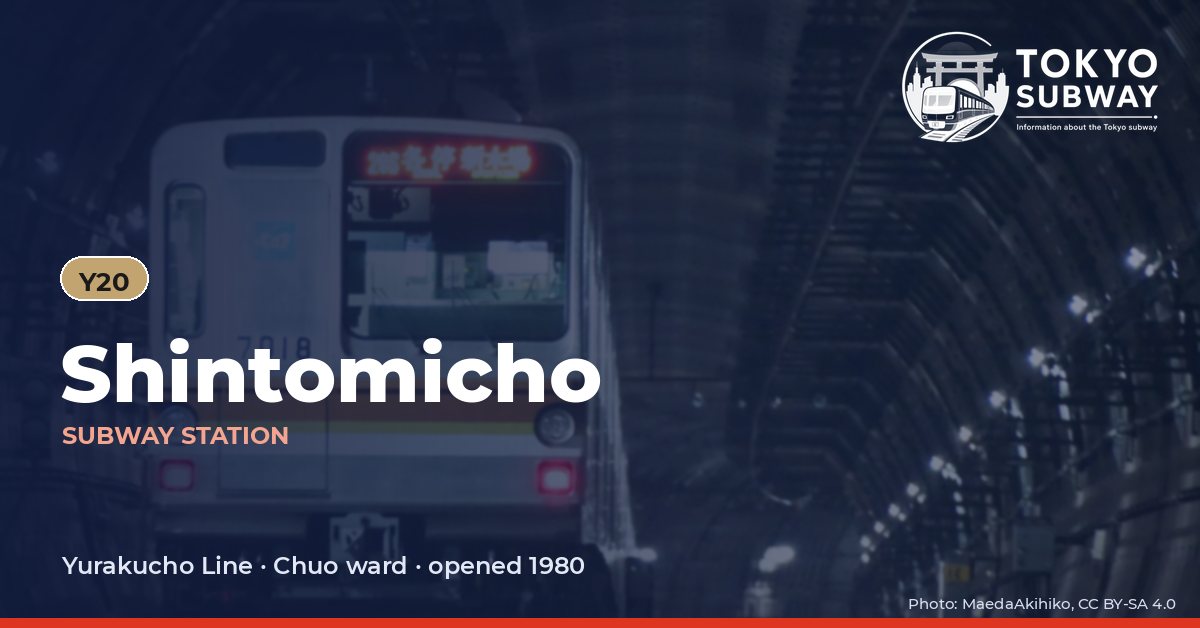
Y20 · Yurakucho Line · Chuo
Shintomicho Station (新富町)
For eight years Shintomicho was where the Yurakucho Line stopped. It opened on 27 March 1980 as the terminus of the extension from Ginza-itchome, and became a through station on 8 June 1988 when the line reached Shin-kiba; the crossover it had used for turning trains back was then removed. The name was nearly Akashicho, and changed after requests from the neighborhood.
Its two side platforms — a rarity on this line, shared only with Hikawadai — curve slightly and, unusually, carry no row of columns between the tracks. The running tunnels either side were bored as one twin-track shield, and adding pillars at the station would have meant enlarging that shield, so the engineers left them out. The clear view that resulted has made Y20 a favourite with railway photographers, and Tokyo Metro ran a photo session here after the last train in 2025. A flood door that can seal the tunnel is fitted on the Tsukishima side. Tokyo Metro counted 37,006 passengers a day in 2025.
Finding Shintomicho on the signs
Every line gives the station its own letter-and-number code. You never have to read the Japanese name to find the right platform.
Station numbers at Shintomicho
Tokyo signposts every platform, exit and train door with a letter and a two-digit number. Matching the number is faster than reading the name — and it is what you will see on the map, in announcements and on the platform edge.
First and last trains at Shintomicho
| Line and direction | Weekdays first – last | Saturdays, Sundays & holidays first – last |
|---|---|---|
| YYurakuchoY20 towards Shin-kiba | 05:05 – 00:22 | 05:05 – 00:22 |
| YYurakuchoY20 towards Wakoshi | 05:09 – 00:10 to Ikebukuro | 05:09 – 00:10 to Ikebukuro |
Departure times come from the operators’ own GTFS timetables (ODPT GTFS Toei-Train-GTFS (version 20261009, valid 2026-03-14..2027-03-12) + TokyoMetro-Train-GTFS (version 20261008, valid 2026-09-19..2027-03-12)). Japan publishes two subway timetables: 平日 weekdays and 土休日 Saturdays, Sundays and national holidays. There is no separate Sunday timetable, and the December 30 – January 3 period runs the holiday timetable.
How often do trains run?
| Line | Weekdays, busiest hour | Sat / Sun / holidays, busiest hour |
|---|---|---|
| YYurakucho | 22 trains/hour (about one every 2.7 min) | 12 trains/hour |
Departures in one direction during the hour with the most trains at this station, counted in the operators’ timetable.
Next stations from Shintomicho
Scheduled running time between Shintomicho and the stations either side of it.
| Line | Next station | Running time |
|---|---|---|
| YYurakucho | Y19Ginza-itchome | 2 min |
| YYurakucho | Y21Tsukishima | 2 min |
Transfers and connections
- Walking transfer: Tsukiji (Hibiya Line), an official transfer between two separately named stations, about 5 minutes on foot — our estimate from the distance, not an operator figure.
Accessibility
| Line | Step-free by elevator | Accessible toilet | Escalator | Exits |
|---|---|---|---|---|
| YYurakucho | Yes | Yes | Yes | 7 |
- Yurakucho Line: Step-free elevator route street-gate-platform (official “1-route by elevator”). Street elevator at exit(s): 1. Operator page (checked Oct 20, 2026).
Taken from the operators’ own accessibility pages and nothing else. Tokyo Metro: the “1-route” (step-free street-gate-platform path by elevator, slope, stair lift or wheelchair escalator) is complete at all 180 stations; a separate list shows stations with an elevator-only 1-route.
What is near Shintomicho Station?
The station stands on the boundary between Tsukiji and Shintomi. Chuo City Hall is about 150 m from an exit and the Tsukiji police station about 200 m, with St. Luke’s International University roughly 340 m away and its hospital among the places the station serves, as are Tsukiji Hongan-ji and the old Tsukiji market site. Small parks named after the Tsukiji River follow its former course nearby, and the Chuo ward local history museum is about 380 m off.
| Place | Distance (straight line) | On foot, estimated |
|---|---|---|
| Hoju Inari Jinja 宝珠 稲荷神社 | 380 m | about 6 min |
| 聖路加国際大学 | 340 m | about 6 min |
| Tsukijigawa Kameibashi Park 築地川亀井橋公園 | 240 m | about 4 min |
| Kyobashi Park 京橋公園 | 330 m | about 5 min |
| Gallery Mai ギャラリー 舞 | 340 m | about 5 min |
| Tsukijigawa Iwaibashi Park Meta | 350 m | about 6 min |
| Tsukijigawa park 築地川公園 | 350 m | about 6 min |
| Chuo Ward Local History Museum 中央区立郷土資料館 | 380 m | about 6 min |
Places from OpenStreetMap within 400 m of the station. The walking time is an estimate (straight line plus 30 %, 80 m a minute), not a measured route. © OpenStreetMap contributors, ODbL.
Frequently asked questions
Yes. Tsukiji on the Hibiya Line and Shintomicho have been paired as a transfer since 17 March 2018, so the two names cover one interchange even though their entrances are on different streets. Tsukiji Hongan-ji and the old market site are among the places the station serves.
The tunnels on either side were driven as a single twin-track shield, and a central row of columns at the station would have required a larger and more expensive shield. Leaving them out gave Y20 an unobstructed platform, which is why railway photographers like it enough for Tokyo Metro to hold an event here.