Kita-senju Station
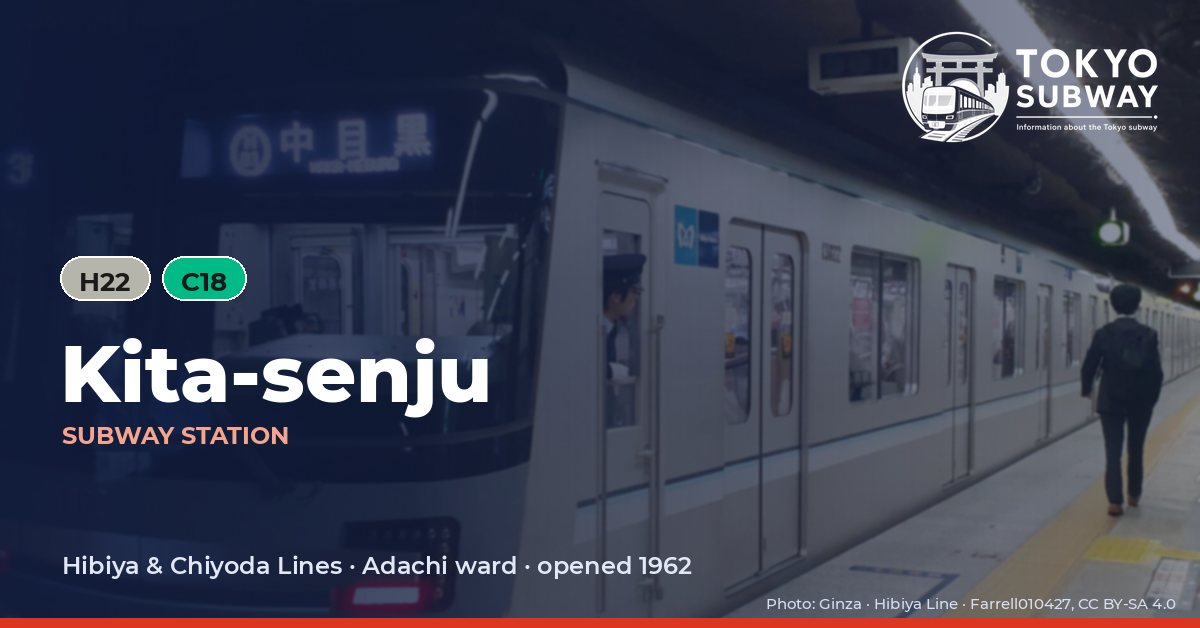
H22 C18 · Hibiya Line and Chiyoda Line · Adachi
Kita-senju Station (北千住)
Five railways meet in the Senju district of Adachi, and they arrived one at a time over more than a century. JR East’s predecessor opened its station on 25 December 1896, Tobu followed three years later, the subway came on 31 May 1962 when the Hibiya Line made Kita-senju its northern end point, H22, with Tobu trains running through from the start, and the Chiyoda Line opened its own platforms, C18, on 20 December 1969 as that line’s first northern terminus. The Tsukuba Express added elevated platforms on 24 August 2005.
The result is a station built on several levels at once: JR East at ground level, the Chiyoda Line underground, the Tobu and Hibiya platforms split between ground level and the third floor, and the Tsukuba Express above. Tokyo Metro counted 246,410 entries and exits a day here in the 2025 survey, which makes Kita-senju one of the heaviest stations on its network and the busiest that the Yamanote Line does not touch. Chiyoda Line trains continue past the subway onto JR East’s Joban tracks and onto Odakyu metals at the far end.
Finding Kita-senju on the signs
Every line gives the station its own letter-and-number code. You never have to read the Japanese name to find the right platform.
Station numbers at Kita-senju
Tokyo signposts every platform, exit and train door with a letter and a two-digit number. Matching the number is faster than reading the name — and it is what you will see on the map, in announcements and on the platform edge.
First and last trains at Kita-senju
| Line and direction | Weekdays first – last | Saturdays, Sundays & holidays first – last |
|---|---|---|
| HHibiyaH22 towards Naka-meguro | 05:00 – 00:28 to Minami-senju | 05:00 – 00:27 to Minami-senju |
| CChiyodaC18 towards Ayase | 04:54 – 00:48 | 04:54 – 00:48 |
| CChiyodaC18 towards Yoyogi-uehara | 05:03 – 00:09 | 05:03 – 00:08 to Kasumigaseki |
Departure times come from the operators’ own GTFS timetables (ODPT GTFS Toei-Train-GTFS (version 20261009, valid 2026-03-14..2027-03-12) + TokyoMetro-Train-GTFS (version 20261008, valid 2026-09-19..2027-03-12)). Japan publishes two subway timetables: 平日 weekdays and 土休日 Saturdays, Sundays and national holidays. There is no separate Sunday timetable, and the December 30 – January 3 period runs the holiday timetable.
How often do trains run?
Departures in one direction during the hour with the most trains at this station, counted in the operators’ timetable.
Transfers and connections
- Subway: transfer between Hibiya Line and Chiyoda Line.
- JR: Joban Rapid Line (JR East). These are separate railways with their own fares.
- Private railways: Tobu Skytree Line (Tobu Railway). These are separate railways with their own fares.
- Other railways: Tsukuba Express Line (Metropolitan Intercity Railway). These are separate railways with their own fares.
Accessibility
- Hibiya Line: Step-free elevator route street-gate-platform (official “1-route by elevator”). Street elevator at exit(s): 4, 5. Operator page (checked Oct 20, 2026).
Taken from the operators’ own accessibility pages and nothing else. Tokyo Metro: the “1-route” (step-free street-gate-platform path by elevator, slope, stair lift or wheelchair escalator) is complete at all 180 stations; a separate list shows stations with an elevator-only 1-route.
What is near Kita-senju Station?
Senju was a post town long before it was an interchange, and the area still works as a center in its own right rather than a commuter dormitory. Kitasenju Marui stands about 140 m from the gates and the Senju Mildix complex about 150 m; Tokyo Denki University’s Senju campus is roughly 250 m away and a campus of the Tokyo University of the Arts about 380 m, which puts a lot of students through the barriers. Shosenji temple and the Senju police station are both within about 360 m.
| Place | Distance (straight line) | On foot, estimated |
|---|---|---|
| Tokyo Denki University Senju Campus 東京電機大学 東京千住キャンパス | 250 m | about 4 min |
| Shosenji Temple 勝専寺 | 360 m | about 6 min |
| Tokyo University of the Arts 東京藝術大学 | 380 m | about 6 min |
| 金蔵寺 | 160 m | about 3 min |
| Kitasenju Marui 北千住マルイ | 140 m | about 2 min |
| 東京電機大学 東京千住アネックス | 260 m | about 4 min |
| 千住宿 高札場 | 360 m | about 6 min |
| SoftBank Shop ソフトバンクショップ | 230 m | about 4 min |
Places from OpenStreetMap within 400 m of the station. The walking time is an estimate (straight line plus 30 %, 80 m a minute), not a measured route. © OpenStreetMap contributors, ODbL.
Frequently asked questions
Because each generation of railway building found the previous one here. The JR station dates from 1896 and Tobu’s from three years later; the Hibiya Line terminated here in 1962, the Chiyoda Line in 1969, and the Tsukuba Express opened its elevated platforms in 2005, making five railways under one name.
It is the end of the subway section — H22 is the line’s terminus — but not the end of the journey. Hibiya Line trains have run through onto Tobu tracks since the station opened in 1962, so many services continue well beyond the subway network.