
Ningyocho Station
H14 A14 · Hibiya Line and Asakusa Line · Chuo
Ningyocho Station (人形町)
Postwar planners marked Ningyocho on the route of Line 1 in December 1946, and the station duly arrived in two halves four months apart: the Hibiya Line opened H14 on 31 May 1962 and Toei Line 1, now the Asakusa Line, opened A14 on 30 September the same year. The two operators have sold tickets jointly at Ningyocho from that second date, which was unusual for its time.
The layouts differ — two side platforms on the Hibiya Line, an island platform on the Asakusa Line — and the connection between them has been improved twice in recent years. A transfer-only ticket gate and a pass-through arrangement began on 1 April 2017, and from 17 March 2018 the operators also treat Suitengumae, on the Hanzomon Line, as a transfer from this station, although that one is a walk along the street. Asakusa Line trains run through onto Keikyu, Keisei, Hokuso and Shibayama tracks.
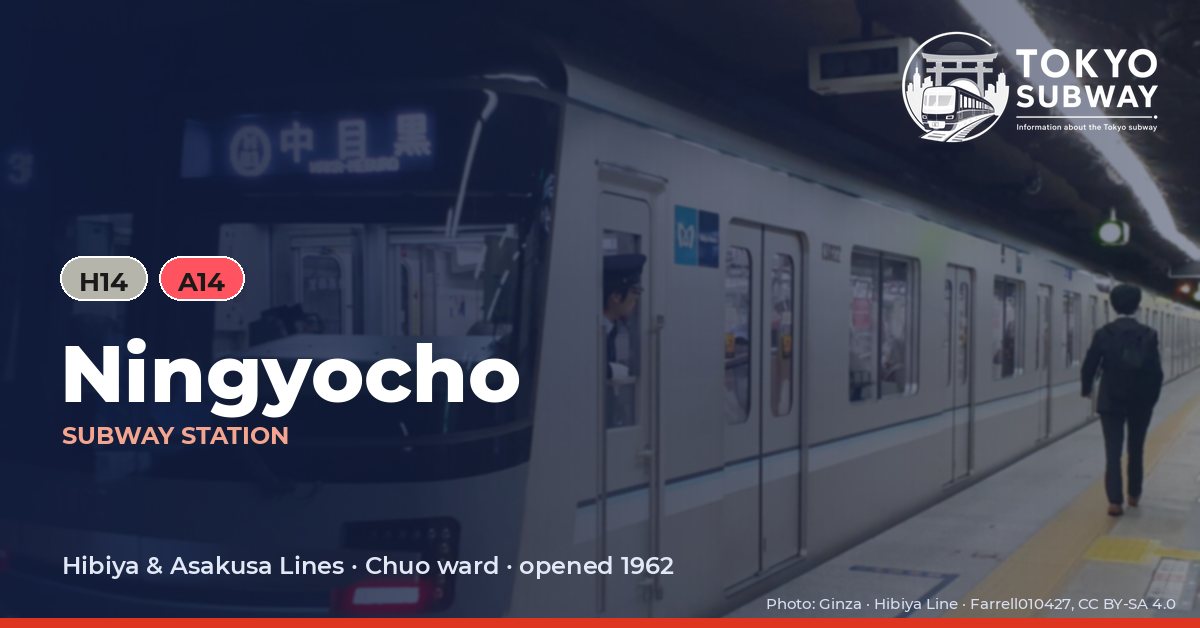
Finding Ningyocho on the signs
Every line gives the station its own letter-and-number code. You never have to read the Japanese name to find the right platform.
Station numbers at Ningyocho
Tokyo signposts every platform, exit and train door with a letter and a two-digit number. Matching the number is faster than reading the name — and it is what you will see on the map, in announcements and on the platform edge.
First and last trains at Ningyocho
| Line and direction | Weekdays first – last | Saturdays, Sundays & holidays first – last |
|---|---|---|
| HHibiyaH14 towards Kita-senju | 05:14 – 00:15 | 05:14 – 00:15 |
| HHibiyaH14 towards Naka-meguro | 05:16 – 00:08 | 05:16 – 00:08 |
| AAsakusaA14 towards Oshiage (Skytree) | 05:13 – 00:16 | 05:13 – 00:16 |
| AAsakusaA14 towards Nishi-magome | 05:10 – 00:16 | 05:10 – 00:16 |
Departure times come from the operators’ own GTFS timetables (ODPT GTFS Toei-Train-GTFS (version 20261009, valid 2026-03-14..2027-03-12) + TokyoMetro-Train-GTFS (version 20261008, valid 2026-09-19..2027-03-12)). Japan publishes two subway timetables: 平日 weekdays and 土休日 Saturdays, Sundays and national holidays. There is no separate Sunday timetable, and the December 30 – January 3 period runs the holiday timetable.
How often do trains run?
Departures in one direction during the hour with the most trains at this station, counted in the operators’ timetable.
Next stations from Ningyocho
Scheduled running time between Ningyocho and the stations either side of it.
| Line | Next station | Running time |
|---|---|---|
| HHibiya | H13Kayabacho | 2 min |
| HHibiya | H15Kodemmacho | 2 min |
| AAsakusa | A15Higashi-nihombashi | 1 min |
| AAsakusa | A13Nihombashi | 1 min |
Transfers and connections
- Subway: transfer between Hibiya Line and Asakusa Line. The Tokyo Metro lines and the Toei Subway lines belong to different companies, so a trip that uses both costs more than one operator alone — see fares.
- Walking transfer: Suitengumae (Hanzomon Line), an official transfer between two separately named stations, about 7 minutes on foot — our estimate from the distance, not an operator figure.
Accessibility
- Hibiya Line: Step-free elevator route street-gate-platform (official “1-route by elevator”). Street elevator at exit(s): 4, A3, A6. Operator page (checked Oct 20, 2026).
- Asakusa Line: Toei: step-free “1-route” secured; 3 elevator(s) on this line. Operator page (checked Oct 20, 2026).
Taken from the operators’ own accessibility pages and nothing else. Tokyo Metro: the “1-route” (step-free street-gate-platform path by elevator, slope, stair lift or wheelchair escalator) is complete at all 180 stations; a separate list shows stations with an elevator-only 1-route. Toei: every station has elevators and a street-gate-platform “1-route” is secured.
What is near Ningyocho Station?
Ningyocho keeps more of old Nihonbashi than most of the district. Amazake Yokocho, the lane of traditional shops, is about 280 m from the exits; Okannonji stands roughly 90 m away, Suehiro Shrine around 170 m, Koami Shrine some 290 m and Suitengu Shrine about 390 m. The Nihonbashi library is roughly 170 m from the gates, with the Hisamatsu police station around 320 m and an elementary school about 350 m, and the headquarters of Nisshinbo and the Nikkan Kogyo Shimbun are the main offices nearby.
| Place | Distance (straight line) | On foot, estimated |
|---|---|---|
| Ōkannonji 大観音寺 | 90 m | about 1 min |
| Koami Shrine 小網神社 | 290 m | about 5 min |
| Matsushima Jinja 松島神社 | 340 m | about 5 min |
| Suitengu Shrine 水天宮 | 390 m | about 6 min |
| Suehiro Shrine 末廣神社 | 170 m | about 3 min |
| Horidome Children's Playground 堀留児童公園 | 290 m | about 5 min |
| Kasama Inari-jinja Shrine 笠間稲荷神社 | 340 m | about 5 min |
| Amazake Yokocho | 280 m | about 4 min |
Places from OpenStreetMap within 400 m of the station. The walking time is an estimate (straight line plus 30 %, 80 m a minute), not a measured route. © OpenStreetMap contributors, ODbL.
Frequently asked questions
Since 17 March 2018, yes: the operators treat Suitengumae on the Hanzomon Line as a transfer from Ningyocho. It is a separate station reached along the street rather than through a passage, and the walking time shown in the data above is our estimate.
Through a transfer-only ticket gate, in use since 1 April 2017, which also allows passengers to pass through the other company’s area. The two operators have shared ticketing at Ningyocho since the Toei platforms opened in September 1962.