
Suitengumae Station
Z10 · Hanzomon Line · Chuo
Suitengumae Station (水天宮前)
Trains reached this corner of Nihonbashi on 28 November 1990, when the Hanzomon Line was pushed one stop east from Mitsukoshimae and stopped. Z10 stayed the end of the line until 19 March 2003, when the extension to Oshiage turned it into a through station; the reversing crossover on the Shibuya side was kept for emergencies. The name took longer to settle than the tunnel. The working title was Kakigaracho, the operator announced Hakozaki in February 1990, and after an argument among residents over which neighborhood the entrances belonged to it changed again, on 20 July 1990, to Suitengumae, after the shrine above rather than any one district.
The island platform lies three floors down, and the walls carry moulded crests of the kind also found at Tawaramachi. On opening day it became the first subway station in Tokyo with a moving walkway, laid in the passage on the Tokyo City Air Terminal side, and the station still works as the way into that building. A season-ticket office once stood here; it was moved to Kinshicho and closed when the Oshiage extension opened. In 2025 Suitengumae was used by 65,487 people on an average day.
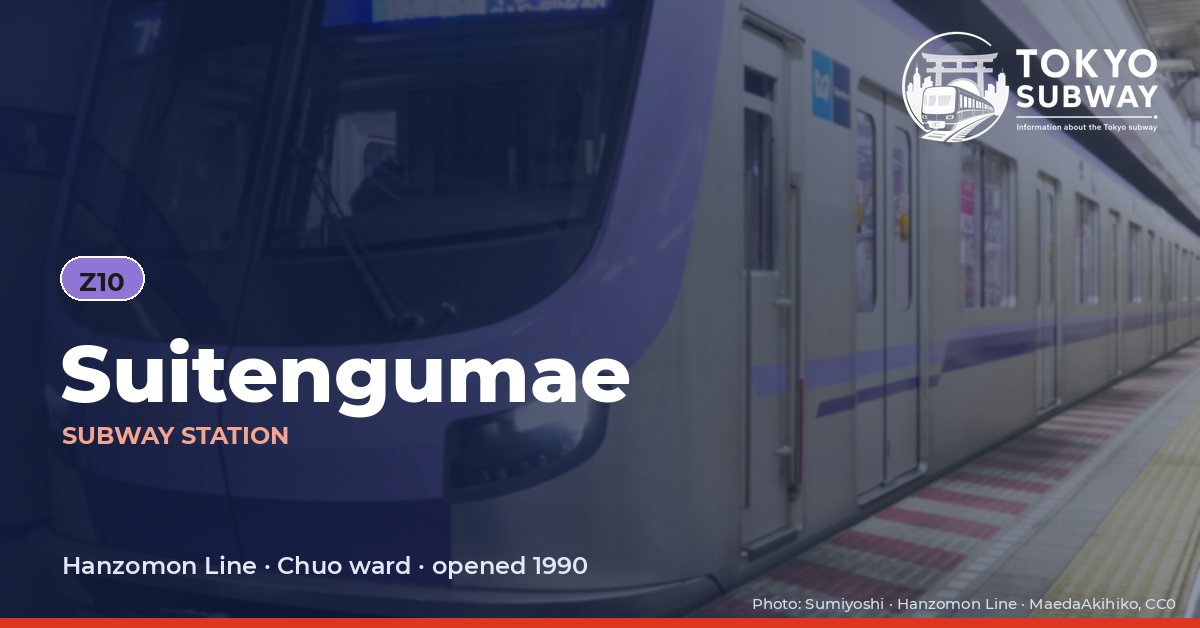
Finding Suitengumae on the signs
Every line gives the station its own letter-and-number code. You never have to read the Japanese name to find the right platform.
Station numbers at Suitengumae
Tokyo signposts every platform, exit and train door with a letter and a two-digit number. Matching the number is faster than reading the name — and it is what you will see on the map, in announcements and on the platform edge.
First and last trains at Suitengumae
| Line and direction | Weekdays first – last | Saturdays, Sundays & holidays first – last |
|---|---|---|
| ZHanzomonZ10 towards Oshiage (Skytree) | 05:20 – 00:33 to Kiyosumi-shirakawa | 05:19 – 00:14 to Kiyosumi-shirakawa |
| ZHanzomonZ10 towards Shibuya | 05:02 – 00:18 | 05:02 – 00:03 |
Departure times come from the operators’ own GTFS timetables (ODPT GTFS Toei-Train-GTFS (version 20261009, valid 2026-03-14..2027-03-12) + TokyoMetro-Train-GTFS (version 20261008, valid 2026-09-19..2027-03-12)). Japan publishes two subway timetables: 平日 weekdays and 土休日 Saturdays, Sundays and national holidays. There is no separate Sunday timetable, and the December 30 – January 3 period runs the holiday timetable.
How often do trains run?
| Line | Weekdays, busiest hour | Sat / Sun / holidays, busiest hour |
|---|---|---|
| ZHanzomon | 26 trains/hour (about one every 2.3 min) | 14 trains/hour |
Departures in one direction during the hour with the most trains at this station, counted in the operators’ timetable.
Next stations from Suitengumae
Scheduled running time between Suitengumae and the stations either side of it.
| Line | Next station | Running time |
|---|---|---|
| ZHanzomon | Z11Kiyosumi-shirakawa | 3 min |
| ZHanzomon | Z09Mitsukoshimae | 3 min |
Transfers and connections
- Walking transfer: Ningyocho (Hibiya Line and Asakusa Line), an official transfer between two separately named stations, about 7 minutes on foot — our estimate from the distance, not an operator figure.
Accessibility
| Line | Step-free by elevator | Accessible toilet | Escalator | Exits |
|---|---|---|---|---|
| ZHanzomon | Yes | Yes | Yes | 7 |
- Hanzomon Line: Step-free elevator route street-gate-platform (official “1-route by elevator”). Street elevator at exit(s): 4. Operator page (checked Oct 20, 2026).
Taken from the operators’ own accessibility pages and nothing else. Tokyo Metro: the “1-route” (step-free street-gate-platform path by elevator, slope, stair lift or wheelchair escalator) is complete at all 180 stations; a separate list shows stations with an elevator-only 1-route.
What is near Suitengumae Station?
Suitengumae is first of all the station for the shrine it is named after: Suitengu stands about 70 m from the exits. The Tokyo City Air Terminal is about 240 m away, and the coaches for Haneda and Narita load there, so this is a useful stop for airport access even though no railway to either airport comes near. Amazake Yokocho, the lane of old shops, is about 270 m off, the Nihonbashi Auditorium about 110 m, and the Musee Hamaguchi Yozo and the small Soy Sauce Centre are both within a few minutes. Hakozaki Park gives the blocks their patch of green.
| Place | Distance (straight line) | On foot, estimated |
|---|---|---|
| Suitengu Shrine 水天宮 | 70 m | about 1 min |
| Matsushima Jinja 松島神社 | 180 m | about 3 min |
| Kakikarachō Park 蛎殻町公園 | 210 m | about 3 min |
| Ōkannonji 大観音寺 | 370 m | about 6 min |
| Nihonbashi Auditorium 日本橋公会堂 | 110 m | about 2 min |
| Musée Hamaguchi Yōzō: Yamasa Collection ミュゼ浜口陽三・ヤマサコレクション | 160 m | about 3 min |
| Soy Sauce Centre (Shoyu Kaikan) 醤油会館 | 300 m | about 5 min |
| Tokyo Performing Arts Activity Support Center 水天宮ピット | 310 m | about 5 min |
Places from OpenStreetMap within 400 m of the station. The walking time is an estimate (straight line plus 30 %, 80 m a minute), not a measured route. © OpenStreetMap contributors, ODbL.
Frequently asked questions
Hakozaki was the operator’s own choice, announced in February 1990, and part of the station does sit in Nihonbashi-Hakozakicho. Local opinion split three ways, between Hakozaki, the older Kakigaracho and a name referring to the air terminal, so rather than take sides the operator switched on 20 July 1990 to Suitengumae, after the shrine at street level.
In the operators’ books, yes. Since 17 March 2018 Suitengumae and Ningyocho have been handled as one transfer, so a change counts even though the two have different names. There is no corridor between them: you leave one station at street level and walk to the other.