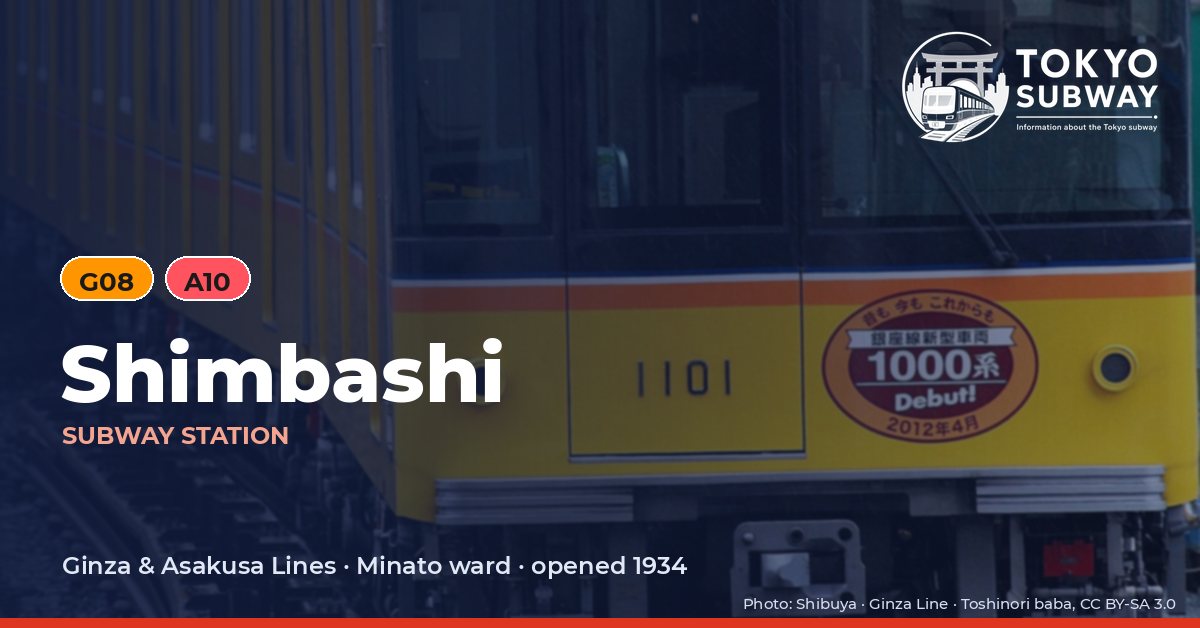
Shimbashi Station
G08 A10 · Ginza Line and Asakusa Line · Minato
Shimbashi Station (新橋)
Japan’s first railway ran from a Shimbashi that no longer exists. The 1872 terminus stood some way east of today’s station and was known as Shimbashi Teishajo; the present structure opened on 16 December 1909 as Karasumori, on the Yamanote Line, and took the Shimbashi name in 1914, when the Tokaido Main Line was extended to Tokyo Station and the old terminus became the Shiodome freight yard.
Asia’s first subway line reached Shimbashi in 1934, and G08 carries a strange footnote: in January 1939 a second, separate subway station opened here for the Tokyo Rapid Railway’s line from Shibuya, and closed again within months once the two companies agreed to run through trains. The Ginza Line made do with a single platform until 1980. Toei’s Asakusa Line platforms, A10, opened on 12 December 1963, and the elevated Yurikamome terminus followed in 1995. Tokyo Metro counted 209,360 passengers a day in 2025; Toei recorded 88,540 in 2024.
Finding Shimbashi on the signs
Every line gives the station its own letter-and-number code. You never have to read the Japanese name to find the right platform.
Station numbers at Shimbashi
Tokyo signposts every platform, exit and train door with a letter and a two-digit number. Matching the number is faster than reading the name — and it is what you will see on the map, in announcements and on the platform edge.
First and last trains at Shimbashi
| Line and direction | Weekdays first – last | Saturdays, Sundays & holidays first – last |
|---|---|---|
| GGinzaG08 towards Asakusa | 05:15 – 00:16 to Ueno | 05:15 – 00:16 to Ueno |
| GGinzaG08 towards Shibuya | 05:21 – 00:15 | 05:21 – 00:15 |
| AAsakusaA10 towards Oshiage (Skytree) | 05:06 – 00:09 | 05:06 – 00:09 |
| AAsakusaA10 towards Nishi-magome | 05:18 – 00:23 | 05:18 – 00:23 |
Departure times come from the operators’ own GTFS timetables (ODPT GTFS Toei-Train-GTFS (version 20261009, valid 2026-03-14..2027-03-12) + TokyoMetro-Train-GTFS (version 20261008, valid 2026-09-19..2027-03-12)). Japan publishes two subway timetables: 平日 weekdays and 土休日 Saturdays, Sundays and national holidays. There is no separate Sunday timetable, and the December 30 – January 3 period runs the holiday timetable.
How often do trains run?
Departures in one direction during the hour with the most trains at this station, counted in the operators’ timetable.
Transfers and connections
- Subway: transfer between Ginza Line and Asakusa Line. The Tokyo Metro lines and the Toei Subway lines belong to different companies, so a trip that uses both costs more than one operator alone — see fares.
- JR: Joban Rapid Line (JR East), Keihin-Tohoku-Negishi Line (JR East), Tokaido Line (JR East), Yamanote Line (JR East), Yokosuka Line (JR East). These are separate railways with their own fares.
- Automated guideway / monorail: Yurikamome line (Yurikamome). These are separate railways with their own fares.
Accessibility
- Ginza Line: Step-free elevator route street-gate-platform (official “1-route by elevator”). Operator page (checked Oct 20, 2026).
- Asakusa Line: Toei: step-free “1-route” secured; 2 elevator(s) on this line. Operator page (checked Oct 20, 2026).
Taken from the operators’ own accessibility pages and nothing else. Tokyo Metro: the “1-route” (step-free street-gate-platform path by elevator, slope, stair lift or wheelchair escalator) is complete at all 180 stations; a separate list shows stations with an elevator-only 1-route. Toei: every station has elevators and a street-gate-platform “1-route” is secured.
What is near Shimbashi Station?
The station’s own history is on display outside it: SL Square with its preserved steam locomotive about 160 m away, a D51 driving wheel barely 40 m off, and the reconstructed Old Shimbashi Station railway history exhibition hall about 250 m. Beyond them the Shiodome Sio-Site towers begin, holding the Advertising Museum Tokyo, the Panasonic Shiodome Museum of Art and the Shiki Theatre Sea. Karasumori Shrine, roughly 200 m away, keeps the name the station carried until 1914, and the Hakuhinkan Theatre is about 250 m off.
| Place | Distance (straight line) | On foot, estimated |
|---|---|---|
| Karasumori Shrine 烏森神社 | 200 m | about 3 min |
| Shiodome Sio-Site 汐留SIO-SITE | 240 m | about 4 min |
| Hakuhinkan Theatre 博品館劇場 | 250 m | about 4 min |
| Hibiya-jinja Shrine 日比谷神社 | 340 m | about 5 min |
| Shiki Theatre Sea 四季劇場 海 | 360 m | about 6 min |
| Advertising Museum Tokyo アド・ミュージアム東京 | 390 m | about 6 min |
| D51機関車の動輪 | 40 m | about 1 min |
| NEW Shiba Building NEWしんばしビル | 140 m | about 2 min |
Places from OpenStreetMap within 400 m of the station. The walking time is an estimate (straight line plus 30 %, 80 m a minute), not a measured route. © OpenStreetMap contributors, ODbL.
Frequently asked questions
Not this building. The 1872 terminus stood a short way east and its site later became the Shiodome goods yard, which closed in 1986. The ground was declared a national monument in 1996, and a reconstruction of the original station completed in 2003 now holds a railway history exhibit and a restaurant.
In January 1939 the Tokyo Rapid Railway opened its own Shimbashi station for the line from Shibuya. A few months later the two subway companies began running through trains, the second station became unnecessary and it was closed; in 1941 the companies merged into the operation that became the Ginza Line.