Shin-ochanomizu Station
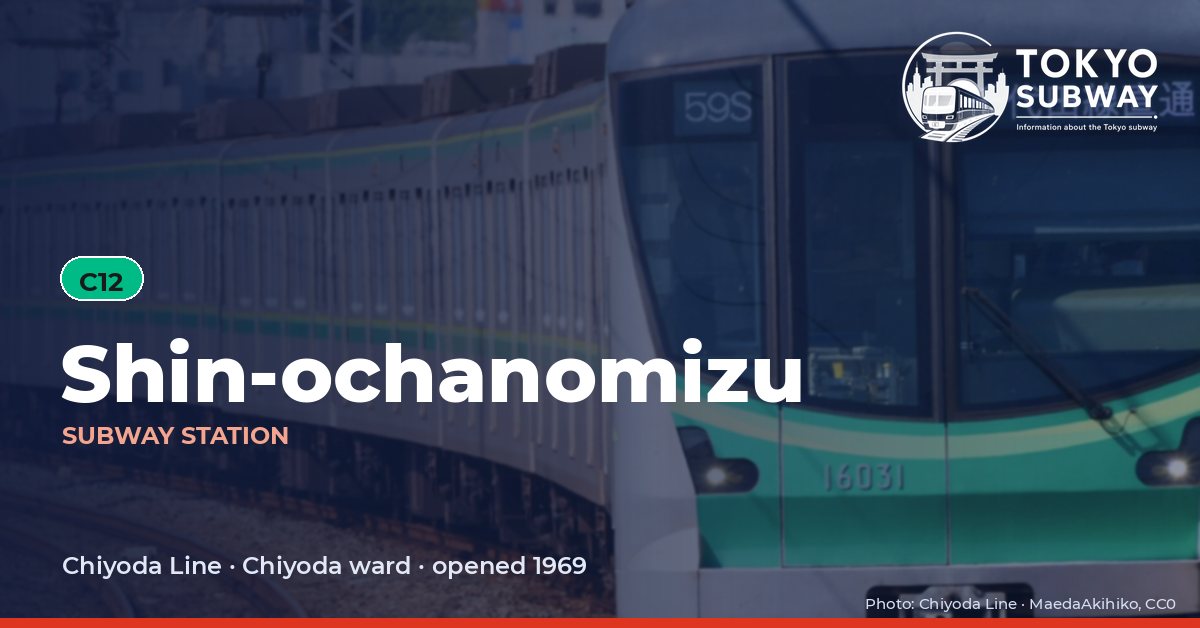
C12 · Chiyoda Line · Chiyoda
Shin-ochanomizu Station (新御茶ノ水)
Surugadai sits on a hill, and the Chiyoda Line had to pass under it. Rather than dig from above, the builders drove two shield tunnels and then opened out the ground between them to form a platform 9 m wide, which is why Shin-ochanomizu has a single island platform and a depth of 24.3 m to the rails — second on the line only to Kokkai-gijidomae. The slope shows in the figures: the ground at one end of the station is 18.4 m above sea level and at the other 4.8 m.
For passengers, the consequence is the escalators. Four of them climb 20.415 m at the Ayase end over a length of 41 m, renewed in 1997 and described at the time as the longest in the Orient. C12 opened on 20 December 1969, and between 1997 and 2001 its platform walls gained a mosaic of the old Japanese month names and the twenty-four solar terms. Tokyo Metro counted 90,708 passengers a day in 2025.
Finding Shin-ochanomizu on the signs
Every line gives the station its own letter-and-number code. You never have to read the Japanese name to find the right platform.
Station numbers at Shin-ochanomizu
Tokyo signposts every platform, exit and train door with a letter and a two-digit number. Matching the number is faster than reading the name — and it is what you will see on the map, in announcements and on the platform edge.
First and last trains at Shin-ochanomizu
| Line and direction | Weekdays first – last | Saturdays, Sundays & holidays first – last |
|---|---|---|
| CChiyodaC12 towards Ayase | 05:22 – 00:22 | 05:22 – 00:18 |
| CChiyodaC12 towards Yoyogi-uehara | 05:17 – 00:25 | 05:17 – 00:22 to Kasumigaseki |
Departure times come from the operators’ own GTFS timetables (ODPT GTFS Toei-Train-GTFS (version 20261009, valid 2026-03-14..2027-03-12) + TokyoMetro-Train-GTFS (version 20261008, valid 2026-09-19..2027-03-12)). Japan publishes two subway timetables: 平日 weekdays and 土休日 Saturdays, Sundays and national holidays. There is no separate Sunday timetable, and the December 30 – January 3 period runs the holiday timetable.
How often do trains run?
| Line | Weekdays, busiest hour | Sat / Sun / holidays, busiest hour |
|---|---|---|
| CChiyoda | 25 trains/hour (about one every 2.4 min) | 13 trains/hour |
Departures in one direction during the hour with the most trains at this station, counted in the operators’ timetable.
Transfers and connections
- Walking transfer: Awajicho (Marunouchi Line), an official transfer between two separately named stations, about 5 minutes on foot — our estimate from the distance, not an operator figure.
- Walking transfer: Ogawamachi (Shinjuku Line), an official transfer between two separately named stations, about 4 minutes on foot — our estimate from the distance, not an operator figure.
- JR: Chuo Rapid Line (JR East), Chuo-Sobu Local Line (JR East). These are separate railways with their own fares.
Accessibility
| Line | Step-free by elevator | Accessible toilet | Escalator | Exits |
|---|---|---|---|---|
| CChiyoda | Yes | Yes | Yes | 16 |
- Chiyoda Line: Step-free elevator route street-gate-platform (official “1-route by elevator”). Street elevator at exit(s): A6, B2, B3a , B3b. Operator page (checked Oct 20, 2026).
Taken from the operators’ own accessibility pages and nothing else. Tokyo Metro: the “1-route” (step-free street-gate-platform path by elevator, slope, stair lift or wheelchair escalator) is complete at all 180 stations; a separate list shows stations with an elevator-only 1-route.
What is near Shin-ochanomizu Station?
This is student territory. Meiji University’s Surugadai campus and its museum lie roughly 330 to 360 m from the exits, Nihon University’s science and dentistry faculties are closer still, and the Kanda second-hand book district and the Hilltop Hotel are among the places the station serves. The dome of the Holy Resurrection Cathedral, Nikolai-do, is about 120 m away and Otahime Shrine about 220 m, with Awaji Pocket Park beyond them. JR East’s Ochanomizu station stands at ground level above the Chiyoda Line platform.
| Place | Distance (straight line) | On foot, estimated |
|---|---|---|
| Holy Resurrection Cathedral (Nikolai-do) ニコライ堂 | 120 m | about 2 min |
| Awaji Pocket Park 淡路公園 | 150 m | about 2 min |
| Otahime Shrine 太田姫稲荷神社 | 220 m | about 4 min |
| Faculty of Science and Technology (Nihon University Ochanomizu Campus) 日本大学理工学部御茶ノ水校舎 | 290 m | about 5 min |
| Kanda Renjakutei 神田連雀亭 | 300 m | about 5 min |
| Meiji University Museum 明治大学博物館 | 360 m | about 6 min |
| College of Science and Technology, Nihon University, Surugadai Campus 日本大学(理工学部)駿河台校舎 | 110 m | about 2 min |
| Nihon University School of Dentistry 日本大学歯学部 | 210 m | about 3 min |
Places from OpenStreetMap within 400 m of the station. The walking time is an estimate (straight line plus 30 %, 80 m a minute), not a measured route. © OpenStreetMap contributors, ODbL.
Frequently asked questions
Because the station is deep and the hill above it steep. The rails lie 24.3 m below ground, and the four escalators at the Ayase end rise 20.415 m over a 41 m run. They were renewed in 1997, and when they were new they were described as the longest in the Orient.
No, although JR East’s Ochanomizu is directly above it at ground level. Shin-ochanomizu is also paired as a walking transfer with Awajicho on the Marunouchi Line and Ogawamachi on the Toei Shinjuku Line, both reached from the Otemachi end of the platform.