Kokkai-gijidomae Station
M14 C07 · Marunouchi Line and Chiyoda Line · Chiyoda
Kokkai-gijidomae Station (国会議事堂前)
The name means “in front of the National Diet Building”, and the Marunouchi Line platforms, M14, now sit directly under the Diet’s grounds — though they did not start that way. When the station opened on 15 March 1959 the tunnel followed a public road alongside the site, and only a later enlargement of the grounds put the station beneath them; exit 1 still follows the angle of the vanished street. The Chiyoda Line platform, C07, opened on 20 October 1972.
That second platform is the reason engineers talk about this station. It lies 37.9 m below the street, the deepest on the Tokyo Metro network, and because it was bored as a single-track shield the walls and the platform itself curve, so staff are stationed there permanently to signal departures; six separate passages link the two sides. Water leaking through the lining led to a repair program that ran from February 2008 to September 2014 and left the gray stone and wood-grain tiling in place today.
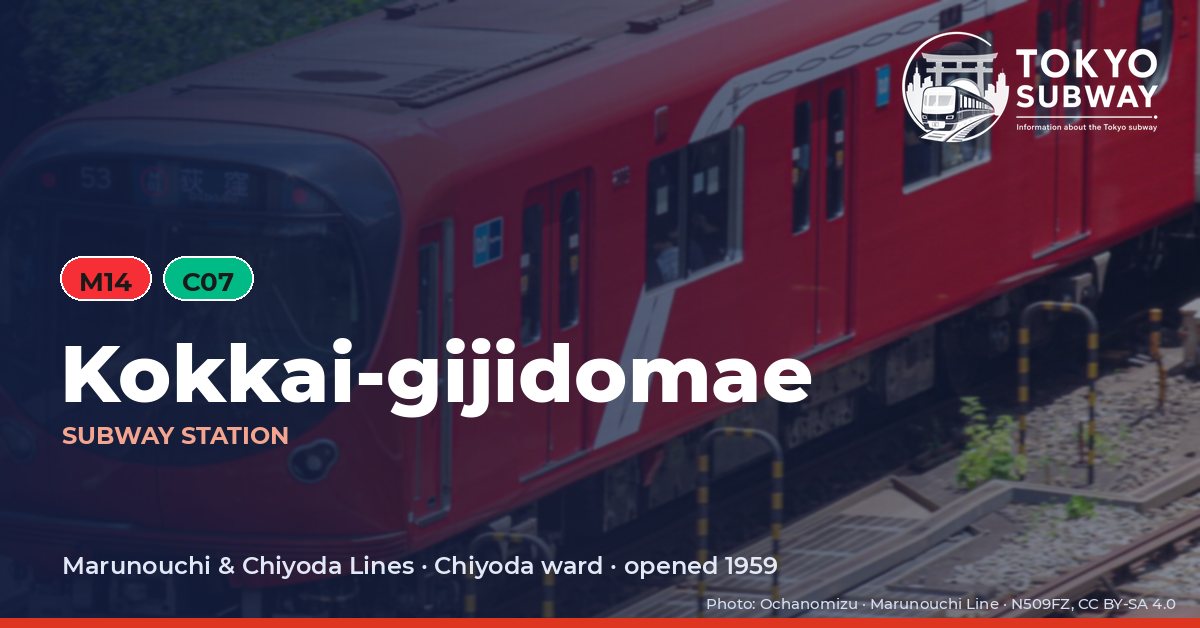
Finding Kokkai-gijidomae on the signs
Every line gives the station its own letter-and-number code. You never have to read the Japanese name to find the right platform.
Station numbers at Kokkai-gijidomae
Tokyo signposts every platform, exit and train door with a letter and a two-digit number. Matching the number is faster than reading the name — and it is what you will see on the map, in announcements and on the platform edge.
First and last trains at Kokkai-gijidomae
| Line and direction | Weekdays first – last | Saturdays, Sundays & holidays first – last |
|---|---|---|
| MMarunouchiM14 towards Ikebukuro | 05:12 – 00:06 | 05:12 – 00:06 |
| MMarunouchiM14 towards Ogikubo | 05:23 – 00:17 to Shinjuku | 05:23 – 00:17 to Shinjuku |
| CChiyodaC07 towards Ayase | 05:12 – 00:12 | 05:12 – 00:07 |
| CChiyodaC07 towards Yoyogi-uehara | 05:27 – 00:36 | 05:27 – 00:18 |
Departure times come from the operators’ own GTFS timetables (ODPT GTFS Toei-Train-GTFS (version 20261009, valid 2026-03-14..2027-03-12) + TokyoMetro-Train-GTFS (version 20261008, valid 2026-09-19..2027-03-12)). Japan publishes two subway timetables: 平日 weekdays and 土休日 Saturdays, Sundays and national holidays. There is no separate Sunday timetable, and the December 30 – January 3 period runs the holiday timetable.
How often do trains run?
| Line | Weekdays, busiest hour | Sat / Sun / holidays, busiest hour |
|---|---|---|
| MMarunouchi | 27 trains/hour (about one every 2.2 min) | 15 trains/hour |
| CChiyoda | 24 trains/hour (about one every 2.5 min) | 13 trains/hour |
Departures in one direction during the hour with the most trains at this station, counted in the operators’ timetable.
Next stations from Kokkai-gijidomae
Scheduled running time between Kokkai-gijidomae and the stations either side of it.
| Line | Next station | Running time |
|---|---|---|
| MMarunouchi | M13Akasaka-mitsuke | 2 min |
| MMarunouchi | M15Kasumigaseki | 2 min |
| CChiyoda | C06Akasaka | 2 min |
| CChiyoda | C08Kasumigaseki | 2 min |
Transfers and connections
- Subway: transfer between Marunouchi Line and Chiyoda Line.
- Walking transfer: Tameike-sanno (Ginza Line and Namboku Line), an official transfer between two separately named stations, about 3 minutes on foot — our estimate from the distance, not an operator figure.
Accessibility
| Line | Step-free by elevator | Accessible toilet | Escalator | Exits |
|---|---|---|---|---|
| MMarunouchi | Yes | Yes | Yes | 10 |
| CChiyoda | Yes | Yes | Yes | 10 |
- Marunouchi Line: Step-free elevator route street-gate-platform (official “1-route by elevator”). Street elevator at exit(s): 11, 14, 2, 6, 7. Operator page (checked Oct 20, 2026).
Taken from the operators’ own accessibility pages and nothing else. Tokyo Metro: the “1-route” (step-free street-gate-platform path by elevator, slope, stair lift or wheelchair escalator) is complete at all 180 stations; a separate list shows stations with an elevator-only 1-route.
What is near Kokkai-gijidomae Station?
Kokkai-gijidomae stands in the government quarter of Chiyoda and its exits serve it directly: the National Diet Building above, the Prime Minister’s Official Residence, the Cabinet Office and Central Government Buildings No. 4 and No. 8, the last about 210 m away. The Diet Front Garden is roughly 360 m out, with a statue of Ito Hirobumi nearby; Sanno Park Tower and The Capitol Hotel Tokyu stand about 310–340 m from the station, and Hie Shrine is among the places it is used for.
| Place | Distance (straight line) | On foot, estimated |
|---|---|---|
| Diet Front Garden 国会前庭 | 360 m | about 6 min |
| Fujidana 藤棚 | 400 m | about 6 min |
| Post Office 国会内郵便局 | 60 m | about 1 min |
| Central Government Building No.8 中央合同庁舎第8号館 | 210 m | about 3 min |
| The Capitol Hotel Tokyu | 310 m | about 5 min |
| Pharmaceuticals and Medical Devices Agency 医薬品医療機器総合機構 | 320 m | about 5 min |
| Sanno Park Tower 山王パークタワー | 340 m | about 6 min |
| Ito Hirobumi 伊藤博文 | 360 m | about 6 min |
Places from OpenStreetMap within 400 m of the station. The walking time is an estimate (straight line plus 30 %, 80 m a minute), not a measured route. © OpenStreetMap contributors, ODbL.
Frequently asked questions
It is the deepest on Tokyo Metro: the Chiyoda Line platform lies 37.9 m below ground. It is not the deepest in the city, because several Toei Oedo Line stations go further down — Toei is a separate operator with a newer, lower network.
Yes, by way of Tameike-sanno, which opened on 30 September 1997 and is linked to this station by passageways inside the ticket gates. The two names are treated as one transfer point; the walking estimate in the data block above is ours, not the operator’s.