
Takanawadai Station
A06 · Asakusa Line · Minato
Takanawadai Station (高輪台)
A06 opened on 15 November 1968, when the line through Minato was still numbered rather than named; it became part of the Asakusa Line on 1 July 1978. The name points at the high ground, the dai, of Takanawa, although the land the station stands on was historically called Shirokane-sarumachi, and the working name while it was being planned was Nihon-enoki, after what the district was then known as. That older name went to the line’s substation instead.
The structure is the interesting part. The single island platform was threaded between two separate single-track shield tunnels, so the two platform faces are divided by tunnel wall along most of their length and joined only by short cross passages at either end; Kokkai-gijidomae on the Chiyoda Line was built the same way. At 18.2 m it was the deepest station on the Toei network until the Mita Line opened between Hibiya and Mita in 1973, and it was the first Toei station given escalators between concourse and platform, in both directions from the day it opened. Exit A1 was moved and rebuilt in 2009 and the station was refurbished with it. With 13,969 users a day in 2024, it is the least used stop on the Asakusa Line.
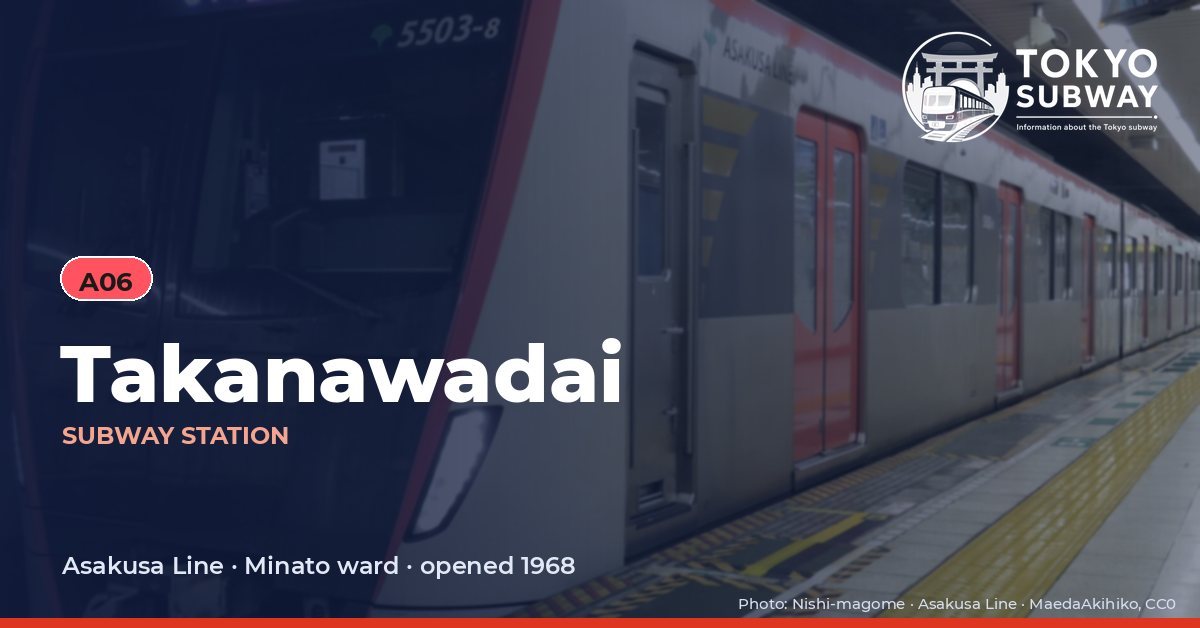
Finding Takanawadai on the signs
Every line gives the station its own letter-and-number code. You never have to read the Japanese name to find the right platform.
Station numbers at Takanawadai
Tokyo signposts every platform, exit and train door with a letter and a two-digit number. Matching the number is faster than reading the name — and it is what you will see on the map, in announcements and on the platform edge.
First and last trains at Takanawadai
| Line and direction | Weekdays first – last | Saturdays, Sundays & holidays first – last |
|---|---|---|
| AAsakusaA06 towards Oshiage (Skytree) | 05:10 – 23:59 to Sengakuji | 05:10 to Oshiage (Skytree) – 23:59 to Oshiage (Skytree) |
| AAsakusaA06 towards Nishi-magome | 05:27 – 00:22 | 05:27 – 00:22 |
Departure times come from the operators’ own GTFS timetables (ODPT GTFS Toei-Train-GTFS (version 20261009, valid 2026-03-14..2027-03-12) + TokyoMetro-Train-GTFS (version 20261008, valid 2026-09-19..2027-03-12)). Japan publishes two subway timetables: 平日 weekdays and 土休日 Saturdays, Sundays and national holidays. There is no separate Sunday timetable, and the December 30 – January 3 period runs the holiday timetable.
How often do trains run?
| Line | Weekdays, busiest hour | Sat / Sun / holidays, busiest hour |
|---|---|---|
| AAsakusa | 14 trains/hour (about one every 4.3 min) | 12 trains/hour |
Departures in one direction during the hour with the most trains at this station, counted in the operators’ timetable.
Transfers and connections
Only the Asakusa Line stops here, and no other railway serves this station, so there is nothing to transfer to inside the station.
Accessibility
| Line | Step-free by elevator | Accessible toilet | Escalator | Exits |
|---|---|---|---|---|
| AAsakusa | Yes | Yes | Yes | 2 |
- Asakusa Line: Toei: step-free “1-route” secured; 1 elevator(s) on this line. Elevator exit(s): A1. Operator page (checked Oct 20, 2026).
Taken from the operators’ own accessibility pages and nothing else. Toei: every station has elevators and a street-gate-platform “1-route” is secured.
What is near Takanawadai Station?
Takanawadai serves the Shirokanedai neighborhood and the slope below it. JCHO Tokyo Takanawa Hospital is about 150 m from the exits and the Grand Prince Hotel Shin Takanawa about 310 m, one of a run of hotels along the ridge. The Ebara Hatakeyama Museum of Art is about 320 m away, the Logistics Museum about 340 m and a small museum of food and life about 260 m. Meiji Gakuin University and two campuses of Tokyo Healthcare University stand nearby, and Gotanda is the next station.
| Place | Distance (straight line) | On foot, estimated |
|---|---|---|
| Ebara Hatakeyama Museum of Art 荏原 畠山美術館 | 320 m | about 5 min |
| Logistics Museum 物流博物館 | 340 m | about 6 min |
| 本立寺 | 260 m | about 4 min |
| 寿昌寺 | 320 m | about 5 min |
| A small museum of food and life 食とくらしの小さな博物館 | 260 m | about 4 min |
| 港区立高輪台遊び場 | 140 m | about 2 min |
| 東京医療保健大学(医療保健学部) | 350 m | about 6 min |
| 箱根マイセンアンティーク美術館東京 | 350 m | about 6 min |
Places from OpenStreetMap within 400 m of the station. The walking time is an estimate (straight line plus 30 %, 80 m a minute), not a measured route. © OpenStreetMap contributors, ODbL.
Frequently asked questions
From the high ground of Takanawa that the line runs under here. The address itself was Shirokane-sarumachi, and the planners’ provisional name was Nihon-enoki, the older name for the area; when the station was given the Takanawadai name, Nihon-enoki was reused for the electrical substation that feeds the line.
Because they are in separate tunnels. The platform was inserted between two single-track shield bores, so a tunnel wall stands between the two faces for most of their length and you cross from one to the other through short passages at either end rather than simply walking across.