
Daimon Station
A09 E20 · Asakusa Line and Oedo Line · Minato
Daimon Station (大門)
Daimon is named after the great gate of Shiba, the entrance on the road up to the temple of Zojo-ji, and the gate’s history is set out on panels in the passage outside the ticket gates. Toei opened the station on 1 October 1964 on what was then Subway Line No. 1, renamed the Asakusa Line in July 1978. It began with a single track and one platform face because the extension beyond was still single track, and was widened to two side platforms before the line pushed on to Sengakuji.
The Oedo Line platform, an island, opened on 12 December 2000 and crosses the older line at close to a right angle, filling most of the space between it and the JR tracks. It was to have been called Hamamatsucho, and that name survives as the station’s official subtitle – carried by the Oedo Line from the start and added to the Asakusa Line platforms on 18 February 2021. Toei counted 103,281 entries and exits a day on the Asakusa Line in 2024 and 116,169 on the Oedo Line, the second highest figure on that line.
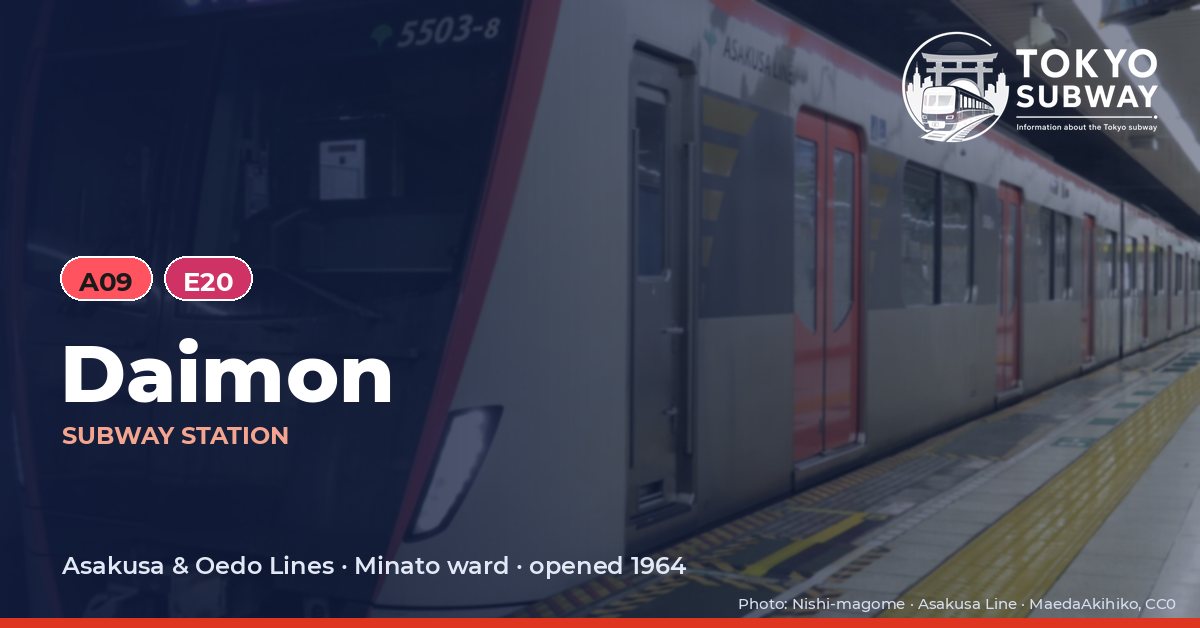
Finding Daimon on the signs
Every line gives the station its own letter-and-number code. You never have to read the Japanese name to find the right platform.
Station numbers at Daimon
Tokyo signposts every platform, exit and train door with a letter and a two-digit number. Matching the number is faster than reading the name — and it is what you will see on the map, in announcements and on the platform edge.
First and last trains at Daimon
| Line and direction | Weekdays first – last | Saturdays, Sundays & holidays first – last |
|---|---|---|
| AAsakusaA09 towards Oshiage (Skytree) | 05:04 – 00:07 | 05:04 – 00:07 |
| AAsakusaA09 towards Nishi-magome | 05:20 – 00:25 | 05:20 – 00:25 |
| EOedoE20 towards Tochomae | 05:02 – 00:30 to Tochomae | 05:02 – 00:30 to Tochomae |
| EOedoE20 towards Tochomae | 05:18 – 00:46 to Shiodome | 05:18 – 00:46 to Shiodome |
Departure times come from the operators’ own GTFS timetables (ODPT GTFS Toei-Train-GTFS (version 20261009, valid 2026-03-14..2027-03-12) + TokyoMetro-Train-GTFS (version 20261008, valid 2026-09-19..2027-03-12)). Japan publishes two subway timetables: 平日 weekdays and 土休日 Saturdays, Sundays and national holidays. There is no separate Sunday timetable, and the December 30 – January 3 period runs the holiday timetable.
How often do trains run?
Departures in one direction during the hour with the most trains at this station, counted in the operators’ timetable.
Transfers and connections
- Subway: transfer between Asakusa Line and Oedo Line.
- JR: Keihin-Tohoku-Negishi Line (JR East), Yamanote Line (JR East). These are separate railways with their own fares.
- Automated guideway / monorail: Haneda Airport Line (Tokyo Monorail). These are separate railways with their own fares.
Accessibility
- Asakusa Line: Toei: step-free “1-route” secured; 3 elevator(s) on this line. Elevator exit(s): A1, B4, B5. Operator page (checked Oct 20, 2026).
- Oedo Line: Toei: step-free “1-route” secured; 2 elevator(s) on this line. Elevator exit(s): A1, B4, B5. Operator page (checked Oct 20, 2026).
Taken from the operators’ own accessibility pages and nothing else. Toei: every station has elevators and a street-gate-platform “1-route” is secured.
What is near Daimon Station?
Hamamatsucho station, with the JR lines and the Tokyo Monorail, is immediately alongside, which is why the Asakusa Line’s Airport Rapid services have called here since 2000 and why the station matters for airport access. Shiba Daimon itself stands about 240 m from the exits and Shibadaijingu roughly 220 m; the Kyu Shiba Rikyu Garden is around 350 m away, Minato City Hall about 360 m, and Nippon Cultural Broadcasting some 180 m, with office buildings filling most of the rest of the walk.
| Place | Distance (straight line) | On foot, estimated |
|---|---|---|
| Shibadaijingu 芝大神宮 | 220 m | about 4 min |
| 常照院 | 310 m | about 5 min |
| Ohyama 大山 | 370 m | about 6 min |
| 仏願寺 | 150 m | about 2 min |
| 浄運院 | 240 m | about 4 min |
| 讃岐小白稲荷神社 | 320 m | about 5 min |
| ハマサイト グルメ | 380 m | about 6 min |
| 芝大門二丁目児童遊園 | 400 m | about 6 min |
Places from OpenStreetMap within 400 m of the station. The walking time is an estimate (straight line plus 30 %, 80 m a minute), not a measured route. © OpenStreetMap contributors, ODbL.