
Tsukishima Station
Y21 E16 · Yurakucho Line and Oedo Line · Chuo
Tsukishima Station (月島)
The Yurakucho Line reached Tsukishima on 8 June 1988 — the ceremony for the completed line had been held at platform 1 the day before — and the Oedo Line opened its own platforms on 12 December 2000. The two cross under the Hatsumibashi junction in the shape of a T, and the later line runs above the earlier one: the Oedo platform is at B2 and the Yurakucho platform at B3, the reverse of the usual order. The reason is that the Oedo route through Tsukishima was planned first, so when the Yurakucho Line was built its box was given a ready-made crossing structure above it.
Both ticket halls are at B1, and there is no gate between the two companies, so a change means leaving one station and entering the other. Each side has a single island platform. The Tokyo Metro side is finished with a checkerboard of brown and hanada blue around the name boards; the Toei side has a public artwork facing its gates, Moon Mirror, given by Toto in June 2000, six months before those platforms opened. The station is close to Tokyo Bay and its passages carry steel flood doors. In 2025 the Tokyo Metro station was used by 71,329 people on an average day.
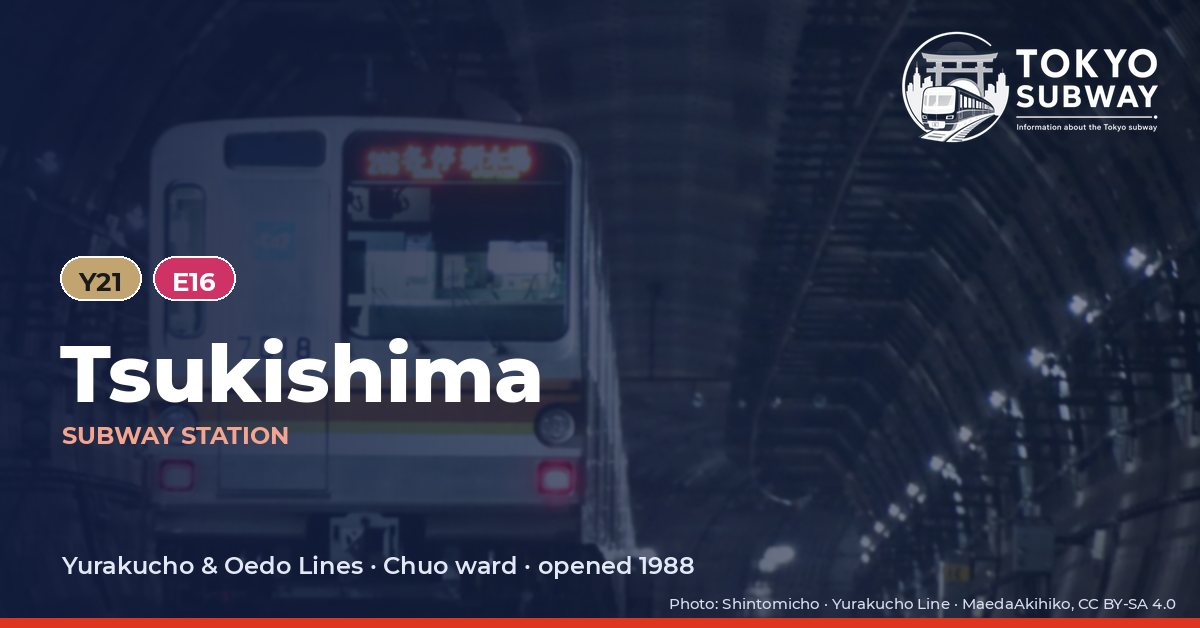
Finding Tsukishima on the signs
Every line gives the station its own letter-and-number code. You never have to read the Japanese name to find the right platform.
Station numbers at Tsukishima
Tokyo signposts every platform, exit and train door with a letter and a two-digit number. Matching the number is faster than reading the name — and it is what you will see on the map, in announcements and on the platform edge.
First and last trains at Tsukishima
| Line and direction | Weekdays first – last | Saturdays, Sundays & holidays first – last |
|---|---|---|
| YYurakuchoY21 towards Shin-kiba | 05:07 – 00:24 | 05:07 – 00:24 |
| YYurakuchoY21 towards Wakoshi | 05:07 – 00:08 to Ikebukuro | 05:07 – 00:08 to Ikebukuro |
| EOedoE16 towards Tochomae | 05:05 – 00:21 to Tochomae | 05:05 – 00:21 to Tochomae |
| EOedoE16 towards Tochomae | 05:27 – 00:40 to Kiyosumi-shirakawa | 05:27 – 00:39 to Kiyosumi-shirakawa |
Departure times come from the operators’ own GTFS timetables (ODPT GTFS Toei-Train-GTFS (version 20261009, valid 2026-03-14..2027-03-12) + TokyoMetro-Train-GTFS (version 20261008, valid 2026-09-19..2027-03-12)). Japan publishes two subway timetables: 平日 weekdays and 土休日 Saturdays, Sundays and national holidays. There is no separate Sunday timetable, and the December 30 – January 3 period runs the holiday timetable.
How often do trains run?
| Line | Weekdays, busiest hour | Sat / Sun / holidays, busiest hour |
|---|---|---|
| YYurakucho | 21 trains/hour (about one every 2.9 min) | 12 trains/hour |
| EOedo | 17 trains/hour (about one every 3.5 min) | 12 trains/hour |
Departures in one direction during the hour with the most trains at this station, counted in the operators’ timetable.
Next stations from Tsukishima
Scheduled running time between Tsukishima and the stations either side of it.
| Line | Next station | Running time |
|---|---|---|
| YYurakucho | Y20Shintomicho | 2 min |
| YYurakucho | Y22Toyosu | 2 min |
| EOedo | E17Kachidoki | 1 min |
| EOedo | E15Monzen-nakacho | 1 min |
Transfers and connections
- Subway: transfer between Yurakucho Line and Oedo Line. The Tokyo Metro lines and the Toei Subway lines belong to different companies, so a trip that uses both costs more than one operator alone — see fares.
Accessibility
| Line | Step-free by elevator | Accessible toilet | Escalator | Exits |
|---|---|---|---|---|
| YYurakucho | Yes | Yes | Yes | 12 |
| EOedo | Yes | Yes | Yes | 11 |
- Yurakucho Line: Step-free elevator route street-gate-platform (official “1-route by elevator”). Street elevator at exit(s): エレベーター出口. Operator page (checked Oct 20, 2026).
- Oedo Line: Toei: step-free “1-route” secured; 2 elevator(s) on this line. Elevator exit(s): 6, 8b, 9, 10. Operator page (checked Oct 20, 2026).
Taken from the operators’ own accessibility pages and nothing else. Tokyo Metro: the “1-route” (step-free street-gate-platform path by elevator, slope, stair lift or wheelchair escalator) is complete at all 180 stations; a separate list shows stations with an elevator-only 1-route. Toei: every station has elevators and a street-gate-platform “1-route” is secured.
What is near Tsukishima Station?
Tsukishima is a low, close-built district on made ground near Tokyo Bay, and the station sits under its main crossing. Tsukishima Library is about 290 m from the exits and the Tsukishima branch of the city hall about 270 m. Most of what is within a few minutes is small parks: the Tsukishima Emikae playground about 140 m away, the Tsukishima 2-chome playground about 160 m, the Tsukuda 3-chome playground about 180 m and Sankaku Park about 300 m. Kachidoki and Monzen-nakacho are the next stops on the Oedo Line.
| Place | Distance (straight line) | On foot, estimated |
|---|---|---|
| Tsukishima Emikae playground park 月島駅前児童遊園 | 140 m | about 2 min |
| Tsukishima 2-Chome playground 月島二丁目児童遊園 | 160 m | about 3 min |
| Tsukuda 3-chome playground 佃三丁目児童遊園 | 180 m | about 3 min |
| Tsukuda 3-chome park 佃三丁目公園 | 260 m | about 4 min |
| Sankaku Park 三角公園 | 300 m | about 5 min |
| Tsukishima Dai-ichi Park 月島第一児童公園 | 310 m | about 5 min |
| Tsukuda Distrital Park 佃公園 | 310 m | about 5 min |
| Ramen Cooking Tokyo ラーメンクッキングトーキョー | 260 m | about 4 min |
Places from OpenStreetMap within 400 m of the station. The walking time is an estimate (straight line plus 30 %, 80 m a minute), not a measured route. © OpenStreetMap contributors, ODbL.
Frequently asked questions
Usually the later tunnel passes underneath, but at Tsukishima the Oedo Line route was planned before the Yurakucho Line was built. The crossing structure for it was therefore put in at B2 during the Yurakucho Line works, and the Yurakucho platform went in below at B3.
Yes. The two ticket halls sit side by side at B1 and are connected by a passage, but each company keeps its own gate line and there is no barrier between them, so you leave one station and enter the other on foot.