
Shin-kiba Station
Y24 · Yurakucho Line · Koto
Shin-kiba Station (新木場)
Shin-kiba has been the end of a line three times over. The Yurakucho Line’s southern terminus opened here on 8 June 1988; JR East followed on 1 December that year with the western end of the Keiyo Line, which was extended on to Tokyo Station in March 1990; and the Rinkai Line arrived on 30 March 1996 with its eastern terminus. From December 2002 JR’s Saikyo Line trains began running over the Rinkai Line to reach it as well.
Three operators mean three sets of station facilities, each with its own gates, gathered under one name. Y24 is still a terminus, and its trains run through at the far end of the line onto the Tobu Tojo and Seibu Ikebukuro lines, so a service standing at the platform may be signed for somewhere well outside the subway. Tokyo Metro’s depot sits alongside the station, and the 2025 survey counted 97,258 passengers a day.
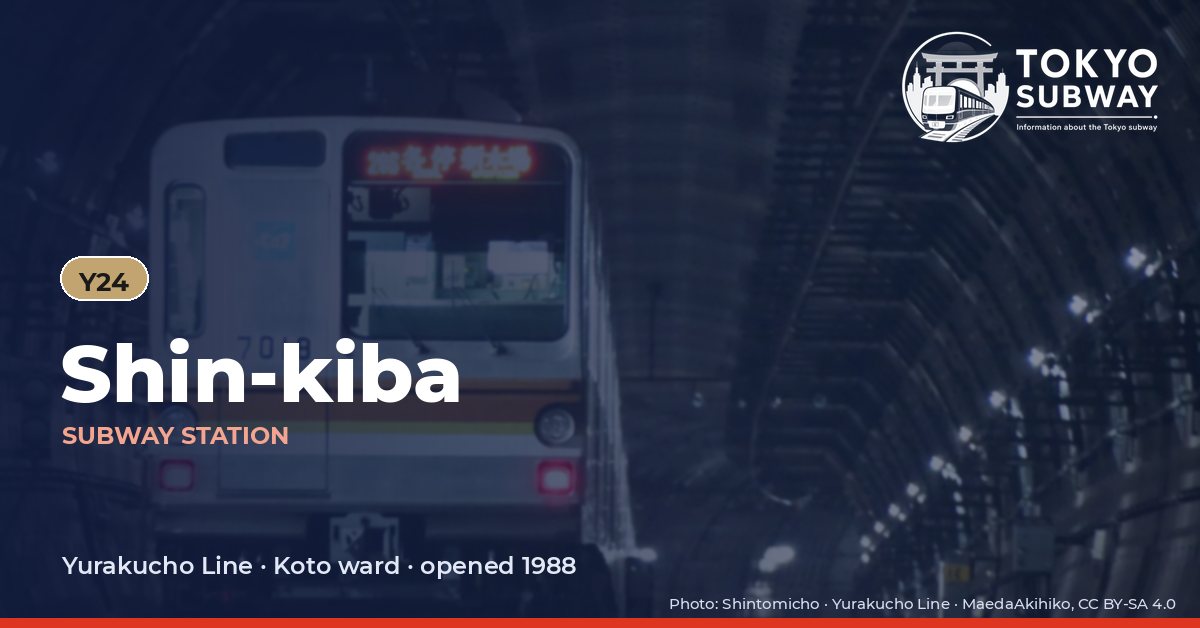
Finding Shin-kiba on the signs
Every line gives the station its own letter-and-number code. You never have to read the Japanese name to find the right platform.
Station numbers at Shin-kiba
Tokyo signposts every platform, exit and train door with a letter and a two-digit number. Matching the number is faster than reading the name — and it is what you will see on the map, in announcements and on the platform edge.
First and last trains at Shin-kiba
| Line and direction | Weekdays first – last | Saturdays, Sundays & holidays first – last |
|---|---|---|
| YYurakuchoY24 towards Wakoshi | 05:00 – 00:01 to Ikebukuro | 05:00 – 00:01 to Ikebukuro |
Departure times come from the operators’ own GTFS timetables (ODPT GTFS Toei-Train-GTFS (version 20261009, valid 2026-03-14..2027-03-12) + TokyoMetro-Train-GTFS (version 20261008, valid 2026-09-19..2027-03-12)). Japan publishes two subway timetables: 平日 weekdays and 土休日 Saturdays, Sundays and national holidays. There is no separate Sunday timetable, and the December 30 – January 3 period runs the holiday timetable.
How often do trains run?
| Line | Weekdays, busiest hour | Sat / Sun / holidays, busiest hour |
|---|---|---|
| YYurakucho | 16 trains/hour (about one every 3.8 min) | 12 trains/hour |
Departures in one direction during the hour with the most trains at this station, counted in the operators’ timetable.
Next stations from Shin-kiba
Scheduled running time between Shin-kiba and the stations either side of it.
| Line | Next station | Running time |
|---|---|---|
| YYurakucho | Y23Tatsumi | 2 min |
Transfers and connections
- JR: Keiyo Line (JR East). These are separate railways with their own fares.
- Other railways: Rinkai Line (Tokyo Waterfront Area Rapid Transit). These are separate railways with their own fares.
Accessibility
| Line | Step-free by elevator | Accessible toilet | Escalator | Exits |
|---|---|---|---|---|
| YYurakucho | Yes | Yes | Yes | 1 |
- Yurakucho Line: Step-free elevator route street-gate-platform (official “1-route by elevator”). Street elevator at exit(s): 出口. Operator page (checked Oct 20, 2026).
Taken from the operators’ own accessibility pages and nothing else. Tokyo Metro: the “1-route” (step-free street-gate-platform path by elevator, slope, stair lift or wheelchair escalator) is complete at all 180 stations; a separate list shows stations with an elevator-only 1-route.
What is near Shin-kiba Station?
Everything around Shin-kiba is on a large scale and spread out. The Yumenoshima Greenway starts about 260 m from the station and leads into Yumenoshima Park with its tropical greenhouse dome; the Shinkiba 1stRING event hall is about 160 m away and a herb garden about 90 m. The AgeHa club, the Tokyo Heliport and the Tokyo Gate Bridge are all places the station serves, and the Tokyo Metro depot takes up much of what is left.
| Place | Distance (straight line) | On foot, estimated |
|---|---|---|
| Yumenoshima Greenway 夢の島緑道公園 | 260 m | about 4 min |
| 新木場のハーブガーデン | 90 m | about 2 min |
| 新木場1stRING | 160 m | about 3 min |
Places from OpenStreetMap within 400 m of the station. The walking time is an estimate (straight line plus 30 %, 80 m a minute), not a measured route. © OpenStreetMap contributors, ODbL.
Frequently asked questions
No. The Yurakucho Line, the JR Keiyo Line and the Rinkai Line each keep their own platforms and their own ticket gates at Shin-kiba, so changing between them means leaving one station and entering another. The name is shared; the facilities are not.
Beyond the subway, in many cases. Services leave this terminus, run the length of the Yurakucho Line and then continue onto the Tobu Tojo Line or the Seibu Ikebukuro Line, so the destination boards here often name places outside the subway map altogether.