Edogawabashi Station
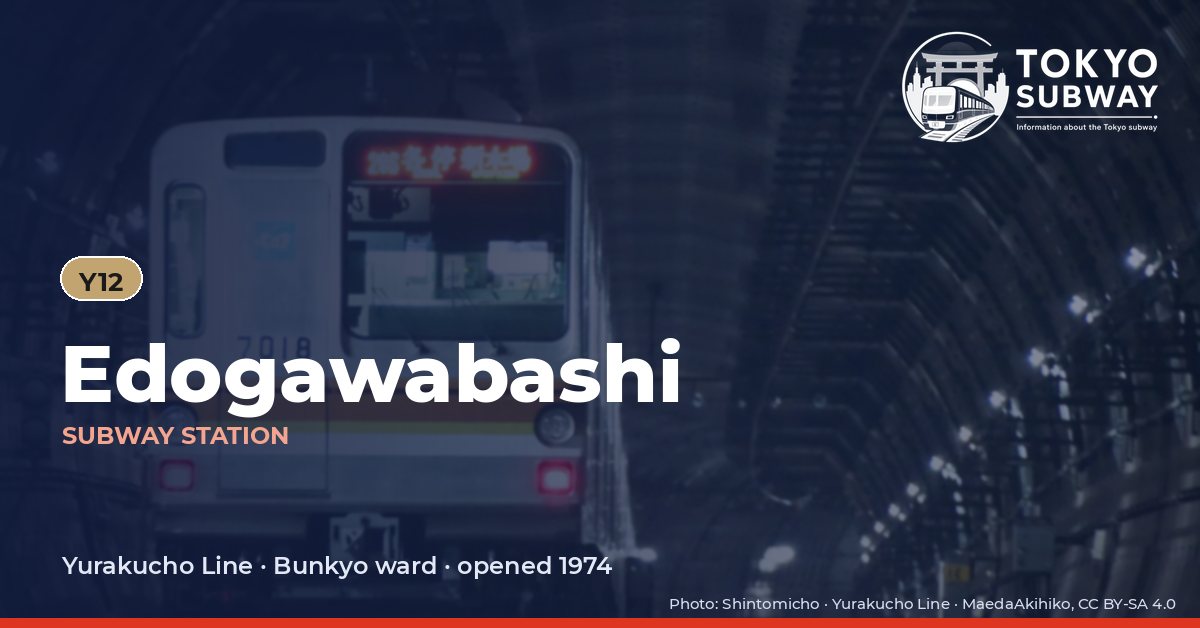
Y12 · Yurakucho Line · Bunkyo
Edogawabashi Station (江戸川橋)
The Edogawa in the name is not the river most people think of. It was the old name for the middle reach of the Kanda river, dropped in August 1970, and it survives here in the bridge that carries Mejiro-dori across the water, in a handful of local schools and parks, and in this station, which took the name straight from the tram stop that served the spot until March 1971. The Yurakucho Line opened the station as Y12 on 30 October 1974.
Its single island platform sits on an S-shaped curve, forced on the engineers by the river above, the flood diversion channel planned beneath the road and the piers of the Metropolitan Expressway. Sightlines along the platform are poor enough that a conductor cannot check the train alone, so two staff stand partway down it, and three at the busiest times, an arrangement that has largely disappeared elsewhere. The platform walls were rebuilt in 2005 with a decorative treatment of their own and larger rectangular name boards, and platform doors followed on 13 August 2011. The 2025 survey recorded 50,264 entries and exits a day.
Finding Edogawabashi on the signs
Every line gives the station its own letter-and-number code. You never have to read the Japanese name to find the right platform.
Station numbers at Edogawabashi
Tokyo signposts every platform, exit and train door with a letter and a two-digit number. Matching the number is faster than reading the name — and it is what you will see on the map, in announcements and on the platform edge.
First and last trains at Edogawabashi
| Line and direction | Weekdays first – last | Saturdays, Sundays & holidays first – last |
|---|---|---|
| YYurakuchoY12 towards Shin-kiba | 05:06 – 00:06 | 05:06 – 00:06 |
| YYurakuchoY12 towards Wakoshi | 05:05 – 00:26 to Ikebukuro | 05:05 – 00:26 to Ikebukuro |
Departure times come from the operators’ own GTFS timetables (ODPT GTFS Toei-Train-GTFS (version 20261009, valid 2026-03-14..2027-03-12) + TokyoMetro-Train-GTFS (version 20261008, valid 2026-09-19..2027-03-12)). Japan publishes two subway timetables: 平日 weekdays and 土休日 Saturdays, Sundays and national holidays. There is no separate Sunday timetable, and the December 30 – January 3 period runs the holiday timetable.
How often do trains run?
| Line | Weekdays, busiest hour | Sat / Sun / holidays, busiest hour |
|---|---|---|
| YYurakucho | 22 trains/hour (about one every 2.7 min) | 12 trains/hour |
Departures in one direction during the hour with the most trains at this station, counted in the operators’ timetable.
Next stations from Edogawabashi
Scheduled running time between Edogawabashi and the stations either side of it.
| Line | Next station | Running time |
|---|---|---|
| YYurakucho | Y11Gokokuji | 2 min |
| YYurakucho | Y13Iidabashi | 3 min |
Transfers and connections
Only the Yurakucho Line stops here, and no other railway serves this station, so there is nothing to transfer to inside the station.
Accessibility
| Line | Step-free by elevator | Accessible toilet | Escalator | Exits |
|---|---|---|---|---|
| YYurakucho | Yes | Yes | Yes | 8 |
- Yurakucho Line: Step-free elevator route street-gate-platform (official “1-route by elevator”). Operator page (checked Oct 20, 2026).
Taken from the operators’ own accessibility pages and nothing else. Tokyo Metro: the “1-route” (step-free street-gate-platform path by elevator, slope, stair lift or wheelchair escalator) is complete at all 180 stations; a separate list shows stations with an elevator-only 1-route.
What is near Edogawabashi Station?
This is the Sekiguchi corner of Bunkyo, and the station is the closest one to St Mary’s Cathedral in Tokyo. Seikoin Temple is about 180 m from the exits, Fukushoji Temple roughly 240 m and Denchu-ji around 270 m, part of a dense scatter of small temples and shrines through the surrounding blocks. Edogawa Elementary School stands about 320 m away and the Suidobata library some 360 m, with the Kanda river and its riverside path a few steps from the gates.
| Place | Distance (straight line) | On foot, estimated |
|---|---|---|
| Fukushoji Temple 福勝寺 | 240 m | about 4 min |
| Denchu-ji temple 田中寺 | 270 m | about 4 min |
| 小日向神社 | 190 m | about 3 min |
| 善仁寺 | 360 m | about 6 min |
| 日輪寺 | 390 m | about 6 min |
| Seikoin Temple 清光院 | 180 m | about 3 min |
| 関口一丁目児童遊園 | 150 m | about 2 min |
| 妙足院 | 200 m | about 3 min |
Places from OpenStreetMap within 400 m of the station. The walking time is an estimate (straight line plus 30 %, 80 m a minute), not a measured route. © OpenStreetMap contributors, ODbL.