Jimbocho Station
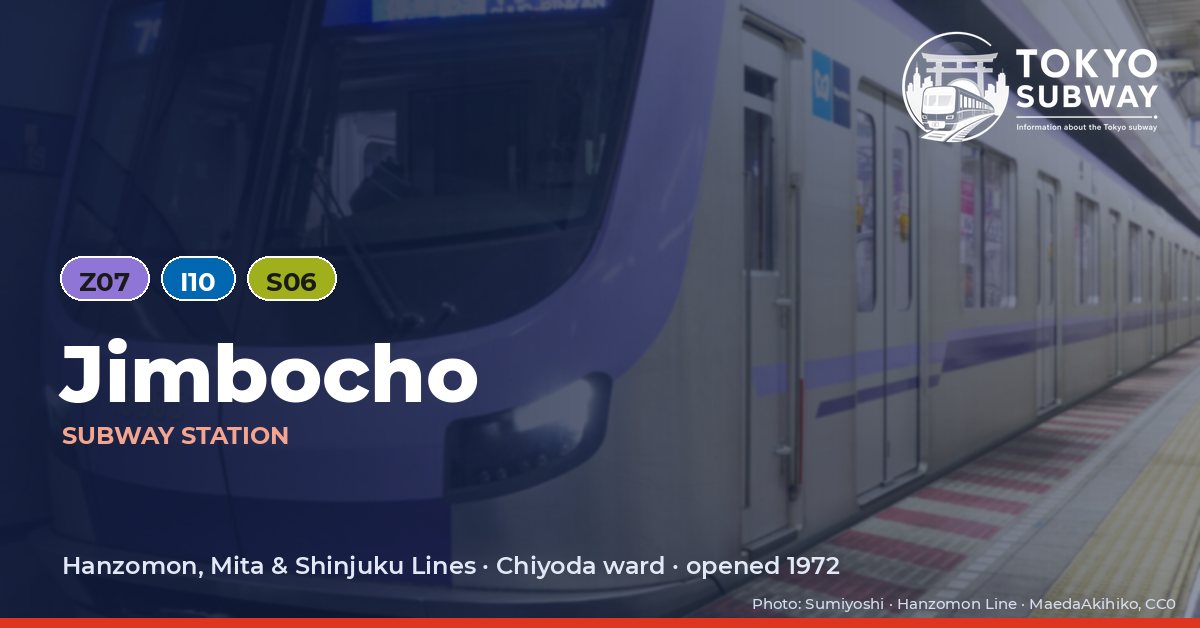
Z07 I10 S06 · Hanzomon Line, Mita Line, and Shinjuku Line · Chiyoda
Jimbocho Station (神保町)
Jimbocho was designed for one line and ended up with three. Toei’s Mita Line platform opened on 30 June 1972; by then the Shinjuku Line and the Hanzomon Line had been approved, so the box for the Shinjuku Line and the piles for the Hanzomon trench were built during that first excavation and used when those lines arrived, on 16 March 1980 and 26 January 1989 – the latter the first new station opened in the Heisei era.
The three platforms are stacked rather than side by side, with the Shinjuku Line highest and the Hanzomon Line lowest. At Kudanshita, one stop away, Yasukuni-dori is wide enough to take two lines on the same level; here it narrows, so the Shinjuku Line climbs a steep gradient into the station while the Hanzomon Line dives below. Their platform centres end up about 150 m apart, and the structure runs some 375 m from end to end, roughly twice the length of an ordinary station. Tokyo Metro counted 88,450 entries and exits a day in 2025; Toei recorded 139,451 on the Mita Line and 123,381 on the Shinjuku Line in 2024.
Finding Jimbocho on the signs
Every line gives the station its own letter-and-number code. You never have to read the Japanese name to find the right platform.
Station numbers at Jimbocho
Tokyo signposts every platform, exit and train door with a letter and a two-digit number. Matching the number is faster than reading the name — and it is what you will see on the map, in announcements and on the platform edge.
First and last trains at Jimbocho
| Line and direction | Weekdays first – last | Saturdays, Sundays & holidays first – last |
|---|---|---|
| ZHanzomonZ07 towards Oshiage (Skytree) | 05:12 – 00:26 to Kiyosumi-shirakawa | 05:11 – 00:06 to Kiyosumi-shirakawa |
| ZHanzomonZ07 towards Shibuya | 05:09 – 00:25 | 05:09 – 00:11 |
| IMitaI10 towards Nishi-takashimadaira | 05:14 – 00:15 to Takashimadaira | 05:14 – 00:15 to Takashimadaira |
| IMitaI10 towards Meguro | 05:15 to Shirokane-takanawa – 00:18 to Shirokane-takanawa | 05:15 to Shirokane-takanawa – 00:18 to Shirokane-takanawa |
| SShinjukuS06 towards Motoyawata | 05:10 – 00:20 to Iwamotocho | 05:10 – 00:20 to Iwamotocho |
| SShinjukuS06 towards Shinjuku | 05:04 – 00:19 | 05:04 – 00:19 |
Departure times come from the operators’ own GTFS timetables (ODPT GTFS Toei-Train-GTFS (version 20261009, valid 2026-03-14..2027-03-12) + TokyoMetro-Train-GTFS (version 20261008, valid 2026-09-19..2027-03-12)). Japan publishes two subway timetables: 平日 weekdays and 土休日 Saturdays, Sundays and national holidays. There is no separate Sunday timetable, and the December 30 – January 3 period runs the holiday timetable.
How often do trains run?
Departures in one direction during the hour with the most trains at this station, counted in the operators’ timetable.
Next stations from Jimbocho
Scheduled running time between Jimbocho and the stations either side of it.
| Line | Next station | Running time |
|---|---|---|
| ZHanzomon | Z06Kudanshita | 2 min |
| ZHanzomon | Z08Otemachi | 3 min |
| IMita | I09Otemachi | 2 min |
| IMita | I11Suidobashi | 1 min |
| SShinjuku | S05Kudanshita | 1 min |
| SShinjuku | S07Ogawamachi | 2 min |
Transfers and connections
- Subway: transfer between Hanzomon Line, Mita Line, and Shinjuku Line. The Tokyo Metro lines and the Toei Subway lines belong to different companies, so a trip that uses both costs more than one operator alone — see fares.
Accessibility
- Hanzomon Line: Step-free elevator route street-gate-platform (official “1-route by elevator”). Street elevator at exit(s): A2, A8, A9. Operator page (checked Oct 20, 2026).
- Mita Line: Toei: step-free “1-route” secured; 2 elevator(s) on this line. Elevator exit(s): A2, A9. Operator page (checked Oct 20, 2026).
- Shinjuku Line: Toei: step-free “1-route” secured; 5 elevator(s) on this line. Elevator exit(s): A2, A9. Operator page (checked Oct 20, 2026).
Taken from the operators’ own accessibility pages and nothing else. Tokyo Metro: the “1-route” (step-free street-gate-platform path by elevator, slope, stair lift or wheelchair escalator) is complete at all 180 stations; a separate list shows stations with an elevator-only 1-route. Toei: every station has elevators and a street-gate-platform “1-route” is secured.
What is near Jimbocho Station?
The Kanda book town starts at the exits, about 60 m away: the densest concentration of second-hand bookshops in the city, with the publishing houses of Iwanami Shoten, Shogakukan and Shueisha in the same few blocks. Senshu University is roughly 330 m from the gates and gives the station its unofficial second name, with the Nippon Institute of Technology about 110 m, Kyoritsu Women’s University around 280 m and Meiji University some 370 m. The Mita Art Gallery is about 70 m off, and Jimbocho Aizen Park roughly 190 m.
| Place | Distance (straight line) | On foot, estimated |
|---|---|---|
| Kanda Book Town 神田古書店街 | 60 m | about 1 min |
| Kyoritsu Auditorium 共立講堂 | 300 m | about 5 min |
| Senshu University 専修大学 | 330 m | about 5 min |
| Mita Art Gallery 三田アート画廊 | 70 m | about 1 min |
| Nippon Institute of Technology 日本工業大学 | 110 m | about 2 min |
| Jimbocho Aizen Park 神保町愛全公園 | 190 m | about 3 min |
| Kyoritsu Women's University 共立女子大学(文芸学部) | 280 m | about 5 min |
| Kyoritsu Women's University 共立女子中学高等学校 | 290 m | about 5 min |
Places from OpenStreetMap within 400 m of the station. The walking time is an estimate (straight line plus 30 %, 80 m a minute), not a measured route. © OpenStreetMap contributors, ODbL.