
Motohasunuma Station
I20 · Mita Line · Itabashi
Motohasunuma Station (本蓮沼)
The name is a compromise. The planners wanted to call this station Hasunuma, but the Tokyu Ikegami Line — the railway the Mita Line was then meant to connect with — already had a Hasunuma, so the station took Motohasunuma from Shimura-Motohasunuma-cho, the name this part of Itabashi carried until 1961. I20 opened on 27 December 1968 with what was still called Toei Line 6; the Mita Line name followed on 1 July 1978.
It is a plain two-platform station with one useful piece of equipment: an emergency crossover on the Shimura-sakaue side. Because the next station along has no way of turning trains back, services are sometimes reversed at Motohasunuma when wind or snow disrupts the open-air section of the line further out. Exit A4 and the ticket gate facing Izumi Park opened on 1 April 2010, and trains from these platforms run through onto Tokyu and Sotetsu tracks beyond the subway.
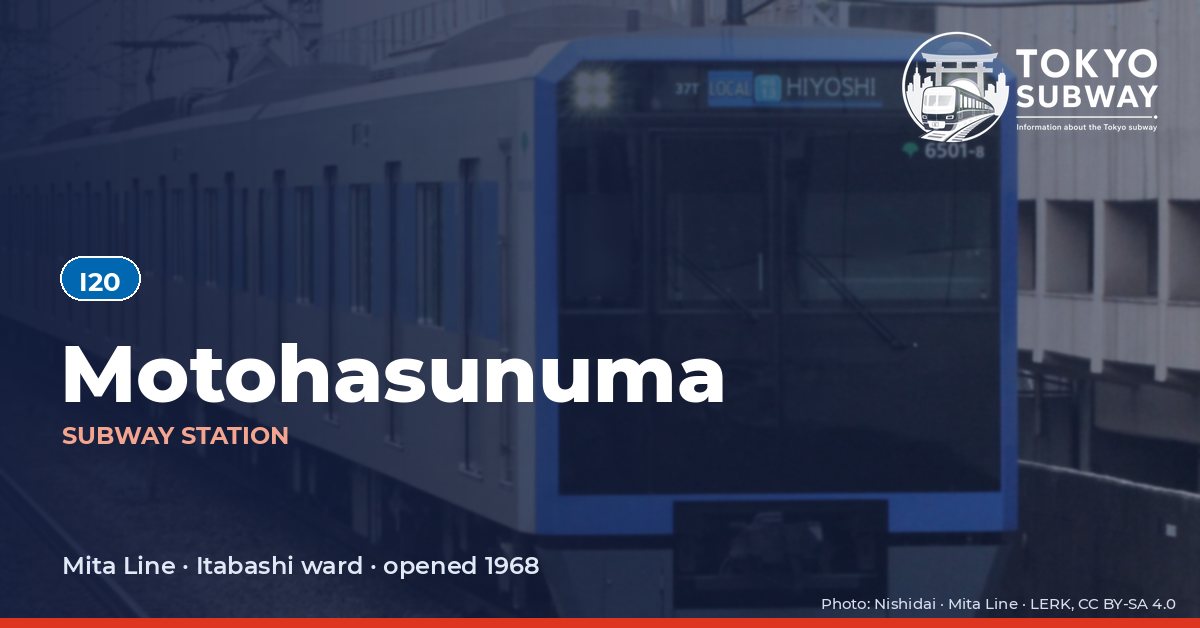
Finding Motohasunuma on the signs
Every line gives the station its own letter-and-number code. You never have to read the Japanese name to find the right platform.
Station numbers at Motohasunuma
Tokyo signposts every platform, exit and train door with a letter and a two-digit number. Matching the number is faster than reading the name — and it is what you will see on the map, in announcements and on the platform edge.
First and last trains at Motohasunuma
Departure times come from the operators’ own GTFS timetables (ODPT GTFS Toei-Train-GTFS (version 20261009, valid 2026-03-14..2027-03-12) + TokyoMetro-Train-GTFS (version 20261008, valid 2026-09-19..2027-03-12)). Japan publishes two subway timetables: 平日 weekdays and 土休日 Saturdays, Sundays and national holidays. There is no separate Sunday timetable, and the December 30 – January 3 period runs the holiday timetable.
How often do trains run?
| Line | Weekdays, busiest hour | Sat / Sun / holidays, busiest hour |
|---|---|---|
| IMita | 20 trains/hour (about one every 3 min) | 11 trains/hour |
Departures in one direction during the hour with the most trains at this station, counted in the operators’ timetable.
Next stations from Motohasunuma
Scheduled running time between Motohasunuma and the stations either side of it.
| Line | Next station | Running time |
|---|---|---|
| IMita | I19Itabashihoncho | 1 min |
| IMita | I21Shimura-sakaue | 1 min |
Transfers and connections
Only the Mita Line stops here, and no other railway serves this station, so there is nothing to transfer to inside the station.
Accessibility
| Line | Step-free by elevator | Accessible toilet | Escalator | Exits |
|---|---|---|---|---|
| IMita | Yes | Yes | Not listed | 4 |
- Mita Line: Toei: step-free “1-route” secured; 2 elevator(s) on this line. Elevator exit(s): A2, A4. Operator page (checked Oct 20, 2026).
Taken from the operators’ own accessibility pages and nothing else. Toei: every station has elevators and a street-gate-platform “1-route” is secured.
What is near Motohasunuma Station?
Motohasunuma serves a quiet stretch of Itabashi, and the landmarks are small. Izumi Park lies about 70 m from the exits, with Hikawa shrine roughly 230 m away, the Nanzo-in temple some 260 m and the Shimizucho library about 260 m; another park is around 280 m out. Shops are the everyday kind, and most of the traffic through the gates is people living within walking distance.
| Place | Distance (straight line) | On foot, estimated |
|---|---|---|
| Hikawa-jinja Shrine 氷川神社 | 230 m | about 4 min |
| Izumi Park いずみ公園 | 70 m | about 1 min |
| Nanzo-in 南蔵院 | 260 m | about 4 min |
| 大原公園 | 280 m | about 4 min |
| Shimizucho Library | 260 m | about 4 min |
| Casa Verace | 310 m | about 5 min |
Places from OpenStreetMap within 400 m of the station. The walking time is an estimate (straight line plus 30 %, 80 m a minute), not a measured route. © OpenStreetMap contributors, ODbL.
Frequently asked questions
Because the name was taken. The Mita Line was planned to run through with the Tokyu Ikegami Line, which already had a Hasunuma station, so this one was named after Shimura-Motohasunuma-cho, the local place name in use until 1961.
There is an emergency crossover just beyond the platforms, and the next station has no equivalent. When wind or snow interferes with the above-ground section further along the Mita Line, trains can be reversed here instead of running into the disruption.