
Sengoku Station
I14 · Mita Line · Bunkyo
Sengoku Station (千石)
Sengoku was nearly called Kagomachi. That was the old name of the district, and a 1919 transport study for the city had already pencilled in a Kagomachi station on a planned Shibuya–Otsuka line; the provisional name stayed on the drawings until shortly before opening. What opened, on 30 June 1972, was a station on Toei Line 6 — the Mita Line did not take that name until 1 July 1978.
The platform is a single island with a ticket hall at either end, running under Hakusan-dori from the Shinobazu-dori crossing to the point where the old and new stretches of Hakusan-dori part company. I14 is the northernmost station in Bunkyo, and Toei’s 2024 survey counted 31,304 passengers a day.
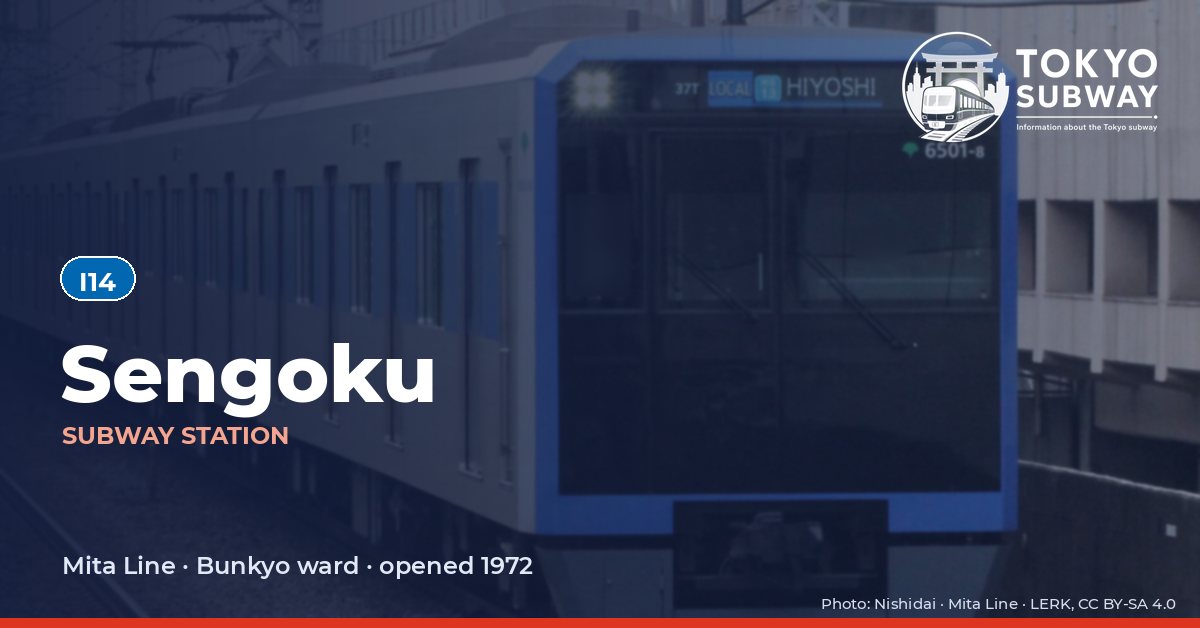
Finding Sengoku on the signs
Every line gives the station its own letter-and-number code. You never have to read the Japanese name to find the right platform.
Station numbers at Sengoku
Tokyo signposts every platform, exit and train door with a letter and a two-digit number. Matching the number is faster than reading the name — and it is what you will see on the map, in announcements and on the platform edge.
First and last trains at Sengoku
| Line and direction | Weekdays first – last | Saturdays, Sundays & holidays first – last |
|---|---|---|
| IMitaI14 towards Nishi-takashimadaira | 05:22 – 00:23 to Takashimadaira | 05:22 – 00:23 to Takashimadaira |
| IMitaI14 towards Meguro | 05:06 to Shirokane-takanawa – 00:10 to Shirokane-takanawa | 05:06 to Shirokane-takanawa – 00:10 to Shirokane-takanawa |
Departure times come from the operators’ own GTFS timetables (ODPT GTFS Toei-Train-GTFS (version 20261009, valid 2026-03-14..2027-03-12) + TokyoMetro-Train-GTFS (version 20261008, valid 2026-09-19..2027-03-12)). Japan publishes two subway timetables: 平日 weekdays and 土休日 Saturdays, Sundays and national holidays. There is no separate Sunday timetable, and the December 30 – January 3 period runs the holiday timetable.
How often do trains run?
| Line | Weekdays, busiest hour | Sat / Sun / holidays, busiest hour |
|---|---|---|
| IMita | 19 trains/hour (about one every 3.2 min) | 11 trains/hour |
Departures in one direction during the hour with the most trains at this station, counted in the operators’ timetable.
Transfers and connections
Only the Mita Line stops here, and no other railway serves this station, so there is nothing to transfer to inside the station.
Accessibility
| Line | Step-free by elevator | Accessible toilet | Escalator | Exits |
|---|---|---|---|---|
| IMita | Yes | Yes | Yes | 5 |
- Mita Line: Toei: step-free “1-route” secured; 2 elevator(s) on this line. Elevator exit(s): A5. Operator page (checked Oct 20, 2026).
Taken from the operators’ own accessibility pages and nothing else. Toei: every station has elevators and a street-gate-platform “1-route” is secured.
What is near Sengoku Station?
Everything near the exits is small in scale: the ward’s Sengoku library about 120 m away, Kagomachi Park about 130 m, and a string of children’s playgrounds — Sengoku 1-chome, Sengoku 4-chome, Hayashicho — filling the gaps between apartment blocks. Hiroo Gakuen Koishikawa junior and senior high school stands roughly 200 m from the station and a kindergarten about 260 m, with the Sengoku green space and Sengoku Park further out. The Rikugien garden and the Toyo Bunko library are among the places the station serves.
| Place | Distance (straight line) | On foot, estimated |
|---|---|---|
| Kagomachi Park 駕籠町公園 | 130 m | about 2 min |
| Sengokuryokuchi Park 千石緑地 | 250 m | about 4 min |
| Sengoku Park 千石公園 | 400 m | about 6 min |
| 千石一丁目 児童遊園 | 110 m | about 2 min |
| 千石四丁目 児童遊園 | 310 m | about 5 min |
| 林町児童遊園 | 370 m | about 6 min |
| Keihoku Kindergarten 京北幼稚園 | 260 m | about 4 min |
| 広尾学園小石川中学校・高等学校 | 200 m | about 3 min |
Places from OpenStreetMap within 400 m of the station. The walking time is an estimate (straight line plus 30 %, 80 m a minute), not a measured route. © OpenStreetMap contributors, ODbL.
Frequently asked questions
Kagomachi, after the former name of the neighborhood. A 1919 study of Tokyo’s transport had already listed a Kagomachi station on a planned Shibuya–Otsuka route, and the name survived as the working title until shortly before the station opened in 1972.
Because that is what the Mita Line was called at the time. Sengoku opened on 30 June 1972 as a station on Toei Line 6, and the line was renamed the Mita Line on 1 July 1978. Plans and photographs from the first six years use the old name.