Machiya Station
C17 · Chiyoda Line · Arakawa
Machiya Station (町屋)
Three different kinds of railway stop at Machiya, and the oldest is the smallest. A tram stop opened here on 1 April 1913 under the Oji Electric Tramway and survives as Machiya-ekimae on the Tokyo Sakura Tram, Toei’s surviving streetcar line. Keisei’s station followed on 19 December 1931, and the subway arrived last, on 20 December 1969, when C17 opened with the first section of the Chiyoda Line.
The combination makes a small Arakawa station work harder than its four exits suggest. Passengers off the Keisei Main Line and the tram pour onto the subway here, and in the transport ministry’s 2015 figures the run from Machiya toward Nishi-nippori was listed among the most crowded rail segments in Tokyo. Chiyoda Line trains themselves do not stop at the edge of the subway: they continue onto JR East’s Joban tracks at one end and Odakyu’s at the other, so a train leaving this platform may be bound for the suburbs of Kanagawa.
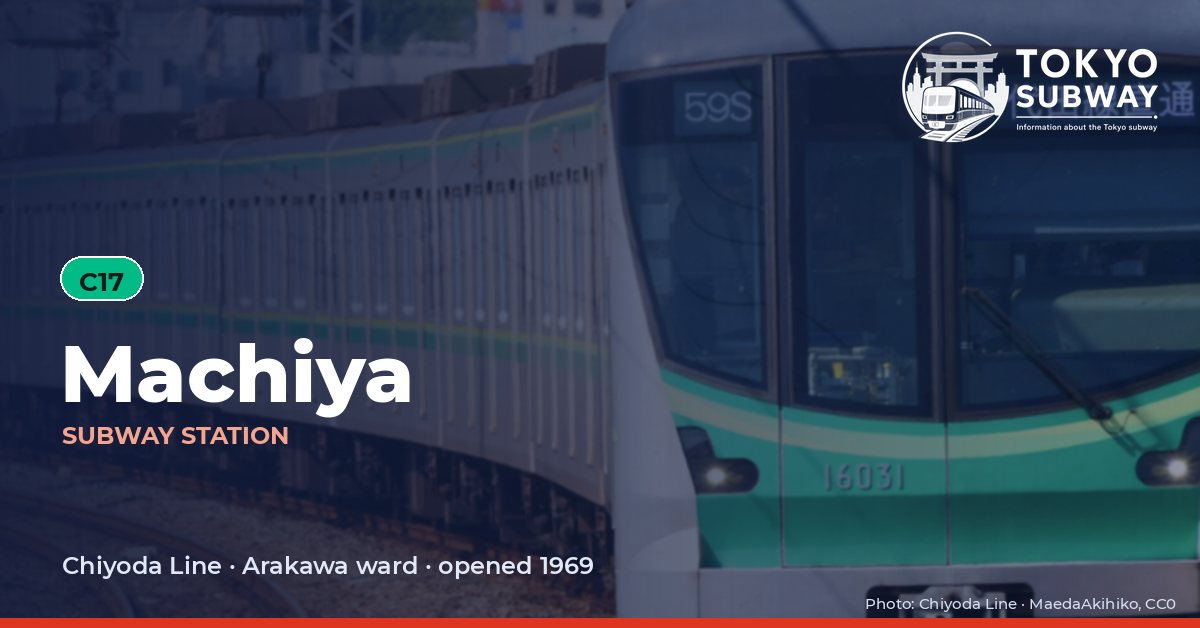
Finding Machiya on the signs
Every line gives the station its own letter-and-number code. You never have to read the Japanese name to find the right platform.
Station numbers at Machiya
Tokyo signposts every platform, exit and train door with a letter and a two-digit number. Matching the number is faster than reading the name — and it is what you will see on the map, in announcements and on the platform edge.
First and last trains at Machiya
| Line and direction | Weekdays first – last | Saturdays, Sundays & holidays first – last |
|---|---|---|
| CChiyodaC17 towards Ayase | 05:08 – 00:32 | 05:08 – 00:28 |
| CChiyodaC17 towards Yoyogi-uehara | 05:07 – 00:12 | 05:07 – 00:11 to Kasumigaseki |
Departure times come from the operators’ own GTFS timetables (ODPT GTFS Toei-Train-GTFS (version 20261009, valid 2026-03-14..2027-03-12) + TokyoMetro-Train-GTFS (version 20261008, valid 2026-09-19..2027-03-12)). Japan publishes two subway timetables: 平日 weekdays and 土休日 Saturdays, Sundays and national holidays. There is no separate Sunday timetable, and the December 30 – January 3 period runs the holiday timetable.
How often do trains run?
| Line | Weekdays, busiest hour | Sat / Sun / holidays, busiest hour |
|---|---|---|
| CChiyoda | 25 trains/hour (about one every 2.4 min) | 13 trains/hour |
Departures in one direction during the hour with the most trains at this station, counted in the operators’ timetable.
Next stations from Machiya
Scheduled running time between Machiya and the stations either side of it.
| Line | Next station | Running time |
|---|---|---|
| CChiyoda | C18Kita-senju | 4 min |
| CChiyoda | C16Nishi-nippori | 3 min |
Transfers and connections
- Private railways: Keisei Main Line (Keisei Electric Railway). These are separate railways with their own fares.
- Tram: Tokyo Sakura Tram (Arakawa Line) (Tokyo Metropolitan Bureau of Transportation). These are separate railways with their own fares.
Accessibility
| Line | Step-free by elevator | Accessible toilet | Escalator | Exits |
|---|---|---|---|---|
| CChiyoda | Yes | Yes | Yes | 4 |
- Chiyoda Line: Step-free elevator route street-gate-platform (official “1-route by elevator”). Operator page (checked Oct 20, 2026).
Taken from the operators’ own accessibility pages and nothing else. Tokyo Metro: the “1-route” (step-free street-gate-platform path by elevator, slope, stair lift or wheelchair escalator) is complete at all 180 stations; a separate list shows stations with an elevator-only 1-route.
What is near Machiya Station?
Machiya serves a dense part of Arakawa where the attractions are local rather than famous. Takeuchi Hospital is about 90 m from the exits, Arakawa-nichome Park roughly 290 m and a disaster-prevention park about 360 m, with four or five children’s playgrounds inside the same radius. The Machiya Bunka Center, Arakawa Shizen Park and the Mikawashima sewage treatment works are the other places the station is used for; Toei and Keisei buses both call outside.
| Place | Distance (straight line) | On foot, estimated |
|---|---|---|
| 泊船軒 | 200 m | about 3 min |
| Arakawa-nichome Park 荒川二丁目公園 | 290 m | about 5 min |
| Arakawa-nichome Disaster Prevention Park 荒川二丁目 防災広場 | 360 m | about 6 min |
| 花の木児童遊園 | 200 m | about 3 min |
| 新地児童遊園 | 240 m | about 4 min |
| 荒川六丁目 児童遊園 | 360 m | about 6 min |
| 荒川五丁目 公園 | 390 m | about 6 min |
| Takeuchi Hospital 真光会竹内病院 | 90 m | about 1 min |
Places from OpenStreetMap within 400 m of the station. The walking time is an estimate (straight line plus 30 %, 80 m a minute), not a measured route. © OpenStreetMap contributors, ODbL.
Frequently asked questions
Yes. The tram stop, Machiya-ekimae, is run by Toei and is the oldest part of the complex, dating from 1913. It is a street tramway rather than a subway line, so it has its own stop and its own fares.
The tram, in April 1913. Keisei opened its station in December 1931, and the subway only in December 1969 — a 56-year gap between the first rails and the Chiyoda Line platform that now carries most of the traffic.