
Minami-senju Station
H21 · Hibiya Line · Arakawa
Minami-senju Station (南千住)
Minami-senju was in at the beginning of the Hibiya Line: on 28 March 1961 the line opened with five stations, from Naka-okachimachi to here, and this was the end of it until the extension to Kita-senju on 31 May 1962. The subway platforms are two elevated side platforms, H21. The Joban Line station beside them is much older, dating from 25 December 1896, and the Tsukuba Express added underground platforms on 24 August 2005.
The three railways never became one building. Each company has its own station house, so changing between them means leaving the gates and crossing a road — worth knowing before you plan a tight connection. Tokyo Metro rebuilt its station in 2005 at the same time as the Tsukuba Express works, added a solar installation in February 2015 and brought in departure melodies on 7 February 2020. Hibiya Line trains do not stop at the subway boundary either: beyond Kita-senju they run through onto Tobu tracks, so some of the services calling at these platforms are heading well out of the city.
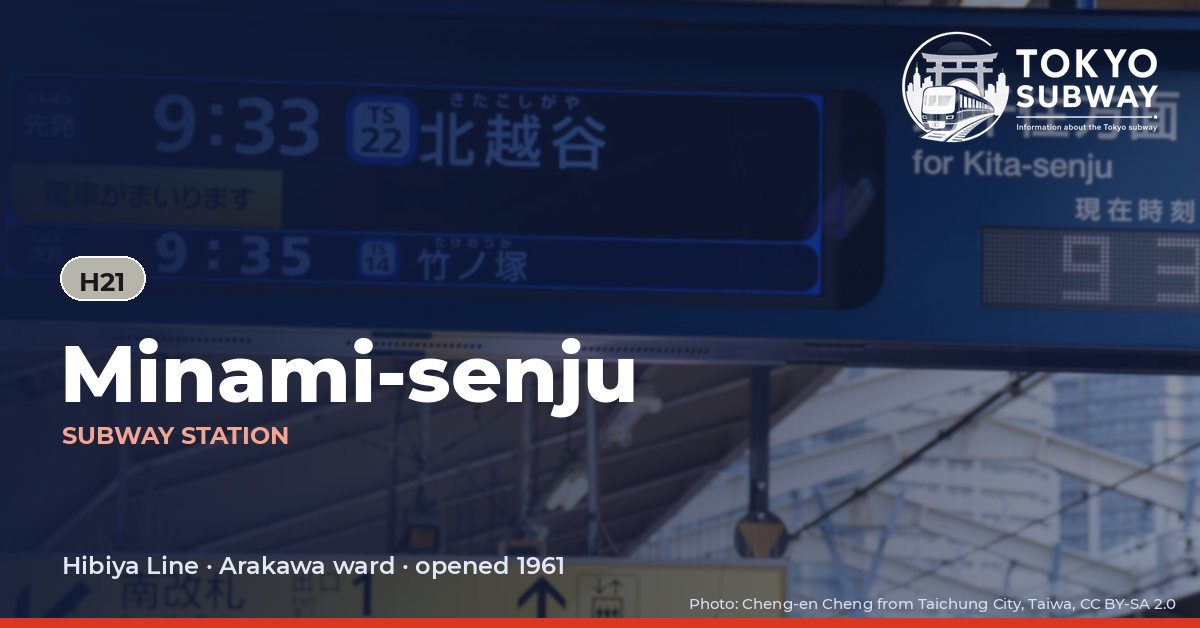
Finding Minami-senju on the signs
Every line gives the station its own letter-and-number code. You never have to read the Japanese name to find the right platform.
Station numbers at Minami-senju
Tokyo signposts every platform, exit and train door with a letter and a two-digit number. Matching the number is faster than reading the name — and it is what you will see on the map, in announcements and on the platform edge.
First and last trains at Minami-senju
| Line and direction | Weekdays first – last | Saturdays, Sundays & holidays first – last |
|---|---|---|
| HHibiyaH21 towards Kita-senju | 05:02 – 00:29 | 05:02 – 00:29 |
| HHibiyaH21 towards Naka-meguro | 05:03 – 23:55 | 05:03 – 23:55 |
Departure times come from the operators’ own GTFS timetables (ODPT GTFS Toei-Train-GTFS (version 20261009, valid 2026-03-14..2027-03-12) + TokyoMetro-Train-GTFS (version 20261008, valid 2026-09-19..2027-03-12)). Japan publishes two subway timetables: 平日 weekdays and 土休日 Saturdays, Sundays and national holidays. There is no separate Sunday timetable, and the December 30 – January 3 period runs the holiday timetable.
How often do trains run?
| Line | Weekdays, busiest hour | Sat / Sun / holidays, busiest hour |
|---|---|---|
| HHibiya | 26 trains/hour (about one every 2.3 min) | 13 trains/hour |
Departures in one direction during the hour with the most trains at this station, counted in the operators’ timetable.
Next stations from Minami-senju
Scheduled running time between Minami-senju and the stations either side of it.
| Line | Next station | Running time |
|---|---|---|
| HHibiya | H22Kita-senju | 3 min |
| HHibiya | H20Minowa | 2 min |
Transfers and connections
- JR: Joban Rapid Line (JR East). These are separate railways with their own fares.
- Other railways: Tsukuba Express Line (Metropolitan Intercity Railway). These are separate railways with their own fares.
Accessibility
| Line | Step-free by elevator | Accessible toilet | Escalator | Exits |
|---|---|---|---|---|
| HHibiya | Yes | Yes | Yes | 2 |
- Hibiya Line: Step-free elevator route street-gate-platform (official “1-route by elevator”). Operator page (checked Oct 20, 2026).
Taken from the operators’ own accessibility pages and nothing else. Tokyo Metro: the “1-route” (step-free street-gate-platform path by elevator, slope, stair lift or wheelchair escalator) is complete at all 180 stations; a separate list shows stations with an elevator-only 1-route.
What is near Minami-senju Station?
The ground here has a heavy history. From 1650 to 1873 this was the Kozukappara execution ground, where between 100,000 and 200,000 people are thought to have died; Ekoin, about 90 m from the exits, keeps the burial ground, part of which lies under the Hibiya Line tracks, and a Jizo statue associated with the site stands roughly 130 m away. Enmeiji is about 110 m out. Beyond that the area is the San’ya district, known for cheap lodging, with the Sumidagawa freight terminal alongside.
| Place | Distance (straight line) | On foot, estimated |
|---|---|---|
| Enmeiji 延命寺 | 110 m | about 2 min |
| Kozukawara Ekoin 小塚原回向院 | 90 m | about 1 min |
| Minami Senju 5-Chome Disaster Space 南千住五丁目防災広場 | 230 m | about 4 min |
| 三瑞児童遊園 | 270 m | about 4 min |
| Beheading Jizo 首切地蔵 | 130 m | about 2 min |
| Obana 尾花 | 190 m | about 3 min |
| 草津湯 | 360 m | about 6 min |
Places from OpenStreetMap within 400 m of the station. The walking time is an estimate (straight line plus 30 %, 80 m a minute), not a measured route. © OpenStreetMap contributors, ODbL.
Frequently asked questions
No. The three operators have separate station buildings at Minami-senju, so you leave the subway gates, cross a road and enter the other station from the street. Allow extra time, and buy a new ticket or tap in again for the second railway.
Kozukappara, an execution ground in use from 1650 to 1873, where estimates of the dead run between 100,000 and 200,000. The Ekoin temple and its graveyard, close to the subway’s south exit, commemorate it, and part of the old grounds now lies beneath the Hibiya Line tracks.