
Ayase Station
C19 · Chiyoda Line · Adachi
Ayase Station (綾瀬)
Ayase has been a railway station since 1 April 1943, when it opened on the Joban Line under the Japanese Government Railways. The subway took it over on 20 April 1971: the Chiyoda Line replaced Joban Line local service between Kita-senju and Ayase, and the Teito Rapid Transit Authority assumed management of the station from JNR. The branch to Kita-ayase opened on 20 December 1979, and the line boundary with JR still lies just beyond the junction for it.
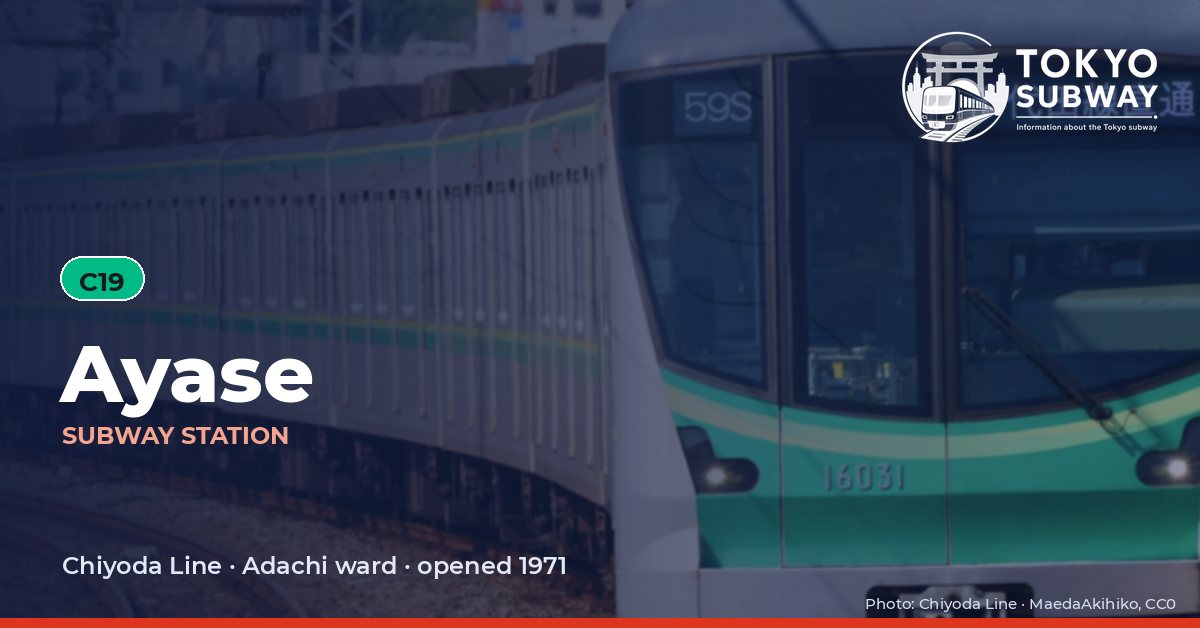
The track layout is unlike anywhere else on the network. There is a side platform serving one track, two island platforms serving three more, and a rectangular bay cut into the structure for the three-car Kita-ayase shuttles – the only Platform 0 in the Tokyo Metro system. Platforms 2 and 3 handle trains that start and finish here. Ayase also serves as the turnaround for Odakyu Romancecar services that run through the Chiyoda Line, and as the place where new Tokyo Metro trainsets are handed over: JR Freight hauls them in during the middle of the night for the short trip to the depot. The 2025 survey recorded 392,964 entries and exits a day.
Finding Ayase on the signs
Every line gives the station its own letter-and-number code. You never have to read the Japanese name to find the right platform.
Station numbers at Ayase
Tokyo signposts every platform, exit and train door with a letter and a two-digit number. Matching the number is faster than reading the name — and it is what you will see on the map, in announcements and on the platform edge.
First and last trains at Ayase
| Line and direction | Weekdays first – last | Saturdays, Sundays & holidays first – last |
|---|---|---|
| CChiyodaC19 towards Ayase | 05:07 – 00:22 | 05:13 – 00:25 |
| CChiyodaC19 towards Yoyogi-uehara | 04:38 to Kita-senju – 00:27 to Kita-senju | 04:38 to Kita-senju – 00:27 to Kita-senju |
Departure times come from the operators’ own GTFS timetables (ODPT GTFS Toei-Train-GTFS (version 20261009, valid 2026-03-14..2027-03-12) + TokyoMetro-Train-GTFS (version 20261008, valid 2026-09-19..2027-03-12)). Japan publishes two subway timetables: 平日 weekdays and 土休日 Saturdays, Sundays and national holidays. There is no separate Sunday timetable, and the December 30 – January 3 period runs the holiday timetable.
How often do trains run?
| Line | Weekdays, busiest hour | Sat / Sun / holidays, busiest hour |
|---|---|---|
| CChiyoda | 25 trains/hour (about one every 2.4 min) | 12 trains/hour |
Departures in one direction during the hour with the most trains at this station, counted in the operators’ timetable.
Next stations from Ayase
Scheduled running time between Ayase and the stations either side of it.
| Line | Next station | Running time |
|---|---|---|
| CChiyoda | C20Kita-ayase | 4 min |
| CChiyoda | C18Kita-senju | 4 min |
Transfers and connections
- JR: Joban Local Line (JR East). These are separate railways with their own fares.
Accessibility
| Line | Step-free by elevator | Accessible toilet | Escalator | Exits |
|---|---|---|---|---|
| CChiyoda | Yes | Yes | Yes | 2 |
- Chiyoda Line: Step-free elevator route street-gate-platform (official “1-route by elevator”). Operator page (checked Oct 20, 2026).
Taken from the operators’ own accessibility pages and nothing else. Tokyo Metro: the “1-route” (step-free street-gate-platform path by elevator, slope, stair lift or wheelchair escalator) is complete at all 180 stations; a separate list shows stations with an elevator-only 1-route.
What is near Ayase Station?
Adachi ward spreads out from the gates, with the Ayase river nearby and the Tokyo Detention House among the institutions the station serves, along with Tokyo Kohoku High School and Higashi-Ayase Junior High School. Kannonji Temple is about 220 m from the exits, Ayase Elementary School roughly 350 m and the Tokyo Budokan around 360 m, with Higashi Ayase park a little beyond the station’s immediate surroundings. The bus interchange on the eastern forecourt feeds much of the traffic into the gates.
| Place | Distance (straight line) | On foot, estimated |
|---|---|---|
| Kannonji Temple 觀音寺 | 220 m | about 4 min |
| 綾瀬稲荷神社 | 220 m | about 4 min |
| 養福寺 | 300 m | about 5 min |
| 袋橋公園 | 190 m | about 3 min |
| 綾瀬北野神社 | 280 m | about 5 min |
| 北野公園 | 370 m | about 6 min |
| Ayase Elementary School 足立区立綾瀬小学校 | 350 m | about 6 min |
| Tokyo Budokan 東京武道館 | 360 m | about 6 min |
Places from OpenStreetMap within 400 m of the station. The walking time is an estimate (straight line plus 30 %, 80 m a minute), not a measured route. © OpenStreetMap contributors, ODbL.