
Akihabara Station
H16 · Hibiya Line · Chiyoda
Akihabara Station (秋葉原)
The subway arrived at Akihabara long after everything else. JR’s tracks have been here since November 1890, when the station opened as a freight terminal connected to Ueno, passengers followed in 1925, and the Chuo-Sobu platforms were added above in 1932. The Hibiya Line‘s two underground side platforms, H16, only opened on 31 May 1962 with the extension from Naka-okachimachi to Ningyocho. The Tsukuba Express terminus was built beneath the complex and opened on 24 August 2005, and the whole station was refurbished and enlarged for it.
Since spring 2016 the departure melody on the Hibiya Line platforms has been AKB48’s Koi Suru Fortune Cookie. Trains do not stop at the edge of the subway either: Hibiya Line services run through onto the Tobu network, and the TH Liner between Ebisu and Kuki began on 6 June 2020. Tokyo Metro counted 114,436 entries and exits a day in its 2025 survey – a figure that covers the subway alone, not the JR or Tsukuba Express crowds moving through the same building.
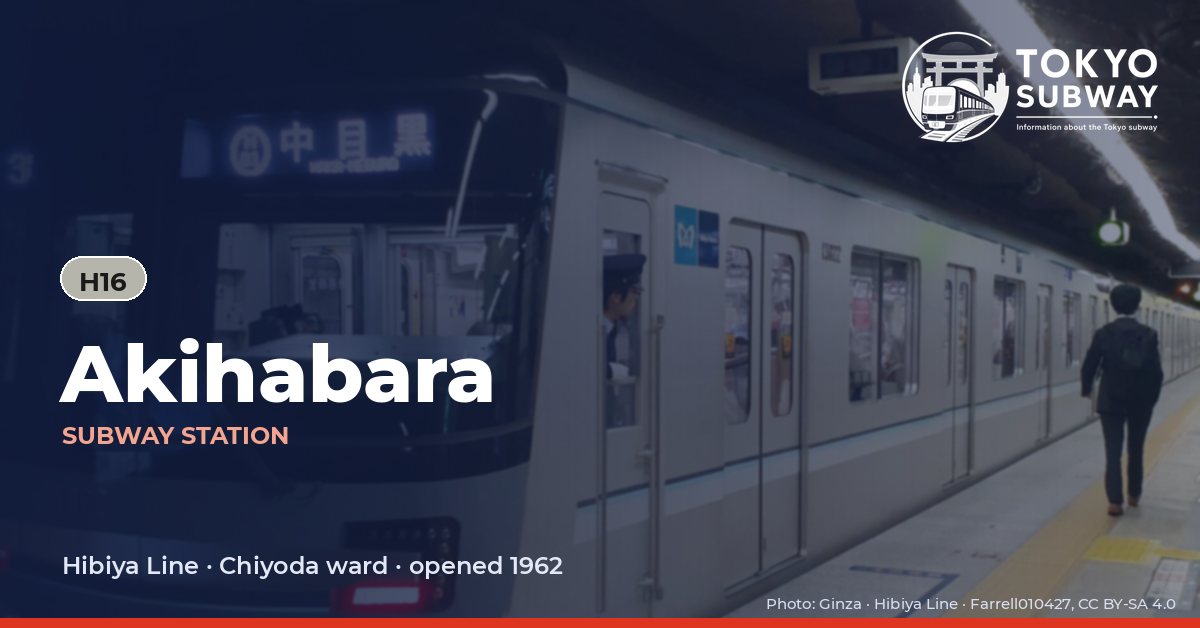
Finding Akihabara on the signs
Every line gives the station its own letter-and-number code. You never have to read the Japanese name to find the right platform.
Station numbers at Akihabara
Tokyo signposts every platform, exit and train door with a letter and a two-digit number. Matching the number is faster than reading the name — and it is what you will see on the map, in announcements and on the platform edge.
First and last trains at Akihabara
| Line and direction | Weekdays first – last | Saturdays, Sundays & holidays first – last |
|---|---|---|
| HHibiyaH16 towards Kita-senju | 05:17 – 00:19 | 05:18 – 00:19 |
| HHibiyaH16 towards Naka-meguro | 05:12 – 00:04 | 05:12 – 00:04 |
Departure times come from the operators’ own GTFS timetables (ODPT GTFS Toei-Train-GTFS (version 20261009, valid 2026-03-14..2027-03-12) + TokyoMetro-Train-GTFS (version 20261008, valid 2026-09-19..2027-03-12)). Japan publishes two subway timetables: 平日 weekdays and 土休日 Saturdays, Sundays and national holidays. There is no separate Sunday timetable, and the December 30 – January 3 period runs the holiday timetable.
How often do trains run?
| Line | Weekdays, busiest hour | Sat / Sun / holidays, busiest hour |
|---|---|---|
| HHibiya | 26 trains/hour (about one every 2.3 min) | 14 trains/hour |
Departures in one direction during the hour with the most trains at this station, counted in the operators’ timetable.
Next stations from Akihabara
Scheduled running time between Akihabara and the stations either side of it.
| Line | Next station | Running time |
|---|---|---|
| HHibiya | H15Kodemmacho | 2 min |
| HHibiya | H17Naka-okachimachi | 2 min |
Transfers and connections
- Walking transfer: Iwamotocho (Shinjuku Line), an official transfer between two separately named stations, about 4 minutes on foot — our estimate from the distance, not an operator figure.
- JR: Chuo-Sobu Local Line (JR East), Keihin-Tohoku-Negishi Line (JR East), Yamanote Line (JR East). These are separate railways with their own fares.
- Other railways: Tsukuba Express Line (Metropolitan Intercity Railway). These are separate railways with their own fares.
Accessibility
| Line | Step-free by elevator | Accessible toilet | Escalator | Exits |
|---|---|---|---|---|
| HHibiya | Yes | Yes | Yes | 5 |
- Hibiya Line: Step-free elevator route street-gate-platform (official “1-route by elevator”). Street elevator at exit(s): 3. Operator page (checked Oct 20, 2026).
Taken from the operators’ own accessibility pages and nothing else. Tokyo Metro: the “1-route” (step-free street-gate-platform path by elevator, slope, stair lift or wheelchair escalator) is complete at all 180 stations; a separate list shows stations with an elevator-only 1-route.
What is near Akihabara Station?
The station sits at the center of the Akihabara shopping district, which specializes in electronic goods, and the big stores are all a short walk away: Yodobashi Multimedia Akiba about 120 m from the exits, Atre Akihabara 1 roughly 290 m, Akihabara Radio Kaikan around 320 m and Akihabara UDX a little beyond. Yanagimori Jinja Shrine is about 240 m away and Akihabara Chuo Reiwa Hiroba closer still. Iwamotocho on the Toei Shinjuku Line is near enough that the operators count it as the same transfer.
| Place | Distance (straight line) | On foot, estimated |
|---|---|---|
| Yodobashi Multimedia Akiba ヨドバシカメラ マルチメディアAkiba | 120 m | about 2 min |
| Yanagimori Jinja Shrine 柳森神社 | 240 m | about 4 min |
| Akihabara Radio Kaikan 秋葉原ラジオ会館 | 320 m | about 5 min |
| Akihabara UDX 秋葉原UDX | 380 m | about 6 min |
| Akihabara chuo reiwa Hiroba (Akihabara Central Reiwa Square) 秋葉原中央令和広場 | 190 m | about 3 min |
| EBIHARA 海老原商店 | 200 m | about 3 min |
| Atre Akihabara 1 アトレ秋葉原1 | 290 m | about 5 min |
| Izumi Park 和泉公園 | 350 m | about 6 min |
Places from OpenStreetMap within 400 m of the station. The walking time is an estimate (straight line plus 30 %, 80 m a minute), not a measured route. © OpenStreetMap contributors, ODbL.