Tawaramachi Station
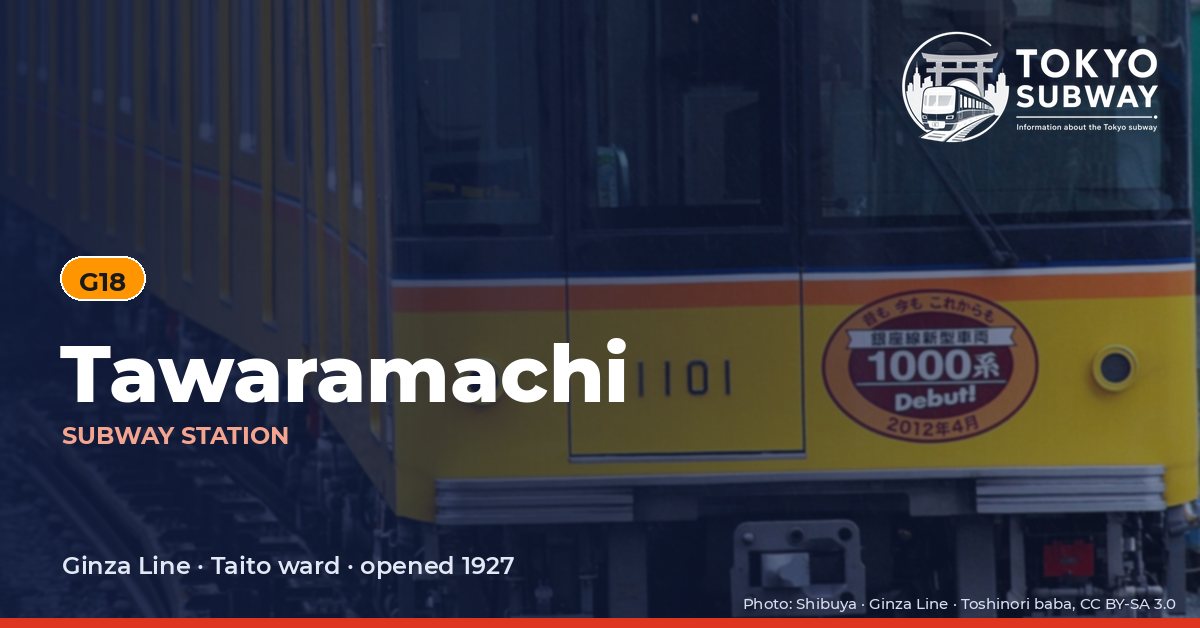
G18 · Ginza Line · Taito
Tawaramachi Station (田原町)
G18 belongs to the oldest piece of subway in Asia. It opened on 30 December 1927 with the first section of the Tokyo Underground Railway, between Ueno and Asakusa, and its two side platforms still sit barely a floor below the street. Where the platform walls meet the ceiling there are reliefs of the family crests of kabuki actors, a detail Tawaramachi shares with Suitengumae on the Hanzomon Line.
The name was borrowed from a tram. When the station was built its address was Asakusa Matsukiyocho, but the nearest city tram stop was called Tawaramachi, so the subway took that. In 1965 the addresses were redrawn, Asakusa Tawaramachi becoming Kaminarimon 1-chome and Matsukiyocho becoming Nishi-asakusa 1-chome, and the tram stop was renamed as well before being abolished in November 1972. The subway name alone stayed where it was. The Tsukuba Express crosses directly beneath the station without a stop, and its own Asakusa station, about 400 m away, has no connecting arrangement with this one. In 2025 Tawaramachi was used by 38,874 people on an average day.
Finding Tawaramachi on the signs
Every line gives the station its own letter-and-number code. You never have to read the Japanese name to find the right platform.
Station numbers at Tawaramachi
Tokyo signposts every platform, exit and train door with a letter and a two-digit number. Matching the number is faster than reading the name — and it is what you will see on the map, in announcements and on the platform edge.
First and last trains at Tawaramachi
Departure times come from the operators’ own GTFS timetables (ODPT GTFS Toei-Train-GTFS (version 20261009, valid 2026-03-14..2027-03-12) + TokyoMetro-Train-GTFS (version 20261008, valid 2026-09-19..2027-03-12)). Japan publishes two subway timetables: 平日 weekdays and 土休日 Saturdays, Sundays and national holidays. There is no separate Sunday timetable, and the December 30 – January 3 period runs the holiday timetable.
How often do trains run?
| Line | Weekdays, busiest hour | Sat / Sun / holidays, busiest hour |
|---|---|---|
| GGinza | 27 trains/hour (about one every 2.2 min) | 20 trains/hour |
Departures in one direction during the hour with the most trains at this station, counted in the operators’ timetable.
Transfers and connections
Only the Ginza Line stops here, and no other railway serves this station, so there is nothing to transfer to inside the station.
Accessibility
| Line | Step-free by elevator | Accessible toilet | Escalator | Exits |
|---|---|---|---|---|
| GGinza | Yes | Yes | Not listed | 4 |
- Ginza Line: Step-free elevator route street-gate-platform (official “1-route by elevator”). Street elevator at exit(s): EV. Operator page (checked Oct 20, 2026).
Taken from the operators’ own accessibility pages and nothing else. Tokyo Metro: the “1-route” (step-free street-gate-platform path by elevator, slope, stair lift or wheelchair escalator) is complete at all 180 stations; a separate list shows stations with an elevator-only 1-route.
What is near Tawaramachi Station?
Tawaramachi sits at the western edge of the Asakusa district, and the streets above it are full of temples: Higashi Honganji about 210 m from the exits, with Ryokusen-ji, Ensho-ji, Zenriu-ji and Sensho-ji nearer still, and the Buddhist-goods shops that go with them. Restaurants crowd the main road. The Taikokan Drum Museum is about 250 m away and the Samurai Ninja Museum Tokyo about 230 m. Kappabashi, the street of kitchen and restaurant suppliers, and the theatres of Asakusa Rokku are both within walking distance.
| Place | Distance (straight line) | On foot, estimated |
|---|---|---|
| Ryokusen-ji 緑泉寺 | 190 m | about 3 min |
| Ensho-ji 円照寺 | 200 m | about 3 min |
| Higashi Honganji 東本願寺 | 210 m | about 3 min |
| Shofukuin 正福院 | 400 m | about 6 min |
| 本法寺 | 50 m | about 1 min |
| 長敬寺 | 80 m | about 1 min |
| 徳本寺 | 100 m | about 2 min |
| 等光寺 | 110 m | about 2 min |
Places from OpenStreetMap within 400 m of the station. The walking time is an estimate (straight line plus 30 %, 80 m a minute), not a measured route. © OpenStreetMap contributors, ODbL.
Frequently asked questions
They are the family crests of kabuki actors, set as reliefs along the join between the platform wall and the ceiling. The same idea was used later at Suitengumae on the Hanzomon Line, but at Tawaramachi they have been there since the platforms were rebuilt in the old station.
It is one stop short of it on the Ginza Line and covers the western part of the same district, including Kappabashi. There is also a Tsukuba Express station called Asakusa about 400 m away, but that is a different railway with no connecting arrangement here, and the Ginza Line’s own Asakusa station is the one most visitors want.