
Ueno Station
G16 H18 · Ginza Line and Hibiya Line · Taito
Ueno Station (上野)
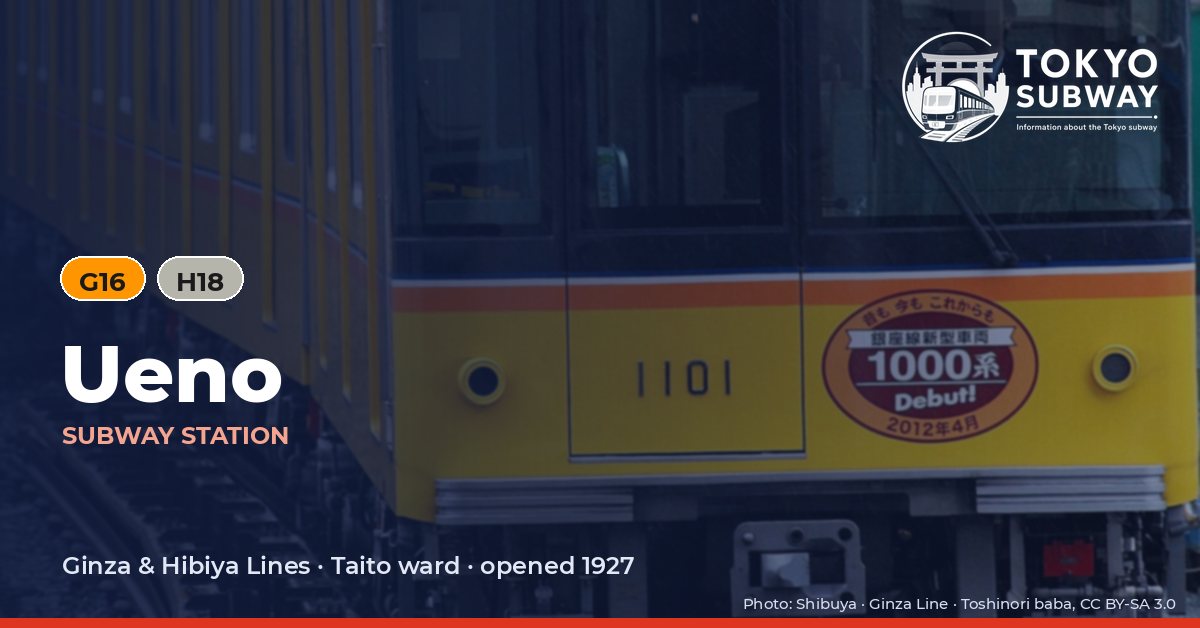
The Ginza Line platforms at Ueno are where the Tokyo subway started. G16 opened on 30 December 1927 with the Tokyo Underground Railway’s first section, the short run to Asakusa, the first underground railway in Asia. The Hibiya Line arrived much later, on 28 March 1961, and H18 lies on its own alignment; unlike most Tokyo Metro interchanges, the two lines here number their tracks separately rather than as one station.
Above them is a railway terminus older than either. The JR station opened on 28 July 1883 and for a century it was the arrival point for trains from northern Japan, enough to have been written into poems and song lyrics; a plaque in the station commemorates one by Ishikawa Takuboku. Digging the foundations of the present building, put up after the first was destroyed in the fires of the 1923 earthquake, turned up bones, swords and lances from the Battle of Ueno. The Shinkansen and the Ueno-Tokyo Line have since shifted much of that traffic. In 2025 the Tokyo Metro station was used by 191,804 people on an average day.
Finding Ueno on the signs
Every line gives the station its own letter-and-number code. You never have to read the Japanese name to find the right platform.
Station numbers at Ueno
Tokyo signposts every platform, exit and train door with a letter and a two-digit number. Matching the number is faster than reading the name — and it is what you will see on the map, in announcements and on the platform edge.
First and last trains at Ueno
| Line and direction | Weekdays first – last | Saturdays, Sundays & holidays first – last |
|---|---|---|
| GGinzaG16 towards Asakusa | 05:15 – 00:19 | 05:15 – 00:19 |
| GGinzaG16 towards Shibuya | 05:06 – 00:00 | 05:06 – 00:00 |
| HHibiyaH18 towards Kita-senju | 05:21 – 00:22 | 05:21 – 00:22 |
| HHibiyaH18 towards Naka-meguro | 05:09 – 00:01 | 05:09 – 00:01 |
Departure times come from the operators’ own GTFS timetables (ODPT GTFS Toei-Train-GTFS (version 20261009, valid 2026-03-14..2027-03-12) + TokyoMetro-Train-GTFS (version 20261008, valid 2026-09-19..2027-03-12)). Japan publishes two subway timetables: 平日 weekdays and 土休日 Saturdays, Sundays and national holidays. There is no separate Sunday timetable, and the December 30 – January 3 period runs the holiday timetable.
How often do trains run?
Departures in one direction during the hour with the most trains at this station, counted in the operators’ timetable.
Next stations from Ueno
Scheduled running time between Ueno and the stations either side of it.
| Line | Next station | Running time |
|---|---|---|
| GGinza | G17Inaricho | 2 min |
| GGinza | G15Ueno-hirokoji | 2 min |
| HHibiya | H19Iriya | 2 min |
| HHibiya | H17Naka-okachimachi | 2 min |
Transfers and connections
- Subway: transfer between Ginza Line and Hibiya Line.
- JR: Akita-Shinkansen (JR East), Hokuriku-Shinkansen (JR East), Joban Rapid Line (JR East), Joetsu-Shinkansen (JR East), Keihin-Tohoku-Negishi Line (JR East), Takasaki Line (JR East), Tohoku-Shinkansen (JR East), Utsunomiya Line (JR East), Yamagata-Shinkansen (JR East), Yamanote Line (JR East). These are separate railways with their own fares.
- Private railways: Keisei Main Line (Keisei Electric Railway). These are separate railways with their own fares.
Accessibility
- Ginza Line: Step-free elevator route street-gate-platform (official “1-route by elevator”). Street elevator at exit(s): 5a. Operator page (checked Oct 20, 2026).
Taken from the operators’ own accessibility pages and nothing else. Tokyo Metro: the “1-route” (step-free street-gate-platform path by elevator, slope, stair lift or wheelchair escalator) is complete at all 180 stations; a separate list shows stations with an elevator-only 1-route.
What is near Ueno Station?
Ueno is the station for the park and the market. Ameya-Yokocho runs from about 250 m from the exits, with Ami Yokocho beside it; the Ueno Royal Museum is about 190 m away, Tokyo Bunka Kaikan about 300 m and the Shitamachi Museum about 360 m, and the park itself holds the Tokyo National Museum, the National Museum of Western Art, Ueno Zoo and Tokyo University of the Arts. Ueno Marui and the Atre mall are about 100 m from the gates, and Kiyomizu Kannon-do about 280 m.
| Place | Distance (straight line) | On foot, estimated |
|---|---|---|
| Ameya-Yokocho アメヤ横丁 | 250 m | about 4 min |
| Shitamachi Museum したまちミュージアム | 360 m | about 6 min |
| Tokudai-ji 徳大寺 | 380 m | about 6 min |
| 徳雲禅院 | 360 m | about 6 min |
| 宋雲院 | 360 m | about 6 min |
| Ueno Marui 上野マルイ | 100 m | about 2 min |
| Atré アトレ | 100 m | about 2 min |
| Ueno Hall 駅前ホール ベースオントップ | 130 m | about 2 min |
Places from OpenStreetMap within 400 m of the station. The walking time is an estimate (straight line plus 30 %, 80 m a minute), not a measured route. © OpenStreetMap contributors, ODbL.
Frequently asked questions
Japan’s first underground railway, and the first in Asia: the Tokyo Underground Railway’s line from Ueno to Asakusa. That company’s tunnel is now the eastern end of the Ginza Line, so the platform you stand on at G16 is the oldest piece of subway in the city. The Hibiya Line platforms are a generation and a half younger, dating from 28 March 1961.
No. Keisei Ueno is close by but belongs to the Keisei Electric Railway, which runs its own main line from there towards Narita Airport Station; see airport access for how those journeys work. The subway has no platform at either airport.