Asakusa Station
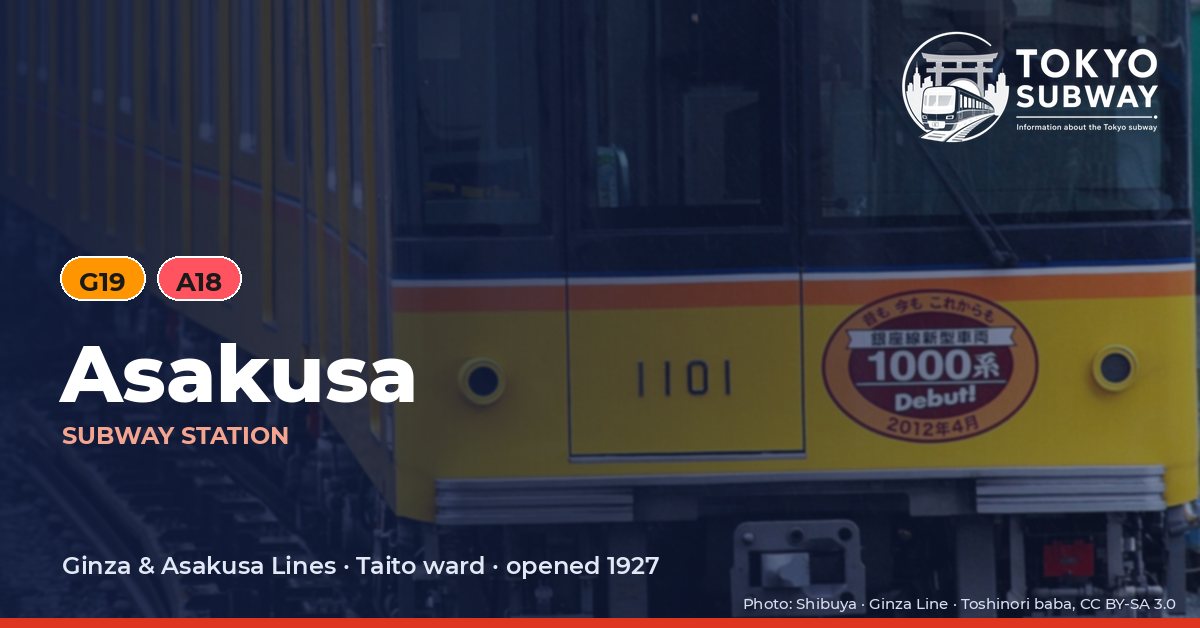
G19 A18 · Ginza Line and Asakusa Line · Taito
Asakusa Station (浅草)
Asakusa is where the Tokyo subway began. The Tokyo Underground Railway opened its eastern terminal here on 30 December 1927, on the first stretch of what became the Ginza Line, running only as far as Ueno; G19 is still a terminus. Tobu’s Skytree Line terminal opened on 25 May 1931 as Asakusa Kaminarimon, took the present name on 1 October 1945 and occupies part of the Matsuya department store. Toei’s Asakusa Line platforms, A18, followed on 4 December 1960 on the first section of the line from Oshiage.
The three stations run in a north-south line and are not all joined to each other. Passages connect Tobu with Tokyo Metro and Tokyo Metro with Toei, but nothing links Tobu directly to Toei, so that change is made at street level, as is the walk to the Tsukuba Express station 600 meters away. Tobu’s approach is famously awkward: trains leaving the terminal turn through 90 degrees at 15 km/h to cross the Sumida, which limits platform 1 to eight-car trains and the others to six, and pushes most Skytree Line express services through Oshiage onto the Hanzomon Line instead. Asakusa Line trains run through onto Keisei and Keikyu, which is why the line matters for airport access.
Finding Asakusa on the signs
Every line gives the station its own letter-and-number code. You never have to read the Japanese name to find the right platform.
Station numbers at Asakusa
Tokyo signposts every platform, exit and train door with a letter and a two-digit number. Matching the number is faster than reading the name — and it is what you will see on the map, in announcements and on the platform edge.
First and last trains at Asakusa
| Line and direction | Weekdays first – last | Saturdays, Sundays & holidays first – last |
|---|---|---|
| GGinzaG19 towards Shibuya | 05:01 – 00:14 to Ueno | 05:01 – 00:14 to Ueno |
| AAsakusaA18 towards Oshiage (Skytree) | 05:03 – 00:23 | 05:03 – 00:23 |
| AAsakusaA18 towards Nishi-magome | 05:03 – 00:26 to Asakusabashi | 05:03 – 00:26 to Asakusabashi |
Departure times come from the operators’ own GTFS timetables (ODPT GTFS Toei-Train-GTFS (version 20261009, valid 2026-03-14..2027-03-12) + TokyoMetro-Train-GTFS (version 20261008, valid 2026-09-19..2027-03-12)). Japan publishes two subway timetables: 平日 weekdays and 土休日 Saturdays, Sundays and national holidays. There is no separate Sunday timetable, and the December 30 – January 3 period runs the holiday timetable.
How often do trains run?
Departures in one direction during the hour with the most trains at this station, counted in the operators’ timetable.
Next stations from Asakusa
Scheduled running time between Asakusa and the stations either side of it.
| Line | Next station | Running time |
|---|---|---|
| GGinza | G18Tawaramachi | 2 min |
| AAsakusa | A19Honjo-azumabashi | 1 min |
| AAsakusa | A17Kuramae | 1 min |
Transfers and connections
- Subway: transfer between Ginza Line and Asakusa Line. The Tokyo Metro lines and the Toei Subway lines belong to different companies, so a trip that uses both costs more than one operator alone — see fares.
- Private railways: Tobu Skytree Line (Tobu Railway). These are separate railways with their own fares.
Accessibility
- Ginza Line: Step-free elevator route street-gate-platform (official “1-route by elevator”). Street elevator at exit(s): 1. Operator page (checked Oct 20, 2026).
- Asakusa Line: Toei: step-free “1-route” secured; 3 elevator(s) on this line. Elevator exit(s): A2. Operator page (checked Oct 20, 2026).
Taken from the operators’ own accessibility pages and nothing else. Tokyo Metro: the “1-route” (step-free street-gate-platform path by elevator, slope, stair lift or wheelchair escalator) is complete at all 180 stations; a separate list shows stations with an elevator-only 1-route. Toei: every station has elevators and a street-gate-platform “1-route” is secured.
What is near Asakusa Station?
Kaminarimon stands about 160 m from the exits with the Nakamise Shopping Street leading on from it, roughly 290 m out, and this is the station most people use for that walk. Matsuya and EKIMISE Asakusa sit directly above the Tobu terminal, Komakata-do Temple is about 110 m away, and the World Bags and Luggage Museum and the Asakusa Kokaido Theater both fall inside 400 m, as does Benten’yama Children’s Playground. Tokyo Metro counted 108,997 entries and exits a day here in 2025, Toei 59,010 in 2024.
| Place | Distance (straight line) | On foot, estimated |
|---|---|---|
| Kaminarimon 雷門 | 160 m | about 3 min |
| 遍照院 | 360 m | about 6 min |
| Komakata-do Temple 駒形堂 | 110 m | about 2 min |
| Matsuya 松屋浅草 | 220 m | about 4 min |
| roof sightseeing SKYTREE 屋上スカイツリー展望 | 250 m | about 4 min |
| World Bags & Luggage Museum エース世界のカバン博物館 | 260 m | about 4 min |
| EKIMISE Asakusa 浅草エキミセ | 270 m | about 4 min |
| Nakamise Shopping Street 仲見世商店街 | 290 m | about 5 min |
Places from OpenStreetMap within 400 m of the station. The walking time is an estimate (straight line plus 30 %, 80 m a minute), not a measured route. © OpenStreetMap contributors, ODbL.