
Honjo-azumabashi Station
A19 · Asakusa Line · Sumida
Honjo-azumabashi Station (本所吾妻橋)
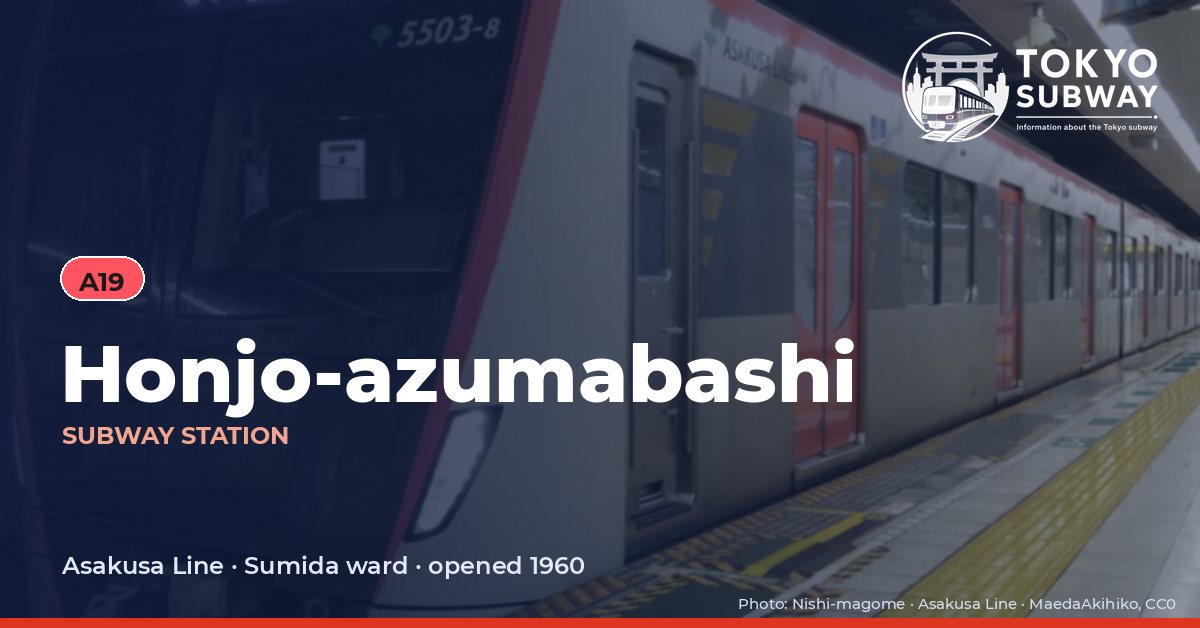
Both halves of the name are older than the railway. Honjo was the ward that once covered this part of what is now Sumida, and Azumabashi is the bridge over the Sumida river north-west of the station, built in 1774 as Okawabashi and renamed in 1875. The station, planned under the name Azumabashi-nichome, opened on 4 December 1960 with the first section of Toei’s Line 1, later the Asakusa Line, and sits beneath the crossing of Asakusa-dori and Mitsume-dori.
A19 has two side platforms and six ways in: four at the corners of the crossing above and two more reserved for lifts. Rebuilding from 2011 brought the passage between the platforms inside the ticket barriers, and in August 2013 a second gate opened at the Oshiage end of one platform, connected directly to exit A5. It sits between two terminals – Asakusa one way, Oshiage the other – and most passengers pass through rather than get off: 21,482 entries and exits a day in 2024, third lowest on the line. Trains here run through onto Keisei, Keikyu, Hokuso and Shibayama tracks.
Finding Honjo-azumabashi on the signs
Every line gives the station its own letter-and-number code. You never have to read the Japanese name to find the right platform.
Station numbers at Honjo-azumabashi
Tokyo signposts every platform, exit and train door with a letter and a two-digit number. Matching the number is faster than reading the name — and it is what you will see on the map, in announcements and on the platform edge.
First and last trains at Honjo-azumabashi
| Line and direction | Weekdays first – last | Saturdays, Sundays & holidays first – last |
|---|---|---|
| AAsakusaA19 towards Oshiage (Skytree) | 05:05 – 00:25 | 05:05 – 00:25 |
| AAsakusaA19 towards Nishi-magome | 05:01 – 00:24 to Asakusabashi | 05:01 – 00:24 to Asakusabashi |
Departure times come from the operators’ own GTFS timetables (ODPT GTFS Toei-Train-GTFS (version 20261009, valid 2026-03-14..2027-03-12) + TokyoMetro-Train-GTFS (version 20261008, valid 2026-09-19..2027-03-12)). Japan publishes two subway timetables: 平日 weekdays and 土休日 Saturdays, Sundays and national holidays. There is no separate Sunday timetable, and the December 30 – January 3 period runs the holiday timetable.
How often do trains run?
| Line | Weekdays, busiest hour | Sat / Sun / holidays, busiest hour |
|---|---|---|
| AAsakusa | 22 trains/hour (about one every 2.7 min) | 13 trains/hour |
Departures in one direction during the hour with the most trains at this station, counted in the operators’ timetable.
Next stations from Honjo-azumabashi
Scheduled running time between Honjo-azumabashi and the stations either side of it.
| Line | Next station | Running time |
|---|---|---|
| AAsakusa | A18Asakusa | 1 min |
| AAsakusa | A20Oshiage (Skytree) | 1 min |
Transfers and connections
Only the Asakusa Line stops here, and no other railway serves this station, so there is nothing to transfer to inside the station.
Accessibility
| Line | Step-free by elevator | Accessible toilet | Escalator | Exits |
|---|---|---|---|---|
| AAsakusa | See note | Not listed | Not listed | — |
Taken from the operators’ own accessibility pages and nothing else. Toei: every station has elevators and a street-gate-platform “1-route” is secured.
What is near Honjo-azumabashi Station?
The Asahi group’s headquarters and the Asahi Beer Hall stand about 400 m from the exits beside the river, and Sumida City Office, for which this is the nearest station, is roughly 370 m away. Temples fill the blocks immediately around: Myoen-ji about 50 m from an exit, Shorei-ji around 110 m, Fukugon-ji and Hokke-ji within 150 m. The Little Museum of Glass Books is some 210 m off and the Museum of Byobu around 360 m, with the Sumida riverside park and Tokyo Mizumachi beyond them.
| Place | Distance (straight line) | On foot, estimated |
|---|---|---|
| 妙縁寺 | 50 m | about 1 min |
| 福厳寺 | 140 m | about 2 min |
| 法華寺 | 150 m | about 2 min |
| 桃青寺 | 230 m | about 4 min |
| 遍照院 | 370 m | about 6 min |
| Little Museum of Glass Books ちいさな硝子の本の博物館 | 210 m | about 3 min |
| Museum of Byōbu 屏風博物館 | 360 m | about 6 min |
| 松嶺寺 | 110 m | about 2 min |
Places from OpenStreetMap within 400 m of the station. The walking time is an estimate (straight line plus 30 %, 80 m a minute), not a measured route. © OpenStreetMap contributors, ODbL.