
Asakusabashi Station
A16 · Asakusa Line · Taito
Asakusabashi Station (浅草橋)
Two railways meet here without sharing much: JR’s Chuo-Sobu platforms have stood above ground since 1 July 1932, and Toei dug its own station below on 4 December 1960, when the Asakusa Line was still called Toei Line 1. The subway part is an island platform between two tracks, A16, with trains on one side running toward Nihombashi and Nishi-magome and on the other toward Oshiage, where many carry on beyond the subway onto Keisei, Keikyu, Hokuso and Shibayama tracks.
The station’s strangest day was 28 November 1985, when masked members of the Revolutionary Communist League firebombed it as part of a wave of sabotage supporting a 24-hour strike against the privatization of Japanese National Railways; 48 people were arrested in the investigation. The attack was aimed at the railway above, and the Asakusa Line platforms, which were not targeted, kept running throughout. Toei counted 60,025 entries and exits on an average day here in 2024.
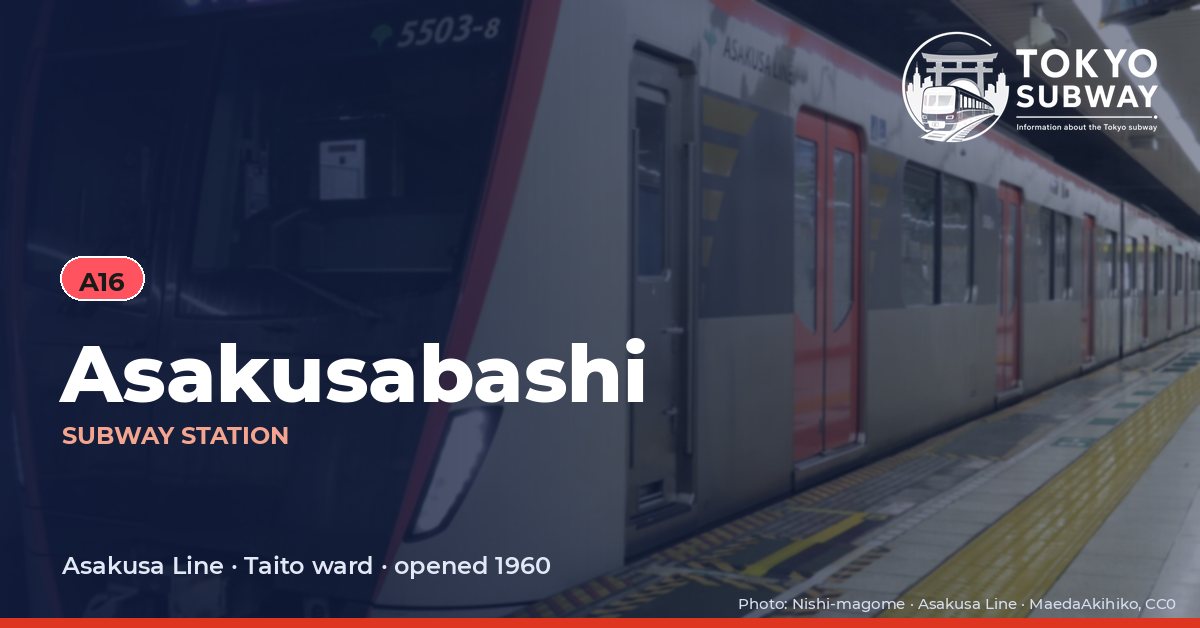
Finding Asakusabashi on the signs
Every line gives the station its own letter-and-number code. You never have to read the Japanese name to find the right platform.
Station numbers at Asakusabashi
Tokyo signposts every platform, exit and train door with a letter and a two-digit number. Matching the number is faster than reading the name — and it is what you will see on the map, in announcements and on the platform edge.
First and last trains at Asakusabashi
| Line and direction | Weekdays first – last | Saturdays, Sundays & holidays first – last |
|---|---|---|
| AAsakusaA16 towards Oshiage (Skytree) | 05:00 – 00:20 | 05:00 – 00:20 |
| AAsakusaA16 towards Nishi-magome | 05:07 – 00:12 | 05:07 – 00:12 |
Departure times come from the operators’ own GTFS timetables (ODPT GTFS Toei-Train-GTFS (version 20261009, valid 2026-03-14..2027-03-12) + TokyoMetro-Train-GTFS (version 20261008, valid 2026-09-19..2027-03-12)). Japan publishes two subway timetables: 平日 weekdays and 土休日 Saturdays, Sundays and national holidays. There is no separate Sunday timetable, and the December 30 – January 3 period runs the holiday timetable.
How often do trains run?
| Line | Weekdays, busiest hour | Sat / Sun / holidays, busiest hour |
|---|---|---|
| AAsakusa | 23 trains/hour (about one every 2.6 min) | 13 trains/hour |
Departures in one direction during the hour with the most trains at this station, counted in the operators’ timetable.
Next stations from Asakusabashi
Scheduled running time between Asakusabashi and the stations either side of it.
| Line | Next station | Running time |
|---|---|---|
| AAsakusa | A15Higashi-nihombashi | 1 min |
| AAsakusa | A17Kuramae | 1 min |
Transfers and connections
- JR: Chuo-Sobu Local Line (JR East). These are separate railways with their own fares.
Accessibility
| Line | Step-free by elevator | Accessible toilet | Escalator | Exits |
|---|---|---|---|---|
| AAsakusa | Yes | Yes | Yes | 6 |
- Asakusa Line: Toei: step-free “1-route” secured; 2 elevator(s) on this line. Elevator exit(s): A1. Operator page (checked Oct 20, 2026).
Taken from the operators’ own accessibility pages and nothing else. Toei: every station has elevators and a street-gate-platform “1-route” is secured.
What is near Asakusabashi Station?
The exits come up in the Asakusabashi neighborhood of Taito, between the Kanda and Sumida rivers, with the Lycée Franco-Japonais de Tokyo among the institutions the station serves and the former Yanagibashi geisha quarter once occupying the blocks nearby. Icho-oka Hachiman Shrine stands about 80 m from the gates and the doll school Kyugetsu Ningyo Gakuin closer still; Suka-jinja Shrine is around 200 m, the Japan Stationary Museum roughly 240 m, and the Taito Central Library’s Asakusabashi branch and the Tokyo Sumidagawa Youth Hostel both within about 350 m.
| Place | Distance (straight line) | On foot, estimated |
|---|---|---|
| Icho-oka Hachiman Shrine 銀杏岡八幡神社 | 80 m | about 1 min |
| Suka-jinja Shrine 須賀神社 | 200 m | about 3 min |
| Sakaki-jinja Shrine 榊神社 | 390 m | about 6 min |
| Japan Stationary Museum 日本文具資料館 | 240 m | about 4 min |
| みちくさアートラボ | 110 m | about 2 min |
| アトリエアール | 270 m | about 4 min |
| parabolica-bis | 310 m | about 5 min |
| Ikuei Elementary School 台東区立 台東育英小学校 | 280 m | about 5 min |
Places from OpenStreetMap within 400 m of the station. The walking time is an estimate (straight line plus 30 %, 80 m a minute), not a measured route. © OpenStreetMap contributors, ODbL.