
Takadanobaba Station
T03 · Tozai Line · Shinjuku
Takadanobaba Station (高田馬場)
The subway came late to Takadanobaba. The Yamanote Line platforms date from 1910 and Seibu built alongside them in the 1920s; the Tozai Line only opened on 23 December 1964, and for a little over a year T03 was its western end, until the link to Nakano and the Chuo Main Line opened in March 1966. Tozai trains now run off the subway at both ends, onto JR East tracks beyond Nakano and onto the Toyo Rapid Railway beyond Nishi-funabashi, so the destination boards here show places that are not on the subway map at all.
Above ground the station is really an interchange between two other railways: the Yamanote island platform and the two Seibu Shinjuku Line platforms lie parallel, joined by an overhead concourse and by transfer gates at street level beside the main Waseda exit, with the freight tracks used by Saikyo and Shonan-Shinjuku services threading between them. The Yamanote platform plays the theme from Astro Boy before each departure, because the series is set in this district. In 2025 the Tokyo Metro station was used by 181,109 people on an average day.
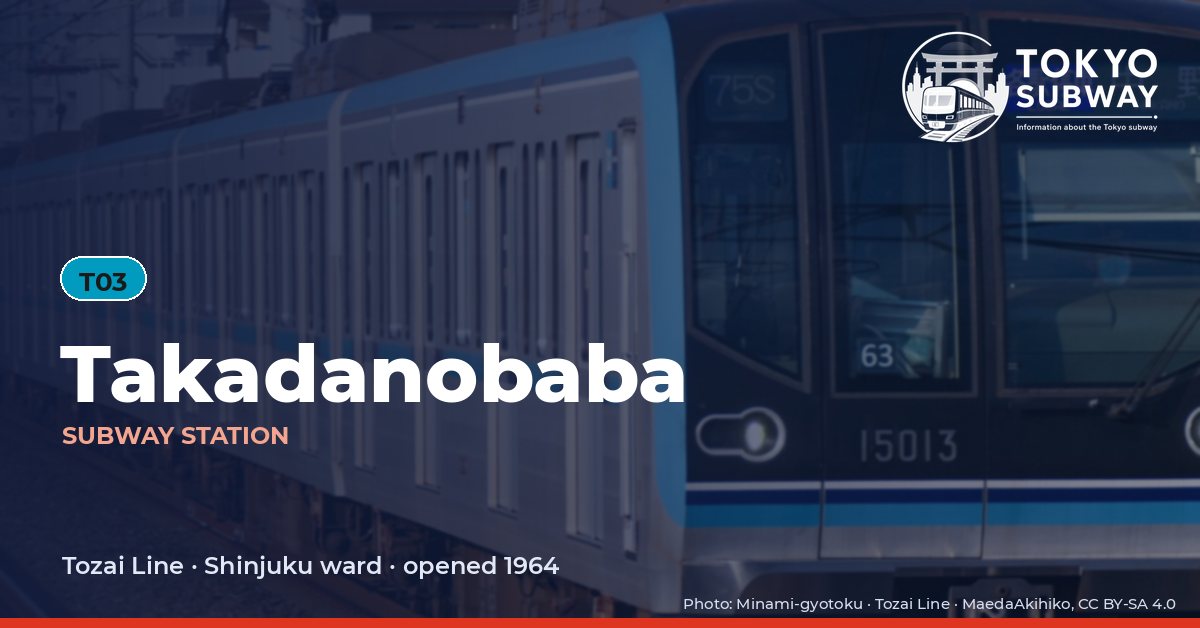
Finding Takadanobaba on the signs
Every line gives the station its own letter-and-number code. You never have to read the Japanese name to find the right platform.
Station numbers at Takadanobaba
Tokyo signposts every platform, exit and train door with a letter and a two-digit number. Matching the number is faster than reading the name — and it is what you will see on the map, in announcements and on the platform edge.
First and last trains at Takadanobaba
Departure times come from the operators’ own GTFS timetables (ODPT GTFS Toei-Train-GTFS (version 20261009, valid 2026-03-14..2027-03-12) + TokyoMetro-Train-GTFS (version 20261008, valid 2026-09-19..2027-03-12)). Japan publishes two subway timetables: 平日 weekdays and 土休日 Saturdays, Sundays and national holidays. There is no separate Sunday timetable, and the December 30 – January 3 period runs the holiday timetable.
How often do trains run?
| Line | Weekdays, busiest hour | Sat / Sun / holidays, busiest hour |
|---|---|---|
| TTozai | 23 trains/hour (about one every 2.6 min) | 14 trains/hour |
Departures in one direction during the hour with the most trains at this station, counted in the operators’ timetable.
Transfers and connections
- JR: Yamanote Line (JR East). These are separate railways with their own fares.
- Private railways: Shinjuku Line (Seibu Railway). These are separate railways with their own fares.
Accessibility
| Line | Step-free by elevator | Accessible toilet | Escalator | Exits |
|---|---|---|---|---|
| TTozai | Yes | Yes | Yes | 8 |
- Tozai Line: Step-free elevator route street-gate-platform (official “1-route by elevator”). Street elevator at exit(s): エレベーター出口. Operator page (checked Oct 20, 2026).
Taken from the operators’ own accessibility pages and nothing else. Tokyo Metro: the “1-route” (step-free street-gate-platform path by elevator, slope, stair lift or wheelchair escalator) is complete at all 180 stations; a separate list shows stations with an elevator-only 1-route.
What is near Takadanobaba Station?
Takadanobaba is known as a student district, and buses link it with Waseda University; Waseda is the next stop on the Tozai Line. BIG BOX stands over the crossing about 100 m from the exits. The Takadanobaba Game Centre Mikado is about 160 m away and the Natsuge Museum about 140 m, both of them arcades of a sort, and the Waseda Chochiku cinema is about 340 m off. Several vocational colleges and the Japan Braille Library sit in the streets behind.
| Place | Distance (straight line) | On foot, estimated |
|---|---|---|
| Natsuge Museum ナツゲーミュージアム | 140 m | about 2 min |
| Cat cafe Nyankoto | 140 m | about 2 min |
| 神田川親水テラス | 150 m | about 2 min |
| 高田馬場駅前公園 | 150 m | about 2 min |
| 諏訪公園 | 320 m | about 5 min |
| Takadanobaba Game Centre Mikado 高田馬場ゲーセンミカド | 160 m | about 3 min |
| BIG BOX | 100 m | about 2 min |
| 高田馬場 | 120 m | about 2 min |
Places from OpenStreetMap within 400 m of the station. The walking time is an estimate (straight line plus 30 %, 80 m a minute), not a measured route. © OpenStreetMap contributors, ODbL.
Frequently asked questions
Because the series is set in the Takadanobaba area, and JR East plays the theme music before every Yamanote Line departure as a homage to it. It belongs to the JR platforms rather than the Tozai Line ones, so you hear it only after crossing between the two companies’ gates.
No. Nishi-waseda on the Fukutoshin Line is about 550 m away, but the operators do not treat the two as one station and there is no corridor between them. If you want the Fukutoshin Line you change elsewhere.